Netanyahu weighs Iran strike as IDF sees no urgency
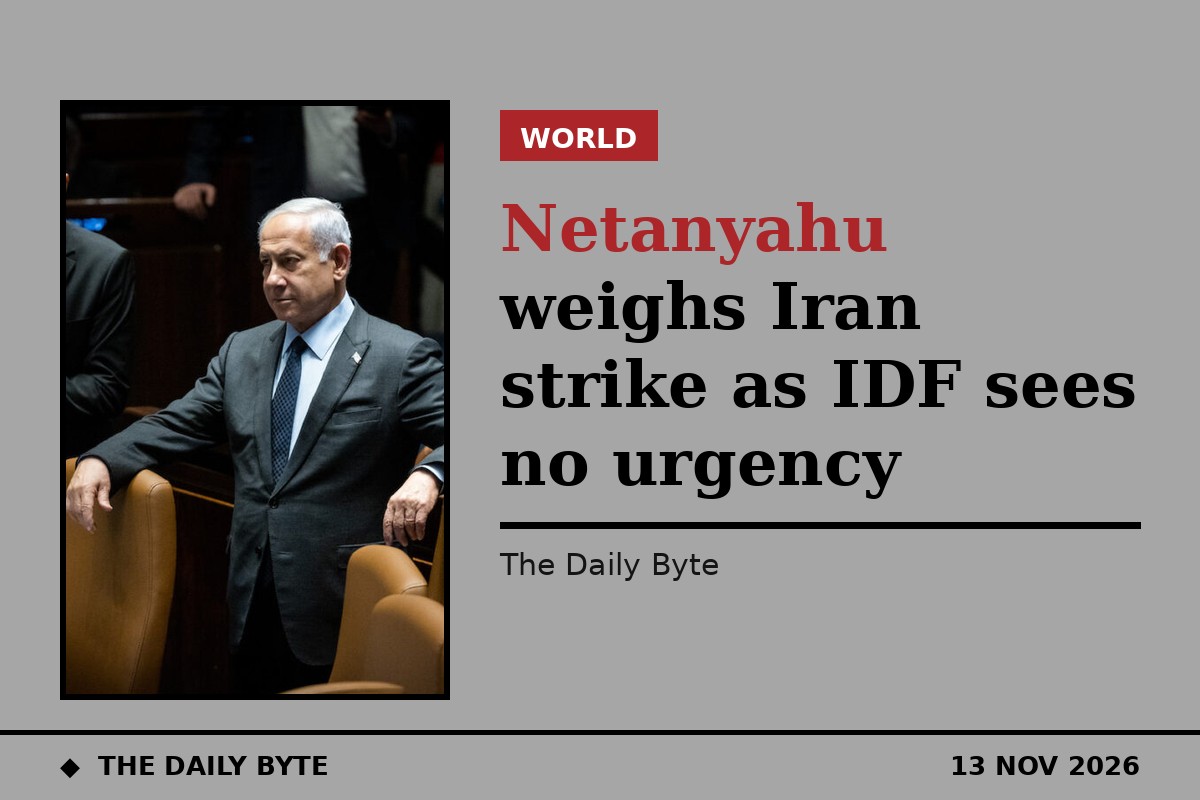
Israeli Prime Minister Benjamin Netanyahu is weighing a new military strike on Iran while leading a caretaker government, but Israel’s military establishment sees no urgent need to attack, according to Israeli media reports. Channel 13 reported that the military’s assessment was presented to Netanyahu and to opposition leader Gadi Eisenkot, who has been tasked with forming the next government, during a briefing on Wednesday. Al Jazeera reported that Netanyahu has been pressing for a new campaign despite a lack of enthusiasm from the United States, his own military and the politicians vying to replace him.
Netanyahu lost his parliamentary majority in last month’s elections, and his government remains in power in a caretaker capacity until a new governing majority is formed, a process that could take months. On Wednesday, Israeli media reported that the security cabinet chaired by Netanyahu had ordered the military to step up preparations for an attack on Iran. Public broadcaster KAN reported that the directives “could lead it to carry out activities that could trigger a war”.
Pressure on Washington, pushback at home
Netanyahu has repeatedly telephoned US President Donald Trump to press for a new military campaign against Iran, with at least one conversation becoming heated, according to Israel’s Ynet News site. On Thursday, a US military official was quoted by KAN as saying Washington had told Israel to get ready for a potential new round of confrontation, but US Central Command later dismissed the reports as “mere speculation”. Trump has said that, at this point, taking military action “doesn’t seem to be a very necessary thing”, while describing US forces as “locked and loaded”.
Opposition leaders have demanded that Netanyahu avoid military action unless it is critical. Yisrael Beytenu leader Avigdor Lieberman said the caretaker government must not “make decisions that could drag Israel into war without parliamentary oversight and without the full agreement of all security officials”. Eisenkot warned in a letter to Netanyahu on Wednesday that deploying forces “without a direct and immediate threat that cannot wait could have devastating consequences for Israeli democracy and public trust in the institutions of government”. Netanyahu responded that the government makes all decisions based only on “security considerations”. Demokratis also reported that Netanyahu told the Knesset at its swearing-in that Iran was rebuilding its nuclear capabilities and called for regime change in Tehran.
Can a caretaker government order a strike?
Legally, the position is contested. Article 30 of Israel’s Basic Law states that an interim government continues to carry out the same duties until a new one takes its place. However, the Supreme Court has previously ruled that an outgoing government must avoid irreversible policy moves unless they are urgent, a principle known as the “duty of restraint”. Neve Gordon, a professor of international law at Queen Mary University of London, said Netanyahu could still initiate military action with his caretaker cabinet’s approval by presenting it as urgent and in the national interest. Researcher Or Asher of the Tachlith Institute told Reuters that security issues were “the clearest exception” to the duty of restraint, adding: “A caretaker prime minister can legally take Israel to war, including against Iran.”
There is precedent. In May 2021, weeks after his party lost seats in legislative elections, Netanyahu launched an 11-day war in Gaza that killed at least 260 people in the Palestinian enclave, while 13 people died in Israel. Former prime ministers Ehud Olmert and Yair Lapid also ordered military action in Gaza while serving in a caretaker capacity. Analysts say the harder question for Netanyahu is political: if Washington is opposed and senior commanders have reservations, a decision to strike could be seen as an attempt to change the political agenda while Eisenkot tries to form a government.


