Netanyahu Orders Direct Talks With Lebanon in Washington
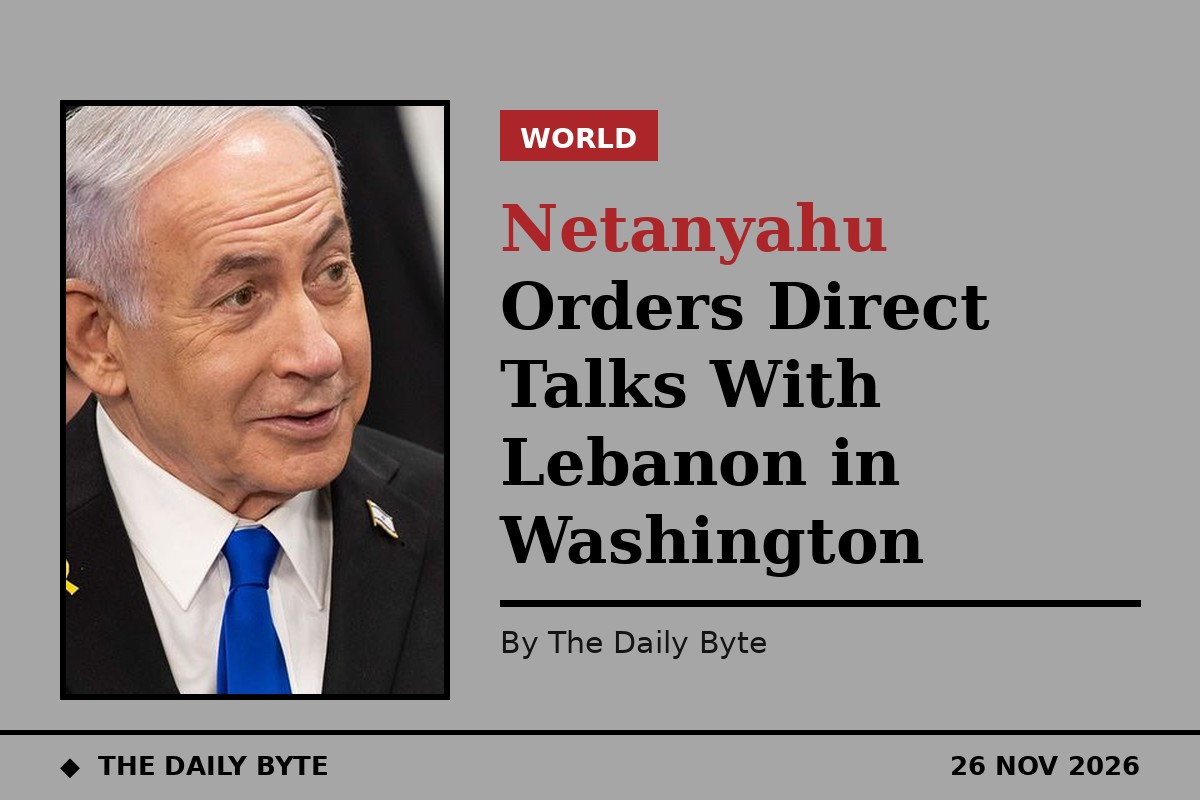
Israeli Prime Minister Benjamin Netanyahu said on Thursday that he has authorised direct negotiations with Lebanon "as soon as possible", aimed at disarming Hezbollah and establishing relations between the two neighbours, which have technically been at war since Israel was established in 1948.
The talks are expected to begin next week at the State Department in Washington, according to a person familiar with the plans. Axios first reported the timing and location. On the American side they are expected to be handled by the US ambassador to Lebanon, Michel Issa, and on the Israeli side by Israel's ambassador to the United States, Yechiel Leiter. A US State Department official confirmed it would host a meeting next week to discuss ceasefire negotiations with Israel and Lebanon. It was not immediately clear who would represent Lebanon, although reports named Lebanon's ambassador to Washington, Nada Hamadeh Moawad, as the expected delegate.
After the deadliest day in Lebanon
The announcement came amid disagreement over whether the ceasefire deal in the wider US-Iran war included a pause in fighting between Israel and Hezbollah, and a day after Israel pounded Beirut with airstrikes that resulted in the deadliest day in Lebanon since the war began on 28 February. Lebanon's health ministry said more than 300 people were killed and more than 1,000 wounded on Wednesday in Israeli strikes in central Beirut and other areas of Lebanon that Israel said targeted Hezbollah.
Hours before opening the way for talks, Netanyahu said Israel would continue striking Hezbollah "with force, precision and determination". Israel said on Thursday it had killed Ali Yusuf Harshi, an aide to Hezbollah leader Naim Qassem. Hezbollah did not immediately respond to a request for comment. Lebanon's state-run National News Agency reported that an Israeli strike overnight killed at least seven people in southern Lebanon.
Iran's parliament speaker, Mohammad Bagher Qalibaf, warned on Thursday that continued Israeli attacks on Hezbollah would bring "explicit costs and STRONG responses" in a social media post. Iran has said Israel's attacks on Hezbollah violate the ceasefire agreement. Netanyahu and US President Donald Trump have said they do not.
Wider ceasefire appears to hold
Despite the fragile and disputed nature of the ceasefire, it appeared to hold on Thursday in the wider war. No new missile or drone launches by Iran against its Gulf Arab neighbours or Israel were reported, and there were no reports of strikes by the US or Israel targeting Iran.
Open questions remain over the fate of Iran's stockpile of highly enriched uranium, how and when normal traffic resumes through the Strait of Hormuz, and Iran's missile programme. The chief of Iran's nuclear agency, Mohammad Eslami, said on Thursday that protecting Tehran's right to enrich uranium is "necessary" for any ceasefire talks. Trump said on Wednesday that the US would work with Iran to remove the uranium, buried in last year's US and Israeli strikes, although Iran did not confirm that.
Iran's deputy foreign minister, Saeed Khatibzadeh, told the BBC that Iran will allow ships to pass through the strait in accordance with "international norms and international law" once the US ends its "aggression" in the Middle East and Israel stops attacking Lebanon. The head of the UAE's major oil company, Sultan al-Jaber, said about 230 ships loaded with oil were waiting to get through the strait. Brent crude was around $98 a barrel on Thursday, up about 35% since the war began.
US Vice-President JD Vance is to lead a delegation for talks starting on Saturday in Islamabad, and Qalibaf has been discussed as a possible negotiator who could meet him. The launch of direct talks between Israel and Lebanon is a significant step after decades of hostilities, though reaching a deal will be difficult given Hezbollah's continued presence and longstanding disagreements over the exact route of the shared border.


