Netanyahu Sets 10 Conditions for Unity Government
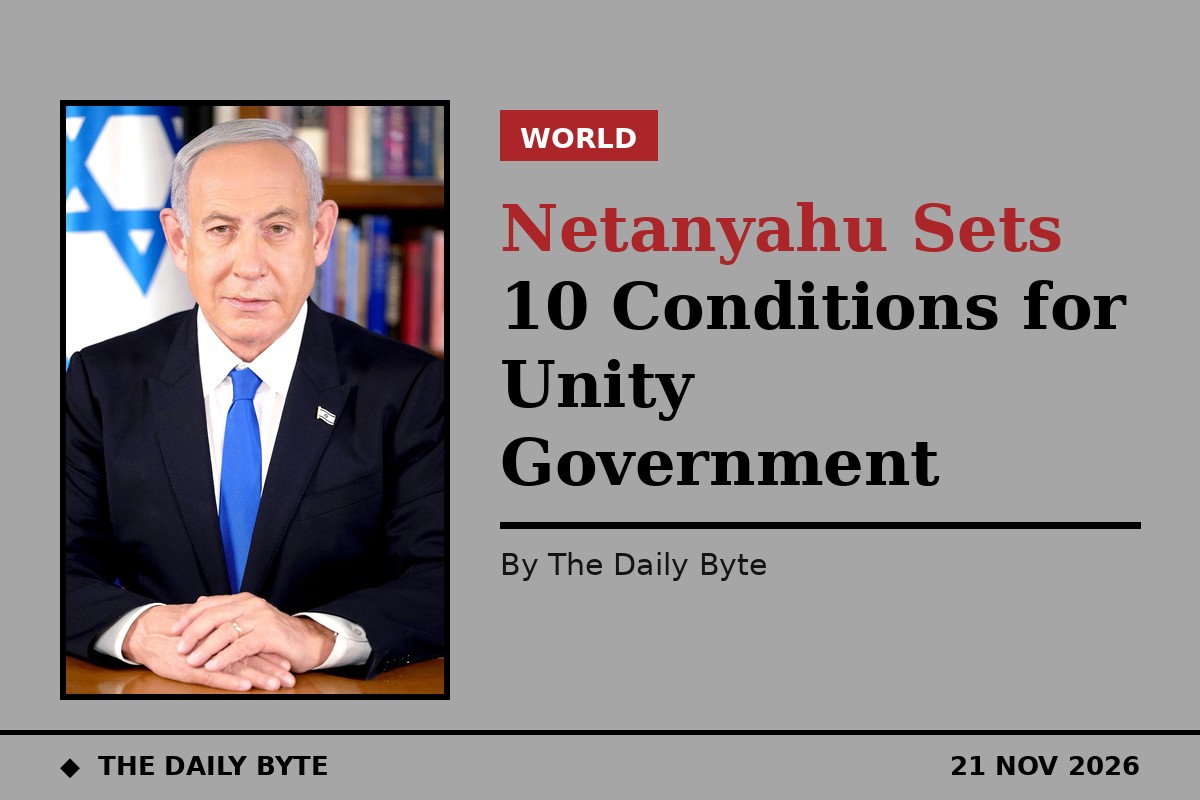
Benjamin Netanyahu has set ten conditions for joining a national unity government in Israel, including remaining prime minister for a full four-year term and blocking an independent state inquiry into the Hamas attack of October 7, 2023. The demands were presented by his Likud party to representatives of opposition leader Gadi Eisenkot, according to a Friday report by Haaretz, which was also reported by Israel's Channel 12.
The proposal would preserve much of Netanyahu's political and security agenda despite his coalition losing its majority last month. Eisenkot's camp dismissed the package as manoeuvring, Haaretz reported, while Likud disputed parts of the account but confirmed Netanyahu staying in office was central.
What Likud is demanding
Netanyahu's most significant demand is that he serve as prime minister for the full four-year term, ruling out a rotation agreement that would let Eisenkot take over the premiership. Eisenkot, a former military chief whose Yashar party leads the effort to form a government, insists any coalition under his leadership must have him as prime minister.
Netanyahu also wants his existing allies carried into any unity government, including National Security Minister Itamar Ben-Gvir's far-right Otzma Yehudit party. The proposal would allow the left-wing Democrats party to take part but would exclude Israel's two Arab-led political parties.
On national security, coalition partners would have to support another military offensive against Iran if necessary, and to oppose any Israeli military withdrawal from current positions in Gaza until Hamas no longer poses a threat. Partners would also have to formally oppose the establishment of a Palestinian state and recognise Israel as the nation-state of the Jewish people.
The proposed agreement would also preserve judicial overhaul legislation enacted under Netanyahu's government until the parties reach a consensus on possible changes. Eisenkot's allies have sought to reverse parts of that legislation, and lawmakers advanced a repeal measure in a preliminary parliamentary vote on Wednesday. On military service, Likud wants the next government to advance a conscription bill based on legislation promoted by the outgoing government.
The October 7 inquiry at the centre
Another major condition concerns the investigation into the failures surrounding the October 7 attack, in which about 1,200 people were killed and which triggered the war in Gaza. Rather than establishing a state commission of inquiry with broad investigative authority and institutional independence, Netanyahu's proposal calls for a politically appointed commission. Eisenkot and other Netanyahu opponents have demanded an independent investigation into the security and intelligence failures that allowed the assault, and opposition parties have sought such an inquiry since the attack, while Netanyahu's coalition has rejected it, arguing that such a commission would not be objective.
According to Kan, Israel's state-owned broadcaster, as reported by Xinhua, the inquiry condition is expected to be raised at a meeting between the two sides' leaders scheduled for Sunday. Kan also reported that the meeting is expected to address, for the first time, the possibility of a rotation agreement between Netanyahu and Eisenkot as prime minister. Both sides say they should lead for the full term, but each is willing to discuss a rotation, demanding to serve first. Kan also reported that Netanyahu's associates have discussed bringing forward the presidential election as a guarantee, letting him serve two years as prime minister before becoming president. A party source told Ynet that preliminary talks had not covered the inquiry in detail.
A mandate running out of time
President Isaac Herzog gave Eisenkot the mandate to form a government after the October 27 election, and that mandate expires on December 6, with a possible extension of up to two weeks. Neither major bloc won a majority in the 120-seat Knesset: Netanyahu's bloc holds 53 seats against 48 for the Eisenkot bloc, with the Arab-led parties holding the remaining 19.
The demands have exposed divisions within Eisenkot's own alliance over whether to negotiate with Netanyahu or seek a government that excludes him. Former Prime Minister Naftali Bennett has supported exploring a unity arrangement, while Yisrael Beytenu leader Avigdor Liberman and Democrats chairman Yair Golan have rejected joining a Netanyahu-led coalition. Bennett's meeting with Netanyahu this week prompted concern among some Eisenkot allies that the prime minister was trying to divide the opposition bloc, according to Ynet.
Netanyahu had previously called for negotiations without preconditions, arguing that Israel needs a broad government capable of confronting the threat from Iran. "Let us go into the room, without preconditions," he said in a video statement last weekend, according to The Times of Israel. Eisenkot dismissed that appeal as political theatre, arguing that Netanyahu must leave office. Eisenkot has also raised the possibility of an emergency government if talks fail. The camps remain divided over leadership, participants and whether to reverse Netanyahu-era policies.


