Neves Wins Second Term as Cape Verde President
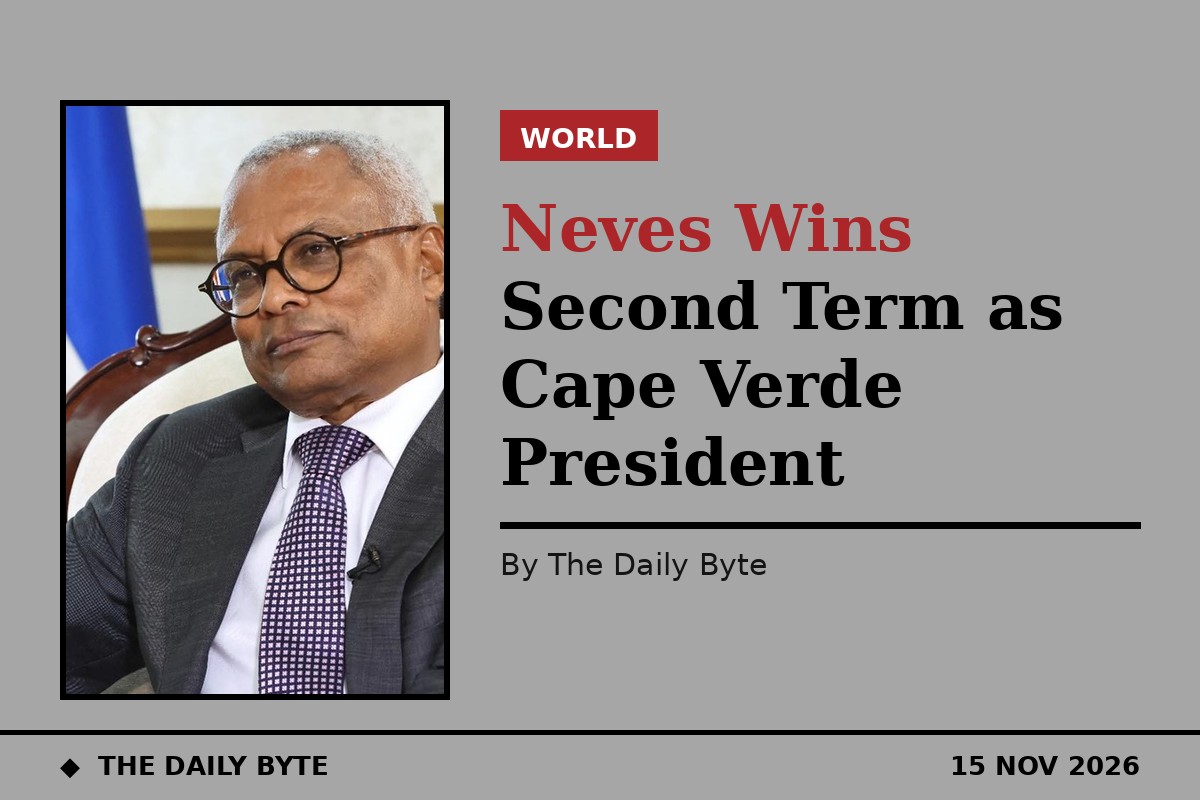
President Jose Maria Neves has won re-election in Cape Verde, taking 63.8 per cent of the vote in Sunday's presidential election, according to provisional results from the country's electoral commission reported by AFP.
Neves, 66, went into the vote as the clear favourite, and the scale of the win means he avoids a run-off, which would have been held on 29 November if no candidate had passed 50 per cent. Nearly 420,000 people were eligible to vote in the West African archipelago, which is widely regarded as one of Africa's most stable democracies.
Neves was first elected president in 2021. Before that he served as prime minister for 15 years, from 2001 to 2016, and as president of the African Party for the Independence of Cape Verde (PAICV), the party that also won legislative elections in May. He has also served as a mayor and a lawmaker.
A historic challenger falls short
Among the five candidates Neves faced was Joana Rosa Amado, a 61-year-old lawyer and former justice minister, who was the first woman ever to stand for the presidency in Cape Verde. Rosa, backed by the opposition Movement for Democracy, campaigned on jobs and outward migration, issues that dominated the race alongside the cost of living and fuel prices.
Her candidacy drew international attention to a country that has never had a woman president or prime minister since independence from Portugal in 1975. But the provisional results show voters opted for continuity, handing Neves a second five-year term by a wide margin.
Observers and a reputation for stability
Some 150 observers from the Economic Community of West African States, the African Union and the European Union were on hand to watch voting across the country's 10 volcanic islands, which lie in the Atlantic Ocean about 600km off the coast of Senegal.
Unlike several of its West African neighbours, where presidential elections have been tense in recent years, Cape Verde is known for political stability and good governance. According to the Mo Ibrahim Foundation's 2026 index on global governance, it ranks third out of 54 countries on the continent, and in July the World Bank classified it as an upper-middle-income country, thanks largely to growth in tourism.
What a second term means
Cape Verde has a semi-presidential system in which the executive is dominated by the prime minister. The president does not govern day to day but acts more as an arbiter, working to guarantee unity and uphold the constitution, appointing the prime minister on the basis of legislative election results and representing the country abroad.
"In these times of international uncertainty, it is essential that Cape Verde continues to have a patriotic, experienced president capable of inspiring Cape Verdeans," Neves said during a rally this week. The challenges awaiting him include persistent social inequality, geographic isolation, limited travel options between the islands, and the cost of living, fuel prices and youth unemployment that voters raised throughout the campaign.


