New Zealand to Cover Penrhyn Port Cost Blowouts
New Zealand will foot the bill for any cost blowouts on the Cook Islands’ Penrhyn port upgrade, newly released Cabinet documents reveal, even though ministers agreed the country’s contribution of US$10 million would be its maximum.
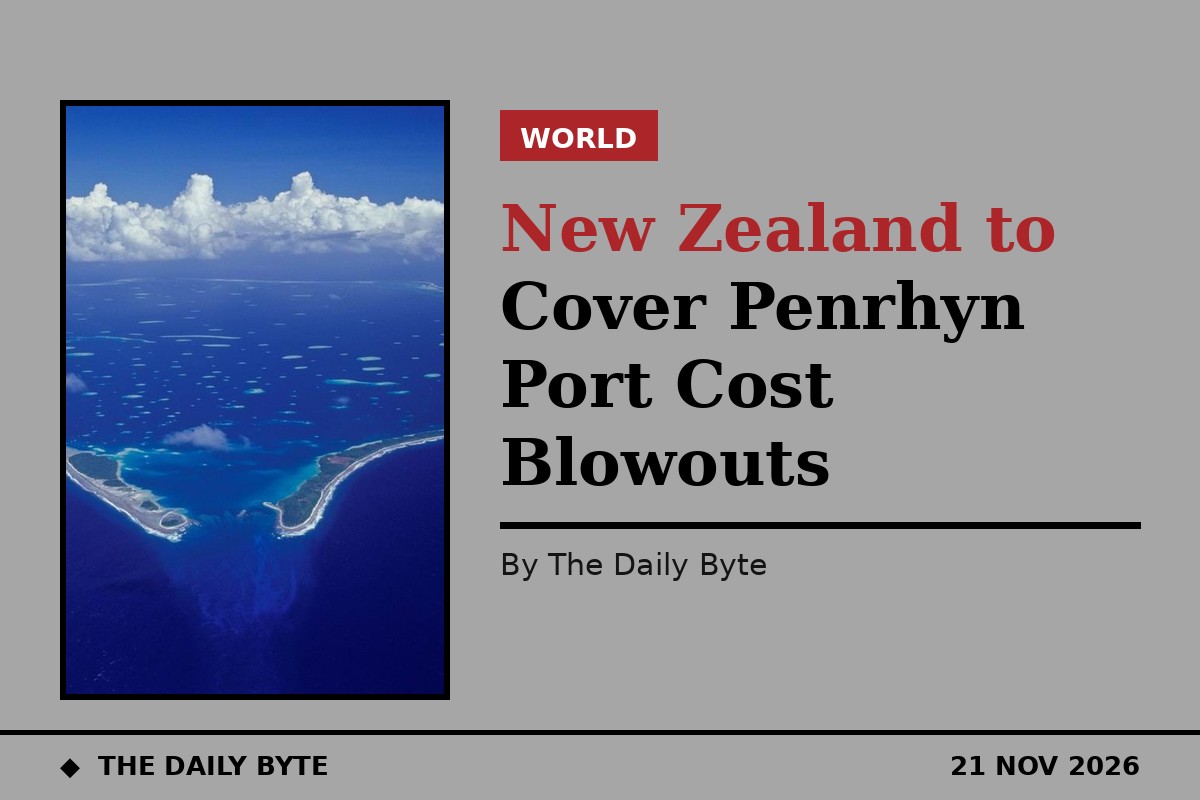
The project, a joint proposal by the New Zealand, United States and Cook Islands governments to build a deep-sea port on the remote northern atoll, was announced at the Pacific Islands Forum leaders’ summit on 1 September. It would extend a Second World War American-built air base on Penrhyn, also known as Tongareva, and is jointly funded at NZ$101 million, with the Americans contributing US$50 million, about NZ$84 million, and New Zealand putting in NZ$17.5 million, about US$10 million.
A Cabinet minute prepared by Foreign Minister Winston Peters’ office said the deal would proceed only if ministers had confidence that the funding available was sufficient to fully fund its implementation. But the same papers record that the American contribution is a one-off fixed sum, and draw the consequence plainly: “New Zealand would therefore be responsible for any cost increases; this is a standard risk for all development projects that New Zealand implements.”
The decision to proceed was taken on 31 August, a day before the announcement, provided the project passed a feasibility study, the Cook Islands continued to support it, and it could happen within the combined funding envelope approved by Cabinet. The August Cabinet paper set out a plan to start construction in 2029 and finish in 2031.
A project without a business case
The documents, released under the Official Information Act and proactively published as Cabinet paper CAB-26-MIN-0286 on 20 October, show officials knew the usual safeguards had not been met. A May briefing to Peters stated that a major New Zealand development activity would ordinarily be supported by a detailed business case prepared over a number of years with firm cost estimates. Officials added that a feasibility study could not be completed in the available timeframe.
Advice from April had been cautious: the project “will be possible, but it needs extensive further work”. Officials noted a 2023 feasibility study by the Australian government, in which New Zealand had no part, but the final cost estimate in the papers was redacted. “New cost estimates will need to be prepared to support the project, which are expected to be significantly higher,” the advice said.
Officials also acknowledged that construction would be “complex and expensive, given its remoteness and lack of supporting infrastructure, local materials or labour supply”. The Ministry of Foreign Affairs and Trade opened a tender on 7 September for the study, with an initial one-year contract of NZ$1.5 million followed by further work of NZ$3–6 million — a sum that alone could make up about 43 percent of New Zealand’s overall contribution.
Why Wellington accepted the risk
The strategic logic is not hidden in the papers. The documents say the project supports New Zealand’s long-term objective of seeing the United States maintain its presence and standing in the Pacific. Development expert Terence Wood said it was possible Wellington was willing to take on the risk to maintain influence in the Cook Islands. “Given how common budget blowouts are in large infrastructure projects, if NZ really is responsible for all cost increases, it is taking a risk — one that it would ideally avoid,” he said. “But these are unusual times. [New Zealand] desperately wants to keep the Cooks away from China’s sphere of influence and it will be very keen not to irritate the Americans.”
The United States is currently negotiating the extent of a military presence on the atoll, confirmed to include Coast Guard vessels. US Ambassador to the Cook Islands Jared Novelly has described Penrhyn as a “friendly port” to help Pacific nations counter “bad actors”, while Cook Islands Prime Minister Mark Brown calls the port a lifeline for safer landings and better links for the outer islands.
Others have raised sharper questions. International law expert Al Gillespie has warned that dual-use projects blur quickly between civil and military purposes, while Te Ipukarea Society director Alanna Smith has raised concern about the lack of information on the project and its link to deep sea mining, and a local landowner has asked about consultation and environmental assessments. With the money committed and the cost risk now sitting with Wellington, those questions fall to Parliament’s select committees — and to the business case officials admit was never written.