NHS Dental Charges in England: Bands and Costs 2026
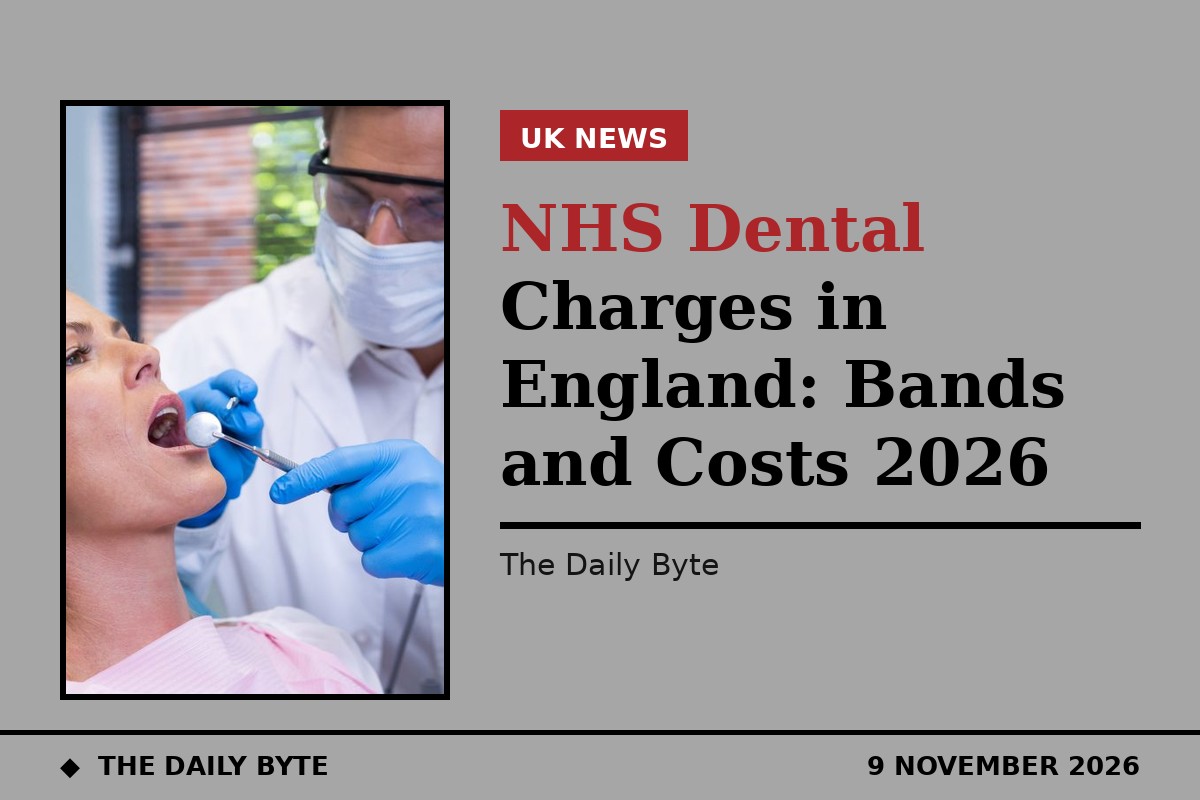
NHS dental treatment in England is not free for most adults, but the price is fixed. Instead of paying per filling or per X-ray, you pay one of three set charges, called bands, for a whole course of treatment. The current charges apply from 1 April 2026, and they are the same at every NHS dental practice in England. This guide explains what each band costs, what it covers, and who does not have to pay at all.
What are the three NHS dental bands?
NHS dental treatment in England is charged in three bands. You pay the charge for the highest band your treatment reaches, and that single payment covers everything in your course of treatment at that level. From 1 April 2026, the charges set by the NHS Business Services Authority are Band 1 at £27.90, Band 2 at £76.60 and Band 3 at £332.10. Urgent or unscheduled care also costs £27.90.
Band 1, at £27.90, covers a routine check-up. It includes an examination, assessment and advice, X-rays if they are clinically needed, a scale and polish if it is clinically needed, and preventive care such as fluoride applied to the surface of the teeth. It also covers moulds of your teeth and minor adjustments to dentures or braces. For most people who visit the dentist for a regular check-up and need nothing else, Band 1 is the whole bill.
Band 2, at £76.60, covers everything in Band 1 plus further treatment such as fillings, root canal treatment and extractions. It also covers other oral surgery, sealants and extensive work on gum disease. If your check-up finds that you need a filling, your course of treatment moves to Band 2 and you pay £76.60 in total for the course, not £27.90 plus £76.60.
Band 3, at £332.10, covers everything in Bands 1 and 2 plus more complex work, including crowns, dentures and bridges. It also covers inlays and onlays, orthodontic treatment such as braces where it is clinically needed, and other custom-made appliances, not including sports guards. A course of treatment that includes a crown therefore costs £332.10 in total.
One charge per course of treatment
The band charge is for a course of treatment, not for each appointment. If your dentist finds more work during the same course, you move up to the higher band and pay the difference, not a second full charge. If you need further treatment in the same band, or a lower band, within two months of completing a course, the NHS says you should not be charged again for it. Your dentist should tell you the cost of your treatment before it starts, and what band it falls into, so ask if anything is unclear.
Urgent treatment is charged at £27.90. This covers an appointment to deal with a problem that needs attention quickly, such as severe pain, swelling or a broken tooth. The urgent appointment deals with the immediate problem; if you then need a full course of treatment, that is charged separately under the band system.
There is also a separate charge for replacement NHS dental appliances. Under Regulation 11, a replacement appliance costs £99.60 for one appliance or £199.20 for two, from 1 April 2026. This applies when an appliance such as a denture needs to be replaced rather than repaired as part of a course of treatment.
Who gets NHS dental treatment free?
Many people do not have to pay NHS dental charges at all. In England, you can get free NHS dental appointments and treatment if, when your course of treatment starts, you are under 18, or under 19 and in full-time education. You also qualify if you are pregnant or have had a baby in the last 12 months, including if you have had a stillbirth in the past 12 months. Treatment carried out by a hospital dentist while you are being treated in an NHS hospital is also free, although you may still have to pay for dentures or bridges in that situation.
People who receive certain benefits also qualify. You can get free NHS dental treatment if you or your partner receive income-related Employment and Support Allowance, Pension Credit Guarantee Credit, or Pension Credit Guarantee Credit with Savings Credit. People on Universal Credit can also qualify, but only if their earnings are below a set amount. The NHS says that if you or your partner receive a benefit that entitles you to free dental treatment, your dependants aged under 20 can also get free treatment.
People on a low income who do not receive one of those benefits may still get help through the NHS Low Income Scheme. You apply on form HC1, and if you qualify you receive an HC2 certificate for full help with NHS costs, or an HC3 certificate for partial help. A valid HC2 certificate entitles you to free NHS dental treatment. A valid maternity exemption certificate is the proof used by pregnant women and new mothers.
It is important to claim free treatment only if you are sure you qualify, and to be able to prove it. The NHS can check claims afterwards, and penalty charges can apply if you claim free treatment when you are not entitled to it. If you have paid for NHS dental treatment and later find out you could have had it free or partly paid for, you may be able to claim a refund, so keep your receipts and ask the NHS Business Services Authority for advice.
What NHS dental charges do not cover
The band charges cover treatment that is clinically necessary. Cosmetic treatments, such as teeth whitening, are not available on the NHS and must be paid for privately. Dental implants are not usually available on the NHS either, except in limited circumstances where there is a clinical need that cannot be met another way. If your dentist suggests a private option alongside NHS treatment, you can choose, but you should only pay for private treatment you have agreed to, and free-treatment entitlement does not cover private work.
Orthodontic treatment, such as braces, is available on the NHS for children and young people where it is clinically needed, and it falls under Band 3. For adults, NHS orthodontic treatment is only available in limited circumstances. Your dentist can explain whether your case meets the clinical criteria.
How much is NHS dental treatment in Scotland, Wales and Northern Ireland?
The band system described here applies to England only. Scotland, Wales and Northern Ireland each run their own arrangements, and the amounts are different. In Scotland, patients pay 80 percent of the cost of NHS dental treatment, up to a maximum of £384 for each course of treatment, unless they are entitled to free treatment. NHS dental examinations in Scotland are free for everyone.
In Wales, charges are set by care package rather than by the English bands. From 1 April 2026, an urgent course of treatment in Wales costs £37.50, a new patient assessment for an adult costs £27.21, and other packages range from £25 for a recall visit to £182.72 for a posterior root canal treatment. Children and young people in Wales are not charged for initial assessments or recall visits. Northern Ireland has its own charging arrangements, and patients there should check the Health and Social Care Board guidance for the current rates.
How to find an NHS dentist
Not every dental practice takes NHS patients, and some practices that do may not be taking on new NHS patients at a given time. The NHS website has a find-a-dentist service that shows which practices near you offer NHS treatment. You can also contact NHS 111 if you need urgent dental care and do not have a dentist. If you are in pain or have swelling that is getting worse, seek urgent care rather than waiting for a routine appointment.
Charges are reviewed each year and usually change on 1 April. The figures in this guide are the charges from 1 April 2026, which replaced the previous charges of £27.40 for Band 1, £75.30 for Band 2 and £326.70 for Band 3. Before you book, check the current charges on the NHS website or with your practice, because the amounts can change and this guide may be out of date if you are reading it after the next annual change.