NHS Winter Plan 2026-27 Explained: Flu Jabs, Urgent Care Funding and How to Get Help
By The Daily Byte
·18 Nov 2026
·9 min read
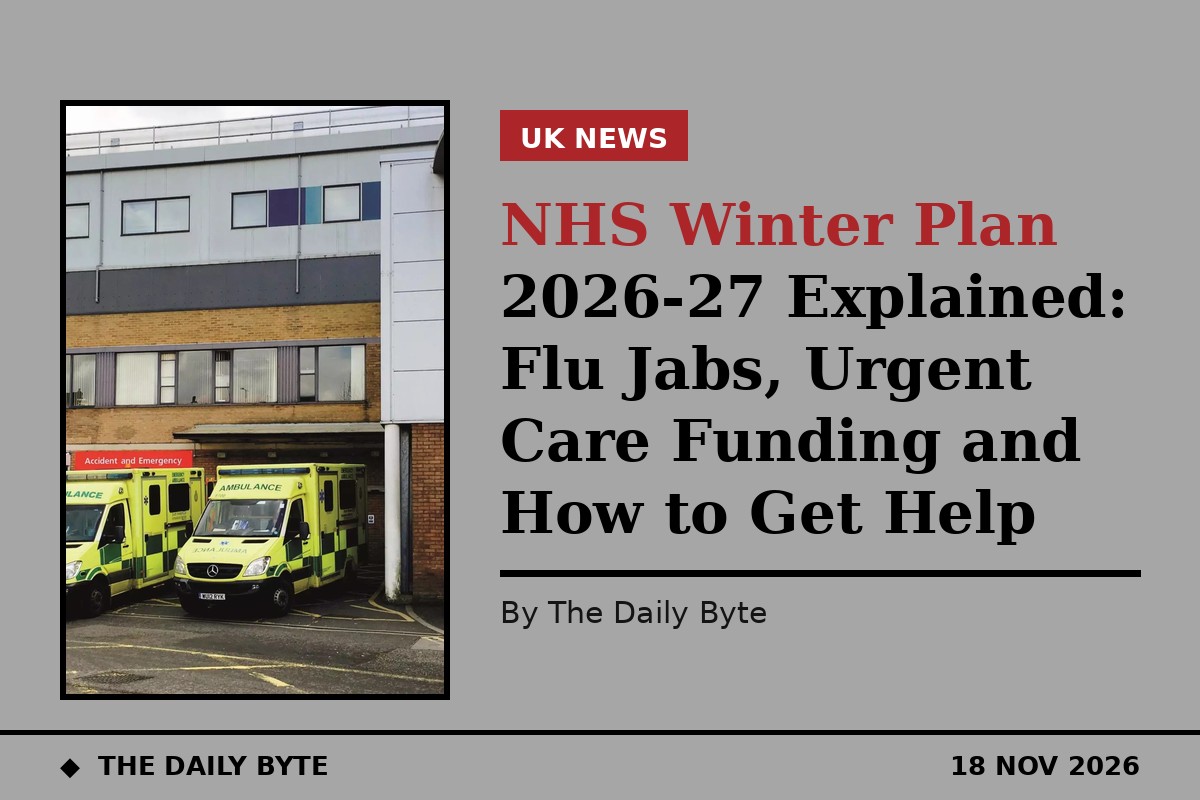
The NHS in England has set out its preparations for winter 2026-27, centred on extra urgent care capacity, the seasonal flu and RSV vaccination programmes, and a new GP scheme aimed at keeping up to 300,000 vulnerable patients out of hospital. Winter is the health service's hardest season, when flu, respiratory syncytial virus (RSV), norovirus and cold weather arrive together and demand on hospitals rises sharply.
This guide explains what the winter plan involves, what money has been announced, who can get a free flu or RSV vaccine, and where to get help if you become unwell. The measures described here apply to England. Health is devolved, so Scotland, Wales and Northern Ireland make their own winter arrangements.
What is the NHS winter plan?
There is no single document called the winter plan. The term covers the package of measures the government and NHS England put in place each autumn to prepare for the winter peak: extra hospital capacity, vaccination programmes, more support from GPs and pharmacies, and public advice on where to get help. Preparations for this winter began in July, after what the government described as the busiest summer in NHS history, with record activity and periods of extreme heat.
The latest measures were announced in two stages. On 18 October 2026 the government announced almost £140 million for 14 new urgent care schemes across England. On 9 November it announced a £40 million GP Winter Proactive Care Programme, alongside £190 million allocated in the Budget to help the NHS manage winter pressures.
How is £140 million being spent on urgent care?
The £140 million announced on 18 October 2026 funds 14 schemes across England, including new urgent treatment centres, same day emergency care services, new ambulance fleets and emergency department upgrades. The aim is to give patients the right care in the right place, and to ease pressure on accident and emergency departments.
The largest single scheme is at Queen's Hospital in Romford, which receives £42.1 million for a comprehensive transformation and reconfiguration of its accident and emergency department. Other schemes include a new £12.9 million same day emergency care facility at Queen's Medical Centre in Nottingham, £6.76 million at Airedale General Hospital and £4.7 million at the Royal Albert Edward Infirmary in Wigan.
A further 25 new or expanded urgent care sites, announced in April, are due to be open for winter. The government says it is investing almost £2 billion in urgent care capital projects up to 2030, on top of £1.5 billion confirmed so far for urgent maintenance work across the NHS estate.
The government said the investment follows a summer of record NHS activity and extreme heat, and warned that seasonal illnesses, including flu and norovirus, would add to the workload over winter. Health and Social Care Secretary Yvette Cooper said winter would be more challenging for the NHS this year after such a heavy summer, which was why preparations had started early. Dr Emma Rowland, NHS England's executive director for performance and delivery, said the new capacity would help reduce pressure on emergency departments while protecting staff.
What is the GP Winter Proactive Care Programme?
The GP Winter Proactive Care Programme, announced on 9 November 2026 by Prime Minister Andy Burnham and Health Secretary Yvette Cooper, gives GP practices ring-fenced funding to identify and support the patients they consider most at risk of becoming seriously unwell this winter.
Up to 300,000 vulnerable patients in England are expected to receive extra support, focused on people with heart disease, frailty and chronic obstructive pulmonary disease (COPD), the group of lung conditions that includes emphysema. Support can include medication reviews, health checks, home assessments and nurse-led respiratory clinics. Primary care networks, the groups of local practices that work together, receive £126 for each eligible patient they support.
There is no application form and no national checklist to apply against. GP practices choose the patients they judge to be most at risk, and contact them directly. The £40 million is ring-fenced for this work, but it is reallocated from existing general practice budgets for the 2026-27 financial year rather than new funding. The government says the aim is to keep people well at home, prevent serious illness and reduce avoidable hospital admissions.
Who can get a free flu vaccine this winter?
The flu vaccination programme for 2026-27 began on 1 September 2026 for pregnant women and eligible children, and on 1 October for most other eligible adults. Vaccinations can be given up until 31 March 2027, but the NHS advises people to get vaccinated as soon as they can, because protection takes around two weeks to develop.
From 1 September 2026, a free flu vaccine is available to pregnant women, all children aged two or three on 31 August 2026, school-aged children from Reception to Year 11, and children aged from six months to under 18 in clinical risk groups.
From 1 October 2026, it is available to people aged 65 and over, adults aged 18 to under 65 in clinical risk groups, people in long-stay residential care homes, carers in receipt of carer's allowance or who are the main carer of an elderly or disabled person, close contacts of immunocompromised people, and frontline health and social care workers.
Eligible adults can book through the NHS website or NHS App, by calling 119, through their GP surgery or at a participating pharmacy. Children are mostly vaccinated at school, and a pharmacy catch-up programme for school-aged children who missed the school offer starts on 1 December 2026.
Uptake has been strong. More than 10 million flu vaccinations had been delivered in England by 22 October 2026, and more than 13.6 million by 1 November. The UK Health Security Agency estimates that vaccination prevented around 100,000 hospitalisations and 7,000 deaths in England in 2025-26, although these are modelled estimates rather than a guarantee of individual protection.
What has changed with the RSV vaccine?
RSV, respiratory syncytial virus, is a common cause of chest infections in older adults and babies. An RSV vaccination programme for older adults and pregnant women began in September 2024, and its eligibility has been extended twice since then.
From 1 April 2026, the older adult programme was extended to everyone aged 75 and over, with no upper age limit, and to all adults living in a care home for older adults. From 1 September 2026 it was extended further to adults aged 65 to 74 with a weakened immune system or a long-term lung condition. Pregnant women are eligible for a single dose from 28 weeks of pregnancy, to help protect their baby in its first months. Only a single dose is needed.
People who are eligible can arrange the RSV vaccine through their GP surgery, or through maternity services if they are pregnant. Anyone unsure whether they qualify should ask their GP surgery or pharmacist.
Where should you go if you become unwell?
The winter plan is built around directing people to the right service, so that emergency departments are kept for emergencies.
NHS 111 is available 24 hours a day, online at 111.nhs.uk, on the NHS App or by calling 111 free of charge. It can advise on symptoms, direct you to a pharmacy or GP practice, or help you access urgent care.
Urgent treatment centres treat urgent but not life-threatening illness and injury, such as sprains, minor burns and infections. Some ask you to contact NHS 111 first, so it is worth checking locally. Same day emergency care units assess and treat patients who can safely go home within a day, avoiding an overnight hospital stay.
Pharmacies can advise on minor illness, and participating pharmacies offer flu vaccinations. GP practices remain the first point of contact for ongoing health problems, and the new winter programme means some vulnerable patients will be contacted proactively by their practice.
Call 999, or go to accident and emergency, only for a life-threatening emergency, such as chest pain, severe breathing difficulty, a suspected stroke or serious injury.
What can patients do to prepare?
Get vaccinated if you are eligible, and do not delay. Book through the NHS App, the NHS website, your GP surgery or a participating pharmacy. Keep any regular medicines in stock, and check on older relatives and neighbours during cold weather. If you have a long-term condition, make sure you know who to contact if your symptoms worsen, and keep your GP practice's number to hand.
The government has also urged people to check their eligibility rather than assume they do not qualify. If you are unsure whether you are eligible for a free flu or RSV vaccine, the NHS website and the NHS App can check for you, or you can ask your GP surgery or a pharmacist.
Frequently asked questions
Am I eligible for a free flu vaccine? You are eligible if you are 65 or over, pregnant, aged 18 to 64 with certain long-term health conditions, a carer, a care home resident, a close contact of someone with a weakened immune system, or a frontline health or social care worker. Children aged two or three and school-aged children from Reception to Year 11 are also eligible. Check on the NHS website or App if you are unsure.
When can I get my flu jab? The programme runs until 31 March 2027. Most eligible adults have been able to book since 1 October 2026, and children and pregnant women since 1 September. Protection takes around two weeks to develop, so earlier is better.
Do I need to apply for the GP winter support scheme? No. There is no application. GP practices identify the patients they consider most at risk, focused on heart disease, frailty and COPD, and contact them directly.
What is an urgent treatment centre? It treats urgent but not life-threatening problems, such as minor injuries and infections, and is an alternative to accident and emergency for problems that need same-day attention but are not emergencies.
When should I call 999 instead of 111? Call 999 for a life-threatening emergency, such as chest pain, severe breathing difficulty, signs of a stroke or a serious injury. Use NHS 111 for urgent advice when it is not an emergency.
Sources: GOV.UK, "£140 million boost to urgent care to ease winter pressures on NHS" (https://www.gov.uk/government/news/140-million-boost-to-urgent-care-to-ease-winter-pressures-on-nhs) and GOV.UK, "£40 million for GPs to keep vulnerable patients out of hospital this winter" (https://www.gov.uk/government/news/40-million-for-gps-to-keep-vulnerable-patients-out-of-hospital-this-winter). Flu eligibility is set out in the National flu immunisation programme 2026 to 2027 letter (https://www.gov.uk/government/publications/national-flu-immunisation-programme-plan-2026-to-2027/national-flu-immunisation-programme-2026-to-2027-letter), and RSV eligibility in the GOV.UK RSV vaccination programme collection (https://www.gov.uk/government/collections/respiratory-syncytial-virus-rsv-vaccination-programme).