Nicaragua Opponents Urge World Pressure on Ortega Regime
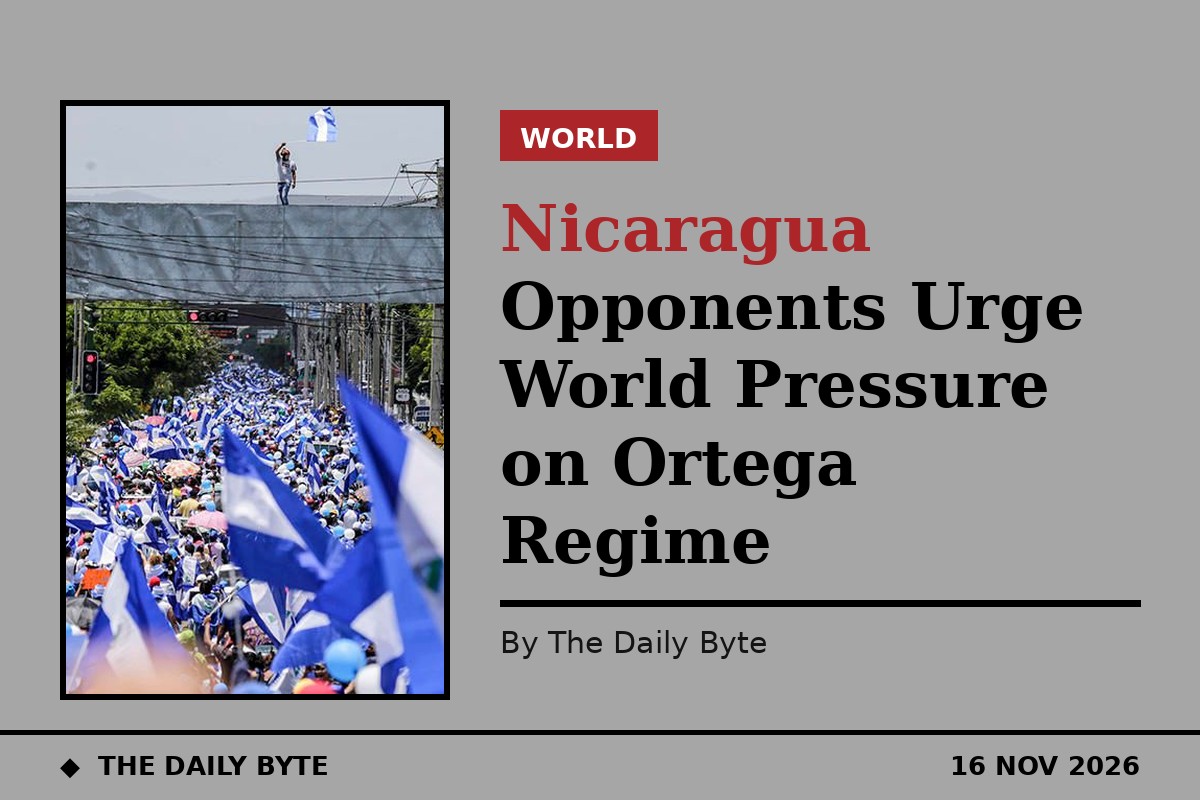
Two leading opponents of Nicaragua's government have called for sustained international pressure on President Daniel Ortega and his wife, co-President Rosario Murillo, warning that the country is sinking deeper into dictatorship after the regime declared there would be no more elections.
Dora María Téllez, 70, a former commander of the Sandinista National Liberation Front, and Carlos Fernando Chamorro, 70, the journalist who founded the news outlet Confidencial, spoke to Le Monde in Paris on the sidelines of a conference held on 6 November at the Maison de l'Amérique latine. The interview was published on Monday, 16 November.
"No more elections ever again"
On 19 July, Ortega and Murillo announced that there would be "no more elections ever again" in Nicaragua. Presidential elections had been scheduled for November 2026, at the end of Ortega's fourth term. Instead, the government pushed through constitutional changes that bar people it calls "traitors to the homeland" — a reference to the opposition — from standing for office.
Téllez and Chamorro, both now in exile, described a police state in place since the crackdown on protests in late 2018. More than 450 Nicaraguans have been declared stateless by the regime, which stripped them of their nationality and labelled them traitors. The United Nations Group of Human Rights Experts on Nicaragua has documented both the statelessness and transnational repression of exiles, and has called for Nicaragua to be brought before the International Court of Justice.
As of 23 October, the Association for Memory and Justice for Nicaragua documented 72 political prisoners, 33 of them in a state of forced disappearance. The UN experts have verified enforced disappearances and reported that 15 women arrested for political reasons remain missing.
The OAS resolution
Chamorro pointed to the resolution adopted by the Organization of American States on 2 October as the most important recent development. All 32 member states voted for a text demanding the restoration of democracy, the release of political prisoners, the annulment of the constitution imposed by the regime, the return of confiscated property and the reinstatement of nationality.
The resolution created a ministerial follow-up group to present the demands directly to the government in Managua, with a 60-day deadline for the regime to adopt measures to restore freedoms and a further evaluation expected within 90 days. Its report is due in early December. Chamorro noted, however, that the countries that signed it have not yet said what they will actually do if Managua refuses.
The European Union has sanctioned 23 Nicaraguan officials, and the European Parliament has adopted two resolutions calling for a review of the association agreement between Nicaragua and the EU because of a violation of the democratic clause. The EU bodies concerned have yet to act on those resolutions.
US measures, limited priority
On 5 November, President Donald Trump issued an executive order extending for another year the national emergency that designates Nicaragua a threat, and further sanctions are scheduled to take effect on 1 January 2027, imposing an additional 10 per cent tariff on top of those Nicaragua already faces.
Chamorro said Nicaragua is on Washington's agenda, but not a priority compared with Venezuela and Cuba, or with anti-immigration and anti-narcotics policy. He argued that the OAS resolution matters precisely because it established a roadmap in which the United States pledged not to act unilaterally, while explicitly ruling out any use of force.
For Téllez and Chamorro, the question now is whether the governments that voted for the resolution will follow words with action. "No dramatic action is expected in the short term," Chamorro said, "but it is significant that this resolution established a roadmap." With the follow-up group's report due in December, the coming weeks will show whether the unanimous vote in Washington produces anything more than condemnation. Source: Le Monde


