Nigeria Drafts State Police Law After All 36 States Back It
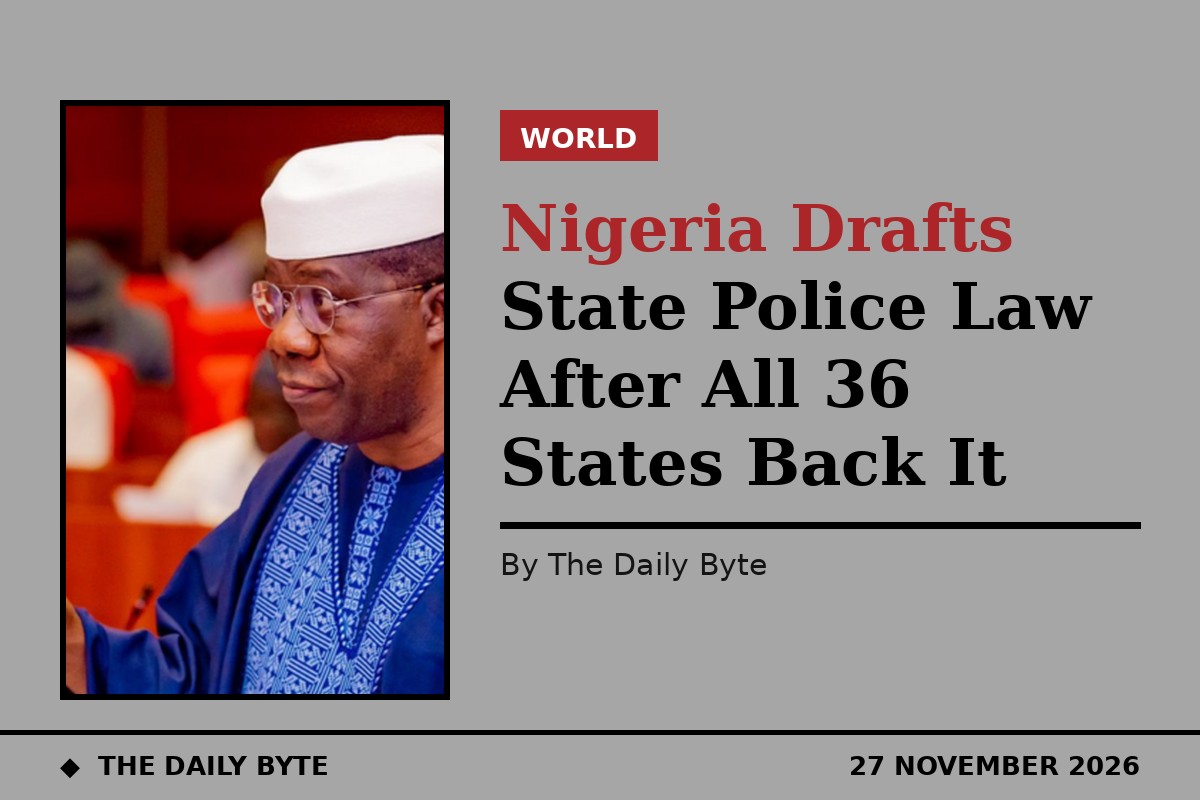
Nigeria's National Assembly is working with the executive and other stakeholders on the operating law for the country's proposed state police system, after every one of the 36 State Houses of Assembly approved the constitutional amendment that would create it.
Senate Leader Opeyemi Bamidele said in Abuja on Thursday that the additional legislation would set out how state police services should operate, the safeguards against abuse by political office holders, and the respective responsibilities of federal and state police authorities. He said the framework was needed to answer concerns about possible interference by state governors and to establish the institutional safeguards the new system would require.
The constitutional amendment, the Constitution of the Federal Republic of Nigeria (Sixth Alteration) Bill, 2026, has been transmitted to President Bola Tinubu for assent. The President's Chief of Staff, Femi Gbajabiamila, said in a statement on 18 November that the President had formally received the bill and would review it in consultation with the Attorney-General of the Federation before assenting to it at a formal signing ceremony.
The amendment passed through a long legislative route. The Senate and the House of Representatives approved it on 24 June and 23 July 2026 respectively, and it was sent to the 36 State Houses of Assembly on 16 September for their consideration. By 3 November, 28 state assemblies had approved it, already more than the 24 required under Section 9(2) of the 1999 Constitution. The Senate then gave the six remaining assemblies until 15 November to return their decisions, and all 36 ultimately approved the proposal.
Assent alone would not put a single state police officer on the street. Each state would first have to pass its own law setting up a service, and that service would need to be certified as meeting national minimum standards. The National Policing Bill, which is meant to set out how the system will operate in practice, and a full funding framework are still outstanding. Plateau State has proposed recruiting between 5,000 and 7,000 personnel for a state police service, with pilot deployments in flashpoint areas before statewide coverage.
The proposal would end the federal monopoly on policing that Nigeria has operated under since independence, replacing a single national force with two tiers: a Federal Police Service and a State Police Service in each state. Supporters argue that locally controlled policing would respond faster to insecurity, including banditry, kidnapping and communal violence, while critics have warned that governors could use state police against political opponents. Bamidele said the operating law now being prepared was designed to address those fears directly. Once the President assents, attention will turn to the state laws and the national standards that must follow before any state police service can begin work.


