Nigeria Rights Body Logs 384,196 Complaints in October
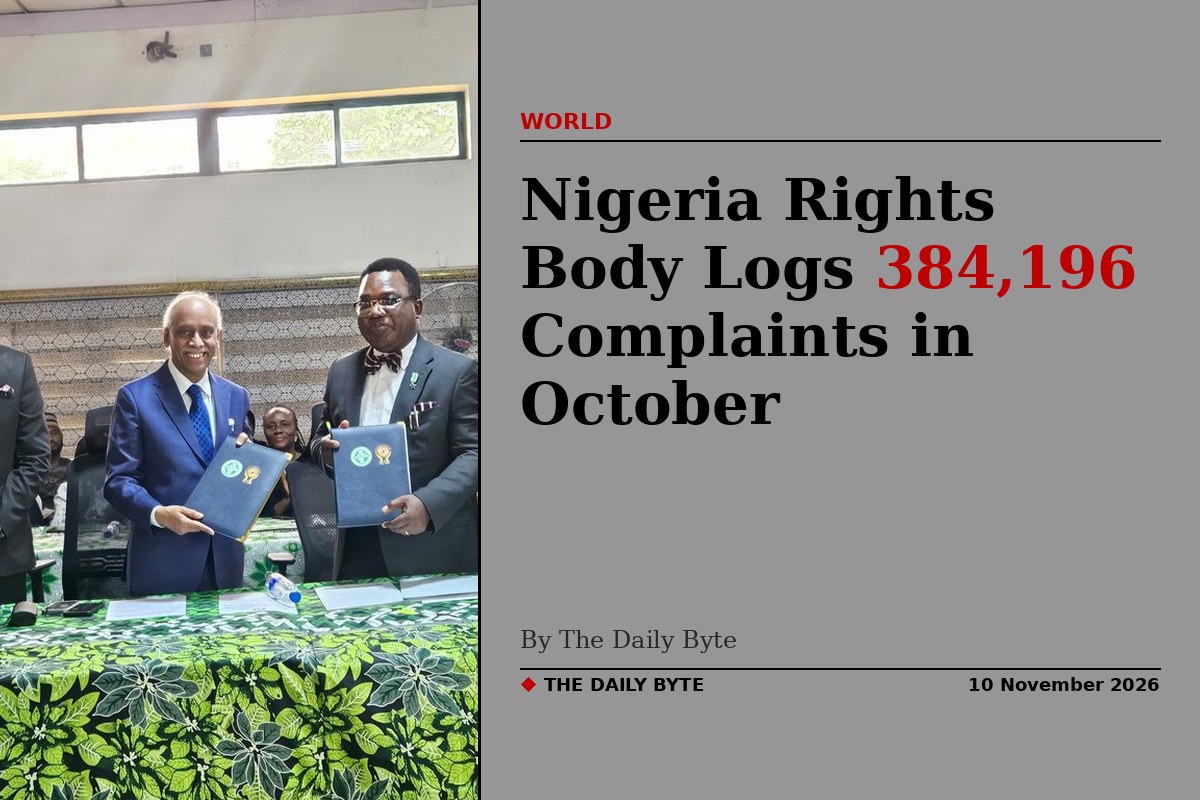
Nigeria’s National Human Rights Commission (NHRC) recorded 384,196 human rights complaints across its 38 locations nationwide in October 2026, a rise of about 45,000 complaints, or 14 per cent, compared with September, the commission disclosed in Abuja on Tuesday, 10 November.
The figures were presented by the commission’s Executive Secretary, Dr Tony Ojukwu, during the launch of the October 2026 Human Rights Situation Dashboard. The September total was 338,810 complaints. Ojukwu said the increase could partly reflect growing public awareness of human rights and improved access to the commission’s complaint-reporting channels, but he stressed that the figures also exposed continuing challenges across the country.
Discrimination and displaced people dominate
Freedom from discrimination was the largest thematic category in October, accounting for 217,243 complaints. Within that category, 184,624 complaints were recorded under the protection of internally displaced persons (IDPs), underlining the scale of protection concerns affecting people forced from their homes by insecurity and other circumstances.
The commission warned that displacement must not deprive individuals and families of their dignity, personal security and access to fundamental rights, and said stronger institutional responses were needed to deal with the humanitarian and human rights consequences of displacement.
Insecurity, child abuse and civic space
The commission expressed serious concern about the security situation in several parts of Nigeria, pointing to reports of killings, armed attacks and abductions affecting vulnerable communities. Its Human Rights Observatory recorded incidents in October involving attacks on farming communities, travellers, students, traditional rulers and security personnel, with reports of mass killings and abductions in parts of Taraba, Borno, Zamfara, Niger and Plateau states.
The October report also highlighted continuing threats to women and children, including sexual and gender-based violence, exploitation and abuse. The observatory documented cases involving alleged rape and sexual abuse of children, human trafficking and domestic violence, as well as severe physical violence against children, abandonment and neglect. The commission called for stronger preventive measures, prompt investigations, support for survivors and improved access to justice.
Concerns were also raised about alleged violations by public authorities and security personnel, freedom of expression and the shrinking of civic space. The commission said democratic participation must be protected and that political disagreements should never be resolved through violence, intimidation or arbitrary restrictions.
Electoral violence warning ahead of 2027
With Nigeria approaching elections scheduled for January 2027, the commission warned about increasing electoral violence and political intolerance. Ojukwu said elections involve fundamental human rights, with political participation at the centre of constitutional democracy, and called on political actors to exercise restraint and act in line with electoral laws and human rights standards. The commission also repeated its demand for the prosecution of people responsible for inciting hateful and divisive speeches.
Nigeria and India sign rights agreement
The dashboard launch also featured the signing of a memorandum of understanding between Nigeria’s NHRC and the National Human Rights Commission of India, aimed at strengthening institutional cooperation, knowledge exchange and capacity development. India’s NHRC chairperson, Justice V. Ramasubramanian, described the agreement as historic, while Ojukwu said it would cover the exchange of expertise and best practices, capacity building, joint research and publications.
The event also marked the unveiling of a logo commemorating the Nigerian commission’s 30th anniversary. Ojukwu said the monthly dashboard was not merely a statistical exercise but an accountability tool designed to identify emerging violations, inform policy and promote effective remedies for victims, adding that every complaint represents an individual, family or community whose rights and dignity require protection. Read the full report on A1 News and Emporium Reporters.


