Nigeria State Police Move Closer as All 36 Assemblies Approve Constitutional Amendment
By The Daily Byte
·18 Nov 2026
·4 min read
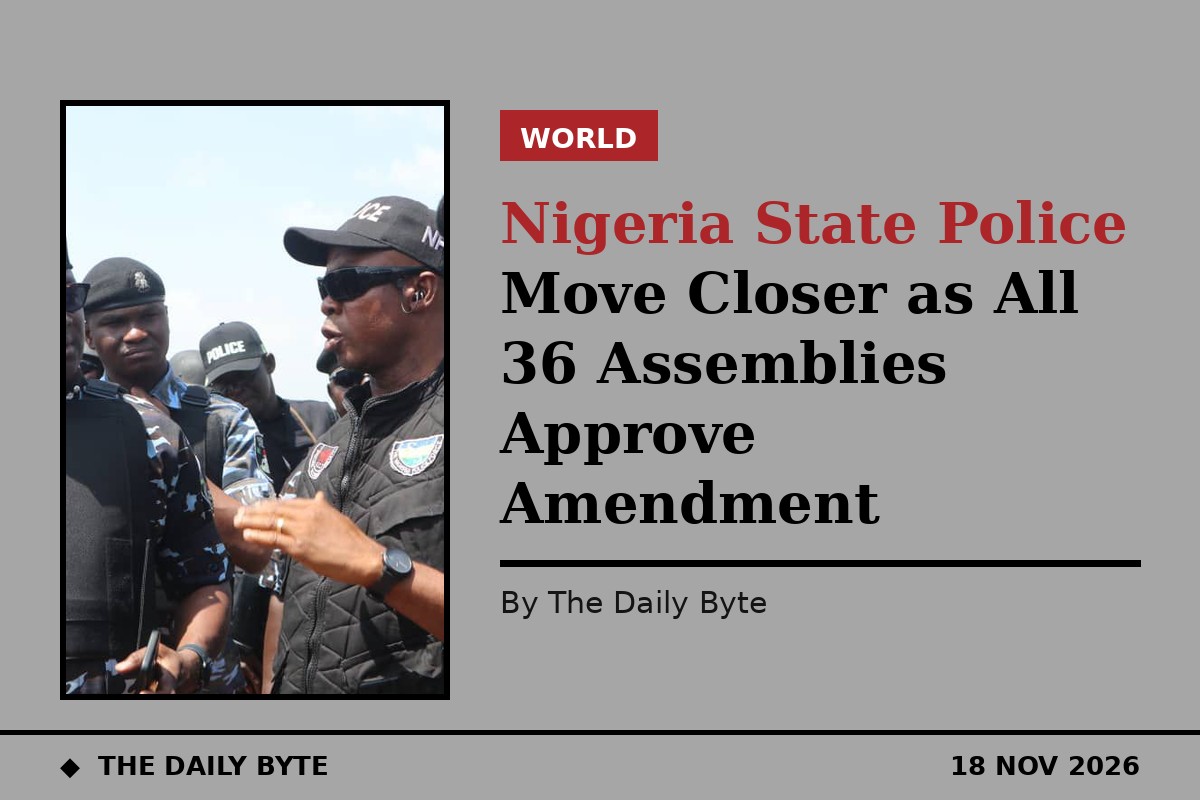
Nigeria has moved a step closer to state policing after all 36 State Houses of Assembly approved a constitutional amendment that would allow individual states to run their own police services alongside the federal force.
The Clerk to the National Assembly, Kamoru Ogunlana, announced the unanimous approval on Monday, 16 November, confirming that his office had completed verification of the resolutions submitted by the state legislatures. The bill is now set to be transmitted to President Bola Tinubu for his assent, the final step before the amendment becomes part of the constitution.
The approval is a major milestone in a debate that has run for years, but state police forces will not begin operating until the President signs the amendment and each state passes its own law, recruits officers and arranges funding — a process likely to take months.
## What the amendment would change
The proposed legislation is formally titled "A Bill for an Act to alter the Constitution of the Federal Republic of Nigeria, 1999 to provide for the establishment of State Police Services and for related matters". It forms part of the Constitution (Sixth Alteration) Bill, 2026.
Under the proposed arrangement, state governments would establish and operate their own police services alongside a Federal Police Service. The single national force under the Inspector-General of Police, which has handled policing across the whole federation, would no longer be the only policing structure in the country.
Governors would appoint commissioners of police on the recommendation of the National Police Council, subject to confirmation by their respective State Houses of Assembly. The Federal Police would retain responsibility for national security matters, while state police formations would focus on law enforcement, crime prevention and security challenges within their own jurisdictions.
## How the bill reached this point
The bill was passed by the Senate on 24 June 2026 and by the House of Representatives on 23 July 2026, before being transmitted to the state legislatures on 16 September for consideration. Under Section 9(2) of the 1999 Constitution, a constitutional amendment requires the approval of at least two-thirds of the 36 state legislatures — 24 states. Unanimous approval by all 36 therefore exceeds the required threshold by a wide margin.
The Clerk said the National Assembly had initially delayed transmission of the bill to the President to allow further engagement with the state legislatures and to secure broader consensus. Further reporting on the announcement is available from [Flash Info](https://www.flashinfong.com/state-police-all-36-state-assemblies-approve-constitutional-amendment-as-bill-heads-to-tinubu-for-assent/).
## Why supporters want state police
The push for state police comes amid persistent security crises across Nigeria, including banditry in the north-west, kidnapping and insurgent violence. Supporters of the reform argue that decentralised policing would strengthen local intelligence gathering and improve responses to security threats, because officers who know a community and its terrain can act more quickly than a force directed entirely from Abuja.
President Tinubu has also pressed security agencies to improve coordination and to make greater use of technology. Speaking at the opening of the Chief of Defence Intelligence Annual Conference 2026 in Abuja, he urged agencies to improve operational coordination and embrace emerging technologies to address increasingly complex security challenges.
## The concerns that remain
Critics and cautious supporters alike warn that the reform carries risks. Concerns remain over possible political interference, abuse of authority, funding and accountability — in particular, whether governors could use a state force against political opponents, and whether poorer states could afford to run a professional service.
Those questions will not be settled by the constitutional amendment alone. The safeguards, funding model and oversight rules will depend on the state laws that follow, and on how the National Police Council and the state assemblies exercise their roles in appointments and supervision.
For now, the immediate step to watch is the formal transmission of the bill and the President's decision. Until he assents, and until states complete their own legislation, the Nigeria Police Force remains the established national policing service operating across the federation.
## Frequently asked questions
**Have state police started operating in Nigeria?**
No. All 36 state assemblies have approved the constitutional amendment, but the bill still needs presidential assent, and each state must then pass its own law and set up its police service before any state force begins operating.
**What does the amendment require?**
A constitutional amendment needs the backing of at least 24 of the 36 state assemblies under Section 9(2) of the 1999 Constitution. All 36 approved, so the threshold was comfortably met.
**Who would run a state police service?**
The state government would establish and fund it. The governor would appoint the commissioner of police on the recommendation of the National Police Council, subject to confirmation by the State House of Assembly.


