Nigeria Senate Sends State Police Bill To Tinubu For Assent After All 36 States Approve
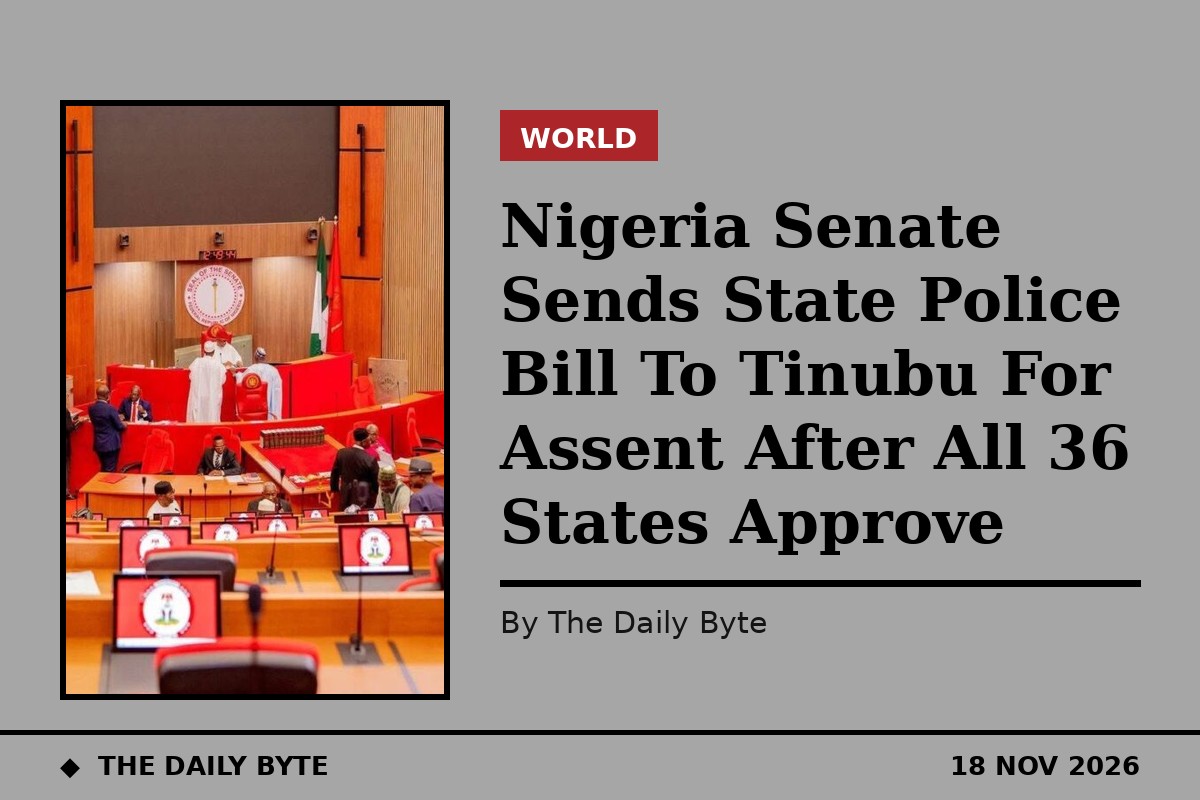
Nigeria's Senate has completed the constitutional amendment process to establish state police and sent the bill to President Bola Ahmed Tinubu for assent, in a landmark step towards decentralising policing in Africa's most populous country. The Senate resolved on Wednesday 18 November 2026 to direct the Clerk to the National Assembly, Kamoru Ogunlana, to transmit the bill to the President.
President Tinubu received the bill the same day. His Chief of Staff, Femi Gbajabiamila, said the President will review the Constitution Alteration Bill in consultation with the Attorney-General of the Federation and will assent to it at a formal signing ceremony.
How the bill reached the President
The resolution followed a motion by Senate Leader Opeyemi Bamidele, who represents Ekiti Central, confirming that the constitutional alteration bill had satisfied all statutory requirements under Sections 9(1) and 9(2) of the 1999 Constitution and the Acts Authentication Act, 2004.
The Senate passed the executive-backed bill on 24 June 2026, and the House of Representatives concurred on 23 July 2026. The legislation was then sent to the 36 State Houses of Assembly, all of which approved it, exceeding the two-thirds threshold of 24 states required to alter the constitution. President Tinubu had earlier transmitted the bill to the Senate as part of broader efforts to reform Nigeria's security architecture.
Deputy Senate President Barau Jibrin, who chaired the session and also chaired the Senate Committee on the Review of the 1999 Constitution, described the development as a historic achievement and a significant milestone in Nigeria's efforts to decentralise policing and strengthen its security architecture. He praised the President for his commitment to the establishment of state police.
What state police would mean
The bill, formally titled the Constitution of the Federal Republic of Nigeria (Sixth Alteration) Bill, 2026, amends the 1999 Constitution to provide for the establishment of State Police Services alongside the existing Nigeria Police Force. Senators described the reform as a historic turning point in efforts to address insecurity, kidnapping, banditry and other security challenges.
State police are designed to complement the operations of the Nigeria Police Force rather than replace it, according to the Deputy Senate President. The proposed arrangement is intended to strengthen the country's overall policing structure and improve its capacity to tackle security challenges at state level.
Assent alone will not make state police operational
The Senate stressed that presidential assent alone will not provide all the legal and administrative arrangements needed to make state police operational. It therefore urged President Tinubu to forward a separate National Policing Bill to the National Assembly to establish the operational framework, including uniform standards for recruitment, training, firearms control, custody protocols, human rights compliance and coordination between the Federal Police Service and state police commands.
State police services will become legally enforceable once President Tinubu signs the constitutional amendment and the enabling operational legislation is enacted.
Frequently asked questions
Has Nigeria approved state police?
The constitutional amendment to establish state police has passed both chambers of the National Assembly and all 36 State Houses of Assembly. It now awaits President Tinubu's assent, which he is expected to give at a formal signing ceremony after consulting the Attorney-General.
Will state police replace the Nigeria Police Force?
No. State police are designed to complement the federal police, not replace them. A separate National Policing Bill will set out how the two levels work together.
When will state police start operating?
Not immediately. Even after presidential assent, the National Assembly must pass operational legislation before state police services can be set up.
Sources: The New Citizen; The Nigerian News.


