Nikkei Posts Best Week Since June as Hang Seng Slumps
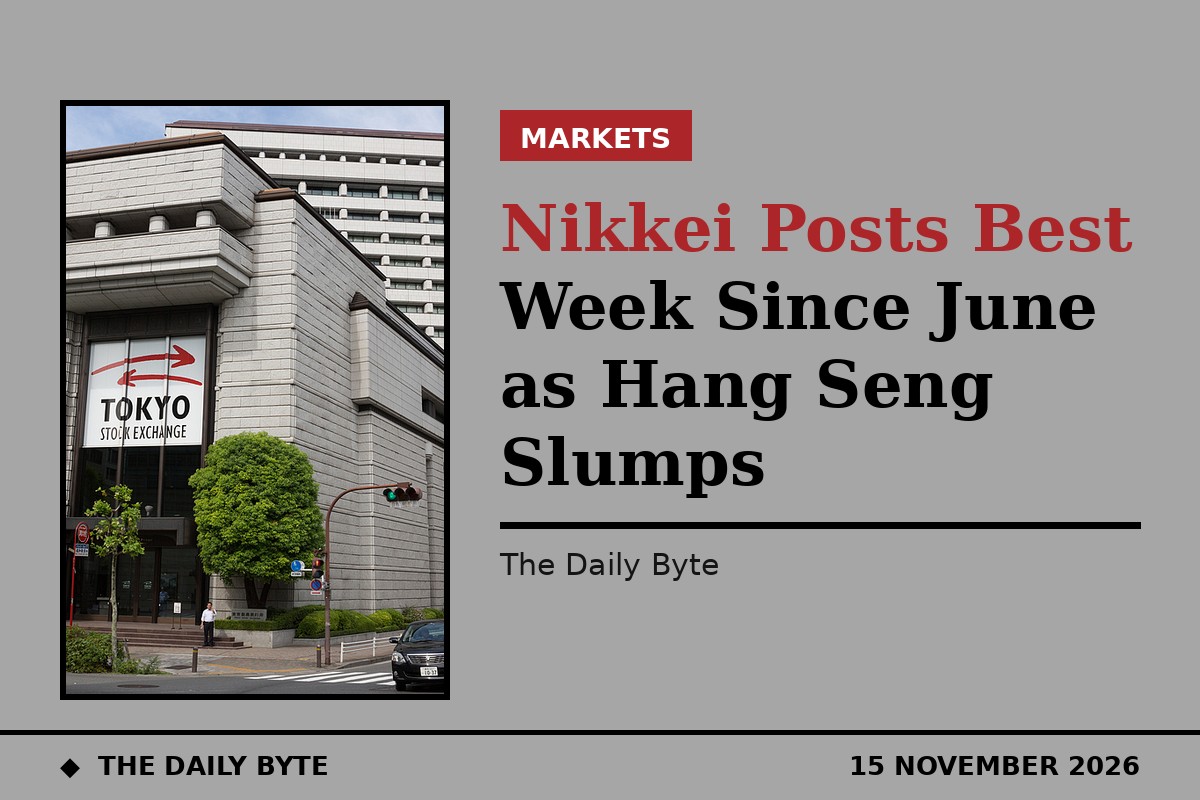
Asian markets split sharply last week, with Japan's Nikkei 225 posting its best weekly gain since June while Hong Kong's Hang Seng Index suffered a steep sell-off. The Nikkei advanced 0.5% on Friday to close at 61,142, bringing its weekly gain to 6.5% as bargain hunting returned to domestic semiconductor and artificial intelligence hardware stocks after an earlier sell-off.
Hong Kong moved the other way. The Hang Seng Index lost 844.31 points, or 3.45%, over the week to close at 23,637.60, ending below the psychologically important 24,000 level. The decline was concentrated in the final two trading sessions, when the index shed a combined 844.31 points: it fell 473.36 points, or 1.93%, on 12 November and a further 370.95 points, or 1.55%, on Friday.
Technology leads the Hong Kong rout
Technology and semiconductor shares led the retreat in Hong Kong, as concerns over the sustainability of artificial intelligence investment and uncertainty around Nvidia unsettled investors. On Friday, 80 of the Hang Seng's 94 constituents ended lower. Lenovo Group was among the worst performers, plunging 6.33%, while Hua Hong Semiconductor fell 6.1%. Xiaomi declined 3.74%, Alibaba lost 3.46% and Tencent shed 3%.
The Hang Seng Tech Index bore the brunt of the sell-off, dropping 118.74 points, or 3.02%, to 3,813.19 on Friday. Its weekly decline reached nearly 6.5%, its steepest weekly fall since 26 June. The Hang Seng China Enterprises Index retreated 119.23 points, or 1.48%, to 7,937.53.
Energy offers the only resistance
Not all sectors moved lower. Energy stocks offered some resistance, supported by stronger oil prices amid heightened geopolitical tensions in the Middle East. PetroChina gained 2.79%, while China Petroleum and Chemical Corporation advanced 1.71%. Paper and packaging, alongside oil and petrochemicals, were also among the few themes to strengthen, but the gains were not enough to offset the losses in technology.
The Hong Kong trading week was short: the market was closed on 9 and 10 November for public holidays, and trading resumed on 12 November, when the Hang Seng suffered its sharpest daily decline of the week. Before the sell-off, the index had been expected to trade within a range of 24,000 to 24,500, but concerns over AI investment prospects, semiconductor valuations and Nvidia-related uncertainty pushed it below that range. Investors will now watch whether the benchmark can climb back above 24,000 in the week ahead.
South Korea's KOSPI also fell, down 1.10% to about 5,284.54, while mainland China's Shanghai Composite slipped 0.78% to 3,627.89. With the Hang Seng ending the week at 23,637.60, investors will be watching whether it can regain the 24,000 level, while developments in global technology sentiment and geopolitical conditions are likely to remain important influences on market direction. Source: BusinessToday — see also Peter Lewis Asian Business & Finance Briefing.