Nikkei and Kospi plunge 5% as AI sell-off sweeps Asia
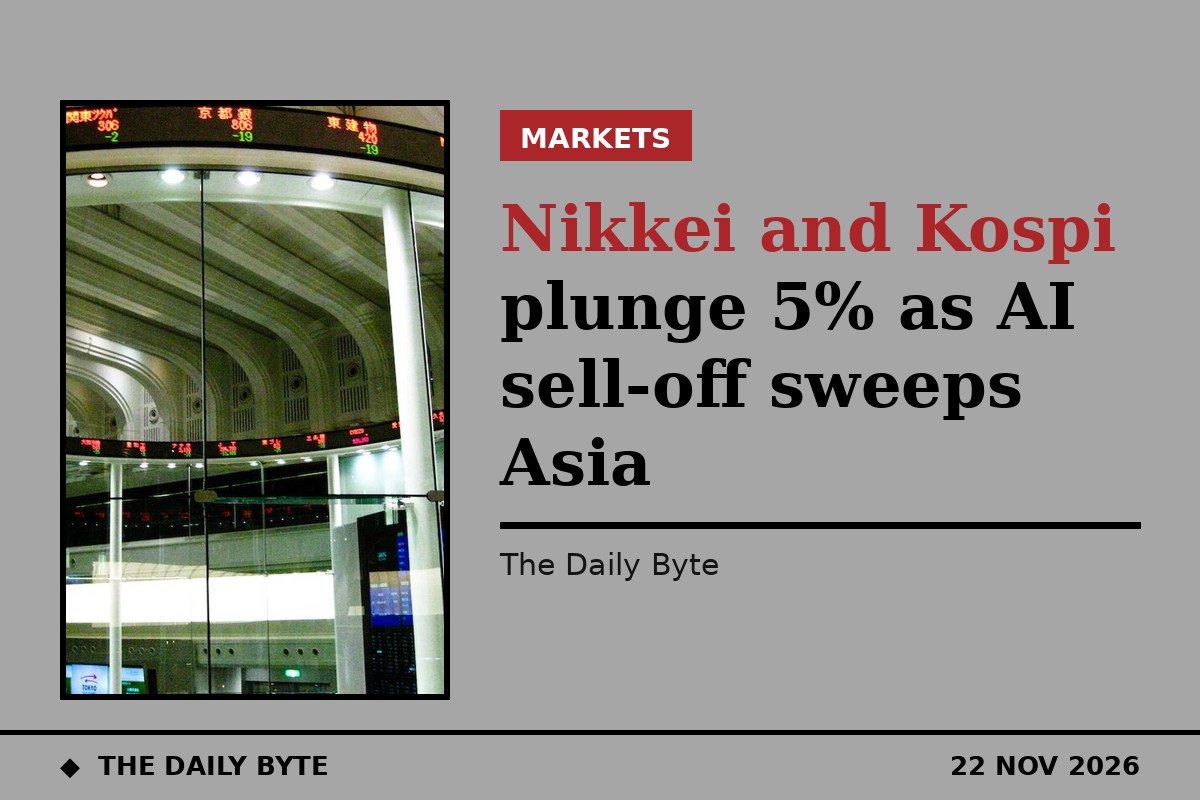
Asian stock markets suffered their worst week since March 2020 on Friday, 20 November 2026, as a global sell-off in artificial intelligence shares swept across Japan, South Korea and Taiwan. Japan's Nikkei 225 closed down 5.06% and South Korea's Kospi fell 5.21%, while Taiwan's Taiex plunged 6.63%.
The Nikkei closed at 56,436.65, down 3,007.56 points, its fifth-largest one-day point decline in history and its lowest close in about seven and a half months, according to BBN Times. The Kospi sank 5.21% to 4,869.96, closing below 4,900 for the first time in 10 months, Aju Press reported. The MSCI Asia-Pacific index fell for a seventh consecutive session.
Chip shares led the falls
The selling was concentrated in the semiconductor and AI supply chain. In Tokyo, SoftBank Group fell 14.48%, its worst day since August 2024, chip-testing equipment maker Advantest dropped 10.32% and Tokyo Electron lost 7.06%. In Seoul, Samsung Electronics fell 7.01% and SK Hynix lost 5.92%. The two memory makers alone account for roughly half of the Kospi's market value, so their falls drove most of the index's drop.
Hong Kong's Hang Seng lost 1.89% to its lowest close since April 2025, and the Shanghai Composite fell 1.22%. India's BSE Sensex was the striking exception, rising 1.08%.
Trading curbs triggered in Seoul
The pressure was strong enough to trigger emergency trading curbs in South Korea. The Korea Exchange halted programme selling for five minutes on the Kospi at 11:54 a.m. and on the Kosdaq around midday, the first such dual activation since 6 November. Foreign investors sold a net 1.13 trillion won, about $849 million, of Kospi shares, while institutions offloaded 951.3 billion won.
Japan's markets are closed on Monday for a public holiday, which added to the rush to sell before a three-day weekend in such a volatile market.
Why Asia fell so hard
The rout followed a sharp reversal on Wall Street on Thursday, when the Nasdaq swung from a gain of more than 2% to a loss of 2.25% in a single session. Investors are questioning whether the AI boom can justify the vast sums spent and borrowed to fund it, and fresh allegations about US chipmakers' compliance with export restrictions on China rattled semiconductor-heavy markets.
The Nikkei closed at a record 72,353.96 on 22 June 2026. Friday's close is about 22% below that level, which puts the index in bear-market territory by the conventional 20% definition.
Frequently asked questions
How far did the Nikkei fall on Friday? The Nikkei 225 closed at 56,436.65, down 5.06%, its fifth-largest one-day point fall in history.
Why did Asian markets fall so sharply? A reversal in US technology shares, doubts about AI infrastructure spending, a hawkish Federal Reserve and concerns about chip export rules combined to drive investors out of the region's semiconductor shares.
Was anywhere in Asia spared? India's BSE Sensex rose 1.08% on Friday, the main exception to the regional sell-off.