Nine EU states seek stricter refugee family reunion rules
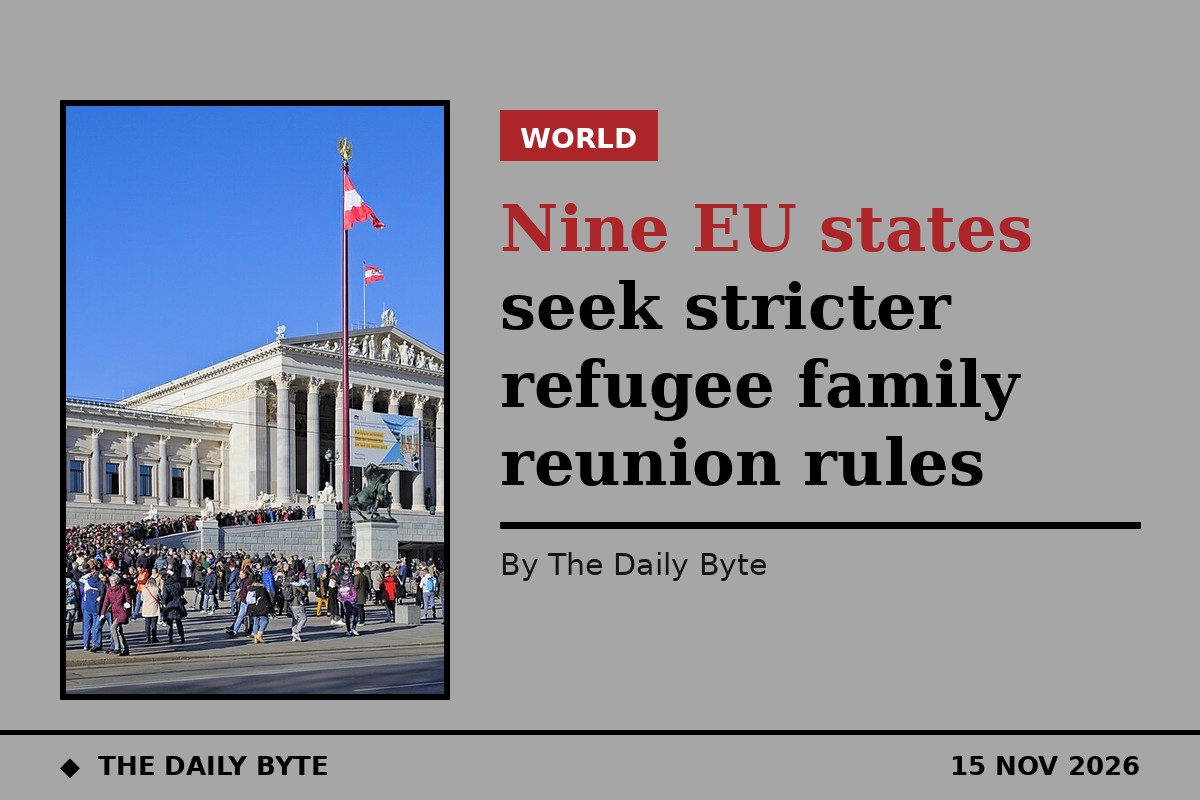
Nine European Union member states have jointly called for stricter rules on the family reunification of refugees, arguing that the arrival of family members is placing growing pressure on schools, housing and public services across the bloc.
The interior ministers of Austria, Bulgaria, the Czech Republic, Finland, Greece, Italy, Luxembourg, the Netherlands and Poland sent a joint letter to Magnus Brunner, the European Commissioner for Migration, urging the European Commission to revise the bloc's existing Family Reunification Directive. The letter was sent on Friday, 13 November 2026, and was obtained by the Austrian Press Agency, according to reporting by Die Presse.
The nine governments want a common European framework that would allow member states to introduce tighter restrictions on family reunification. They are seeking a review of the existing EU rules rather than setting out specific new restrictions for individual countries, and they say any restrictions should operate within a legally robust family reunification mechanism.
Pressure on schools and housing
The ministers argue that countries which have received large numbers of migrants are now facing additional challenges as refugees seek to bring their family members to Europe. They highlight the pressure on schools in urban areas in particular, where large numbers of newly arrived children have entered classrooms, some with little or no previous formal education.
Housing, kindergartens, healthcare services and labour markets are also struggling to cope with growing demand, the ministers say. Under current EU rules, refugees are generally entitled to reunification with their immediate family members, including spouses and minor children, provided the people concerned do not pose a threat to public security or public order.
Several EU countries have already introduced national measures to restrict family reunification. The signatories of the letter argue, however, that individual national policies are not enough and that a coordinated European approach is necessary, with changes to the existing directive to provide a clearer legal basis for restrictive measures.
Austria's quota at the centre of the debate
Austria, which led the initiative, has already taken significant steps in this direction. After suspending family reunification for more than a year, the Austrian government has recently introduced a quota system, with only 314 places allocated for this year and the following year.
Both the suspension and the quota system remain legally controversial, with their compatibility with existing law yet to be conclusively determined by the courts. Legal experts have questioned whether a quota on refugee family reunification can be reconciled with EU law, which guarantees an individual right to reunification, and Austria could face infringement proceedings from the European Commission.
The letter to Commissioner Brunner does not itself change the law. Any revision of the Family Reunification Directive would need to be proposed by the European Commission and agreed by EU governments and the European Parliament, a process that would take months at least. But the backing of nine member states, including some of the countries that receive the most asylum seekers, puts the issue firmly on the Commission's agenda as it works through the second year of the EU's migration pact.
Sources: Voice of Vienna and Bytes Europe.


