Ninth Circuit Blocks California Climate Disclosure
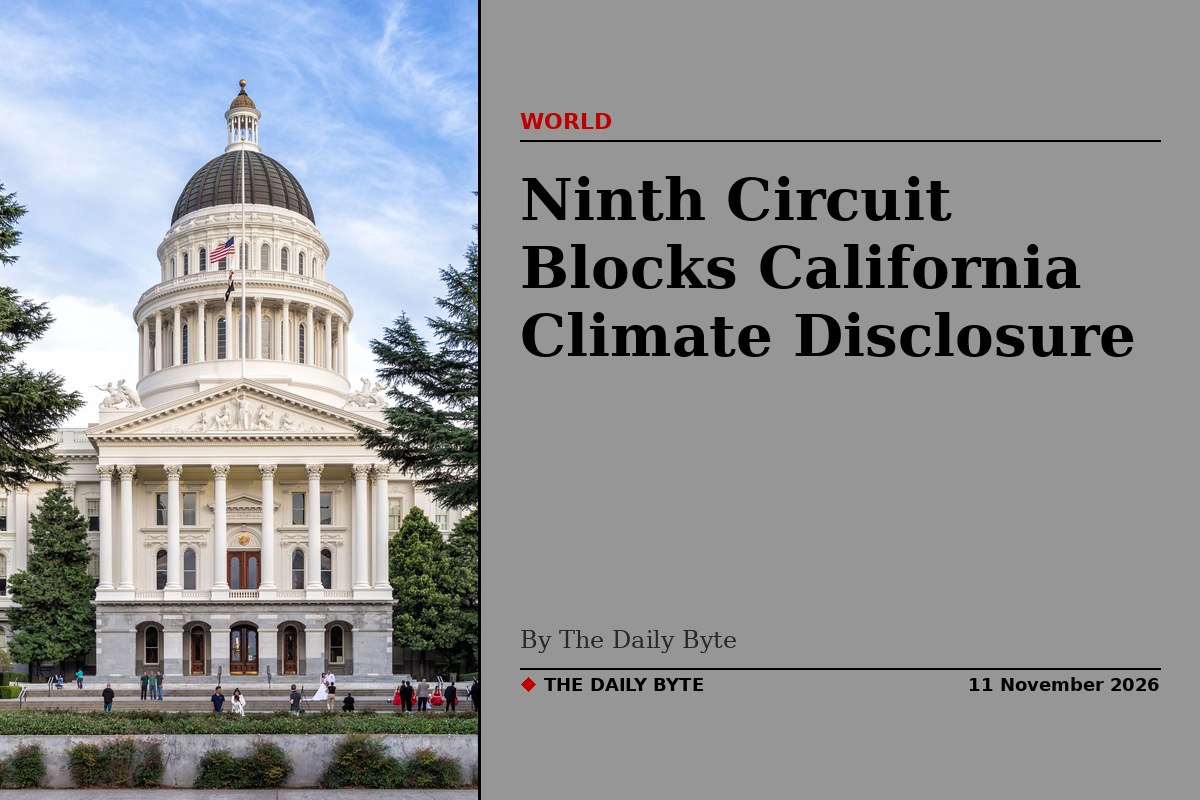
A federal appeals court has blocked key parts of California's first-of-its-kind climate disclosure laws, dealing a setback to the state's effort to force large companies to report their greenhouse gas emissions and climate-related financial risks.
On Monday, 9 November, a three-judge panel of the 9th US Circuit Court of Appeals in San Francisco ruled that two of the requirements likely violate the First Amendment, while allowing part of the emissions reporting regime to go ahead. The decision came one day before the first disclosures under the laws were due, according to Reuters.
What the court blocked
The ruling covers two laws signed by Democratic Governor Gavin Newsom in 2023, which made California the first US state to require the disclosures. Senate Bill 253, the Climate Corporate Data Accountability Act, requires companies with more than $1 billion in annual revenue that do business in California to report their greenhouse gas emissions each year. Senate Bill 261, the Climate-Related Financial Risk Act, requires companies with more than $500 million in annual revenue to report on their climate-related financial risks every two years.
The panel said California could enforce the parts of Senate Bill 253 covering a company's own emissions and emissions from the energy it buys, known as Scope 1 and Scope 2 emissions. Those first disclosures were due on 10 November 2026. But it blocked the requirement to report Scope 3 emissions, the indirect emissions produced across a company's supply chain by suppliers, customers and others, ruling that those disclosures were too loosely connected to the company's own operations to count as commercial speech.
It also blocked all of Senate Bill 261. The court said that law forced companies to share "value-laden" judgments on a "politically fraught" subject rather than simply providing factual information, and was therefore likely to fail. Circuit Judge Jacqueline Nguyen, an appointee of Democratic President Barack Obama, wrote for the court that while climate change will increasingly affect human activity, "the First Amendment, however, limits the government's ability to compel speech."
Who brought the case
The lawsuit was filed by the US Chamber of Commerce, the American Farm Bureau Federation and several California business groups, which argued that the laws imposed massive costs and compelled speech in breach of the Constitution. The California Air Resources Board, which administers the reporting regime, had drawn up a preliminary list of more than 4,000 US companies likely to be covered.
A district judge had refused to halt the laws, and the appeals court had already stayed enforcement of the financial risk law while the appeal was pending. Monday's decision, in Chamber of Commerce v. Sanchez, partly reverses that earlier refusal and sends the case back to US District Judge Otis Wright in Los Angeles, who must now decide whether the Scope 3 provisions can be separated from the rest of Senate Bill 253.
The decision is a preliminary one, not a final judgment on the merits, and the constitutional case continues in the district court. Circuit Judge Mark Bennett, an appointee of Republican President Donald Trump, partly dissented, saying he would have blocked both laws entirely.
Reaction and next steps
Business groups welcomed the ruling. Daryl Joseffer, president of the US Chamber Litigation Center, called it an "important victory" that halted the "most onerous" disclosure requirements, and said the Chamber would seek permanent injunctions. Travis Cushman, a deputy general counsel at the American Farm Bureau Federation, called the decision "a win for the little guys", arguing that large companies would otherwise have pressed small and mid-sized farms to supply them with emissions data.
California Attorney General Rob Bonta's office said it was evaluating its next steps, was pleased that part of the emissions disclosure law could be enforced, and remained committed to protecting Californians' access to climate data. According to ESG Today, the ruling places the laws in legal jeopardy just as the first reports were falling due, and leaves the future of the most far-reaching parts of the regime to the lower court.
The outcome matters well beyond California. Because the laws apply to any large company doing business in the state, they were set to become a de facto national reporting standard for thousands of American businesses. For now, companies must still report their direct emissions, but the supply-chain and climate-risk disclosures that would have reached deepest into their operations are on hold.


