Ninth Circuit Vacates Portland ICE Teargas Order
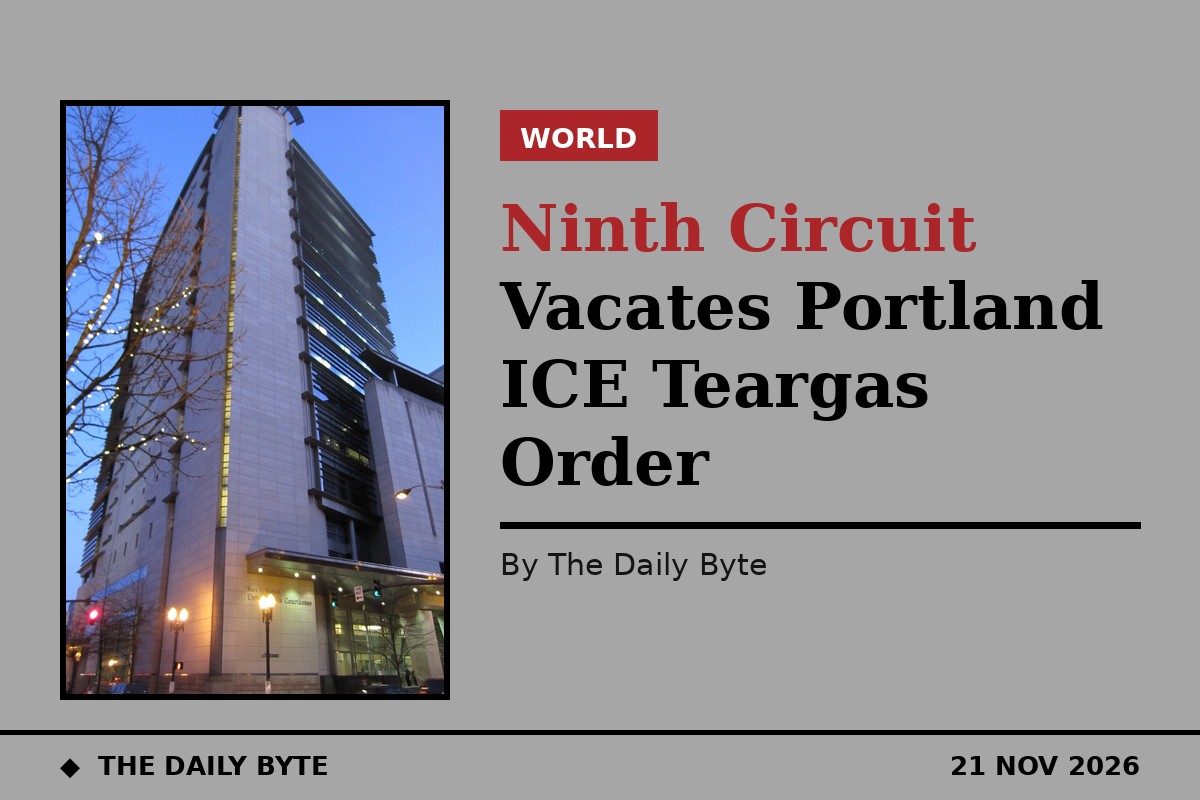
A federal appeals court ruled on 10 November that a lower court went too far when it restricted how federal agents could use tear gas and other crowd-control weapons against protesters outside an immigration enforcement building in Portland, Oregon.
The United States Court of Appeals for the Ninth Circuit vacated a preliminary injunction issued by Judge Michael H. Simon of the District of Oregon, along with a provisional class certification that had extended the order to everyone who protested or reported on demonstrations at the facility. The ruling was published, which makes it binding precedent across the Ninth Circuit, covering nine western states.
The case, Dickinson v. Trump, was brought by five people who attended demonstrations at the Immigration and Customs Enforcement building in Portland: Jack Dickinson, known at the protests as the Portland Chicken, Laurie and Richard Eckman, and freelance journalists Hugo Rios and Mason Lake. They sued the President, the Secretary of Homeland Security and the Department of Homeland Security, alleging that federal officers had used tear gas and pepper balls to punish them for exercising their First Amendment rights.
What the lower court had ordered
Judge Simon had barred federal agents from using chemical or projectile munitions unless the person targeted posed an imminent threat of physical harm, and from firing them at the head, neck or torso unless the officer was legally justified in using deadly force. He had also ordered agents to wear uniforms with more conspicuous and unique identifying markings, and provisionally certified a class covering all those who had peacefully protested or reported on demonstrations at the building in recent months.
The three-judge panel disagreed. Judge Kenneth K. Lee, writing for the majority and joined by Judge Eric C. Tung, held that the plaintiffs were not likely to succeed on their First Amendment retaliation claim. The panel said law enforcement officers may use non-lethal force to clear crowds and restore order without waiting until they face an imminent threat of physical harm, and that the record did not show an unwritten policy of retaliating against protected speech.
The panel also found the injunction overbroad and unworkable. It said the order wrongly extended relief to people who were not parties to the case, and that the uniform-marking requirement went beyond what a court could properly order. The provisional class failed the requirements for a class action, the panel said, because the claims did not share enough in common and the remedy could not be applied to the whole group at once. Judge Ana de Alba partly concurred and partly dissented.
A second injunction fell as well
The same panel also vacated a second preliminary injunction in a companion case, Reach Community Development v. DHS, brought by residents of an affordable housing complex next to the Portland facility. In that case, Judge Tung wrote that the residents had no substantive due process right to be free from crowd-control chemicals, and Judge de Alba dissented in full.
The rulings do not end the underlying lawsuits, which return to the District of Oregon, and they are not final judgments on the merits of the protesters' claims. In practical terms, little changed on the day of the ruling: the same panel had already stayed Judge Simon's injunction on 27 April, so it had not been in force while the appeal was pending. The protests at the centre of the case took place between June 2025 and February 2026, with at least 150 demonstrations staged outside the facility on South Macadam Avenue and crowds at times reaching several thousand people.


