Nordic-African ministers meet in Oslo, Ghana to chair 2027
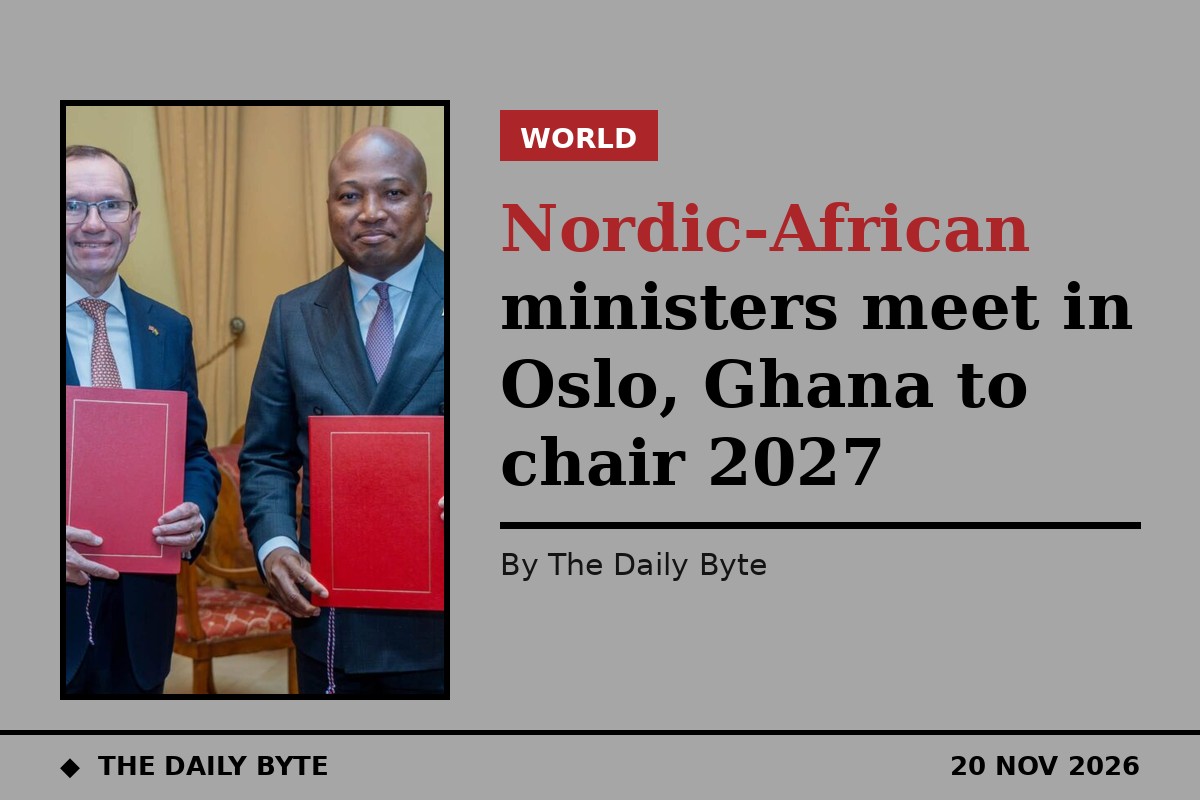
Foreign ministers from 35 African and Nordic countries ended two days of talks in Oslo on Friday, agreeing to push for deeper trade and investment ties, reform of global institutions and closer cooperation on artificial intelligence.
The Nordic-African Foreign Ministers’ Meeting, held on 19 and 20 November under the theme “Dialogue in an era of uncertainty. United for a prosperous future”, brought together ministers and high-level representatives from across Africa and the five Nordic countries, as well as the African Union Commissioner for Political Affairs, Peace and Security. It was hosted by Norwegian Foreign Minister Espen Barth Eide and Minister of International Development Åsmund Aukrust, and Norway presented a Chair’s Summary capturing the main themes of the discussions at its conclusion.
Trade, investment and cheaper finance
The meeting opened with a business forum that brought together 130 public and private sector participants to strengthen economic ties between African and Nordic countries. Participants called for African and Nordic countries to focus increasingly on mutually beneficial trade, investment and knowledge partnerships that support growth and local value creation.
Discussions focused on the need for predictable rules, effective institutions and more affordable finance, as well as ways to connect available capital with viable projects. Development finance institutions can help attract private investment by sharing risk and working with local investors and businesses, the meeting heard. Reducing the cost of capital and closing the gap between perceived and actual risk are also essential to getting more projects off the ground.
Future economic partnerships must advance the green transition, participants agreed. Climate change is driving more extreme weather worldwide, with increasingly severe consequences, and several African countries are among the hardest hit. Nordic-African partnerships on renewable energy, green business solutions, climate finance and adaptation offer significant potential to address these challenges while creating mutually beneficial opportunities. COP32 in Addis Ababa next year will provide a platform to advance these shared priorities.
A call for stronger African representation
Amid growing uncertainty and geopolitical fragmentation, participants said a fair multilateral system grounded in the United Nations Charter is vital to African and Nordic countries alike. Double standards and selective adherence to these principles risk undermining confidence in the multilateral system and weakening the basis for cooperation across regions.
There was also a clear emphasis on the need for reform. Participants stressed that global institutions must better reflect current political and economic realities, including through stronger African representation and more meaningful participation by all member states.
Artificial intelligence on the agenda
Artificial intelligence is developing rapidly, bringing new opportunities for development and innovation, but also new risks. At the meeting, African and Nordic countries discussed how to make better use of the technology while managing these risks, and how new partnerships can support closer cooperation and capacity-building.
In this context, reference was made to the Finnish-Norwegian Call for Control of Frontier AI Models, which calls for stronger safety measures and international coordination to manage emerging risks related to frontier models.
Ghana to chair the forum in 2027
Ghana’s Foreign Minister, Samuel Okudzeto Ablakwa, was elected to chair the Nordic-African Foreign Ministers’ Meeting in 2027, securing a leadership role for the country in the annual diplomatic forum. He is expected to succeed Norway’s Espen Barth Eide, who assumed the chairmanship at this year’s meeting in Oslo, following Zimbabwe’s Amon Murwira. The forum, which has been held since 2001, is hosted alternately in Africa and the Nordic region.
On the sidelines of the meeting, Norway pledged to collaborate with President John Dramani Mahama during his African Union chairmanship to advance Africa’s priorities on debt relief and global financial reforms. The commitment was conveyed during a meeting between Eide and Ablakwa on Thursday, 19 November. Norway also expressed readiness to work with Mahama’s chairmanship on health sovereignty under the Accra Reset initiative, United Nations reforms, climate justice, the protection of the rules-based international order and peacekeeping operations. Ablakwa also co-chaired the Nordic-Africa Business Conference, a flagship event of this year’s ministerial gathering.
Ministers from Algeria, Angola, Benin, Botswana, Côte d’Ivoire, the Democratic Republic of Congo, Egypt, Eritrea, Ethiopia, Ghana, Kenya, Liberia, Libya, Malawi, Morocco, Mozambique, Nigeria, the Republic of Congo, Rwanda, Senegal, Sierra Leone, Somalia, South Africa, South Sudan, Tanzania, Togo, Tunisia, Uganda, Zambia and Zimbabwe took part, alongside Denmark, Finland, Iceland, Norway and Sweden.


