Norway Pauses Data Centre Grid Links in Licensing Squeeze
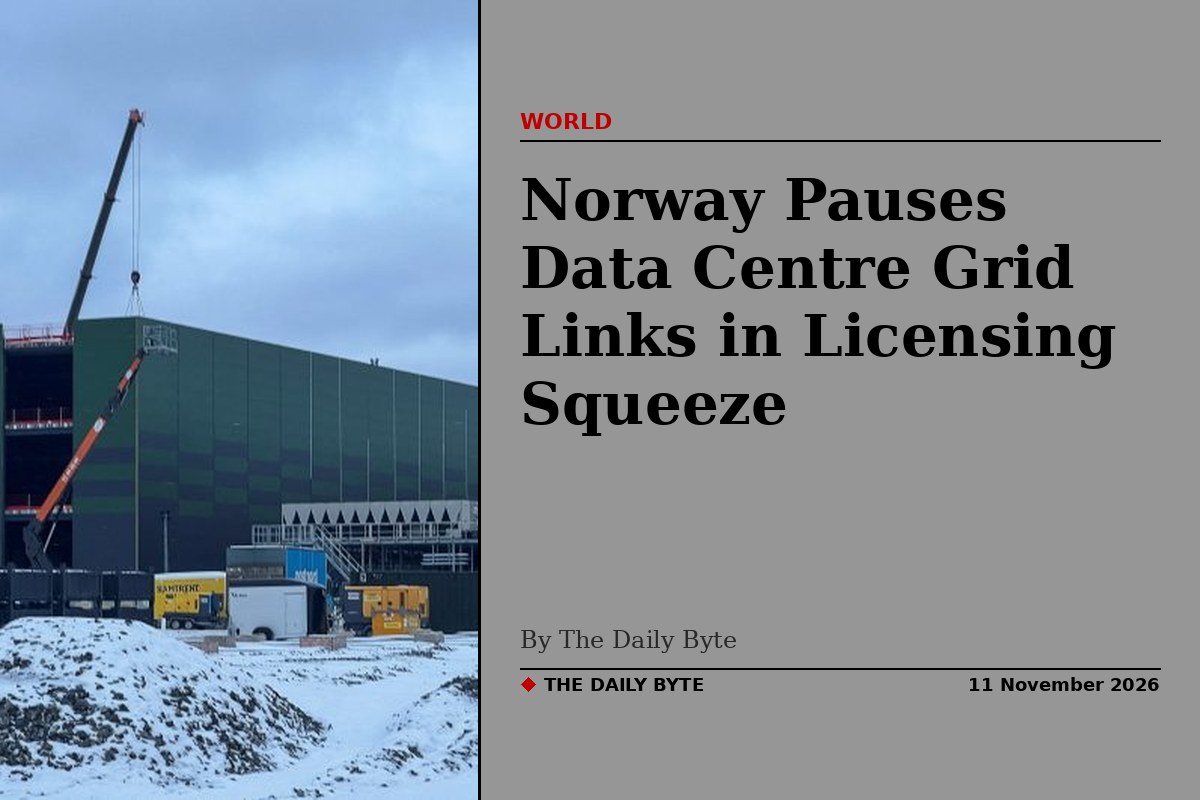
Norway has paused new electricity grid reservations for data centres and announced plans to license the sector, in the clearest sign yet that Europe's race to build artificial intelligence infrastructure is colliding with the physical limits of national power grids.
The double announcement came on Monday 9 November 2026. Statnett, the state-owned operator of Norway's national transmission grid, said it would stop accepting new capacity reservations from data centres with immediate effect, while the government said it would introduce a licensing scheme to decide which data centres the country actually wants.
What Statnett has paused
The pause covers new reservations of grid capacity for data centres and the processing of some technical approval applications that projects need before they can connect. It also covers applications already received for facilities that would connect directly to the 420-kilovolt transmission network, the high-voltage backbone of the Norwegian grid.
Statnett expects the measures to remain in place until no later than 1 August 2027, while it develops new functional requirements for how large computing facilities behave on the network. The requirements will go out for consultation and must be approved by Norway's energy regulator, the Norwegian Energy Regulatory Authority, known as RME.
The operator stressed that the move is not a general ban on new data centres. Existing connections are unaffected, facilities that have already secured the necessary technical approvals can still connect, and some applications already being processed for regional-network projects due to enter operation in the near future will continue.
The numbers behind the decision
Statnett's own figures explain why it acted. About 800 megawatts of data centre demand is already connected to the Norwegian grid, a further 4,200 megawatts has secured capacity reservations, and 9,100 megawatts is waiting in the connection queue.
Energy Minister Terje Aasland said Statnett had received applications for 26,000 megawatts of new capacity this year alone. The government wants faster development of power and grid capacity, he said, but considers it neither desirable nor possible to build enough to satisfy every data centre seeking to establish itself in Norway.
Norway's cheap, almost entirely hydropower electricity has made it a magnet for data centres, and the surge in AI computing has sharply increased the size and speed of new requests. Statnett says the electrical characteristics of very large, rapidly changing computing loads create risks for system stability that the current rules were not designed to handle.
Licensing to favour essential services
The licensing scheme, announced the same day by Digitalisation Minister Torgeir Micaelsen and Aasland, is the longer-term half of the response. Under the plan, data centres would need a licence to operate in Norway, covering both new and existing facilities, with the main features expected to be in place in autumn 2027.
Ministers said the aim was to gain control over the sector's growth and ensure the country gets the data centres it actually needs. Priority would go to facilities serving essential national functions, including the police, emergency preparedness, health services and critical infrastructure such as mobile networks and the financial system. Requirements under consideration include support for digital security and preparedness and for AI computing capacity needed in Norway, the Nordic region and Europe.
Cryptocurrency mining, by contrast, will not count as socially useful and is explicitly excluded from the favoured category. New data centres will also be expected to bear more of the grid and system costs they create, and the government wants to replace the first-come, first-served principle for allocating scarce capacity.
What happens next
Statnett will develop the new technical requirements in consultation with Norwegian authorities and will consider approaches being adopted by other Nordic transmission system operators and by ENTSO-E, the European association of system operators. Until the requirements are approved and the licensing scheme is in place, prospective developers cannot reserve new grid connections for data centres in Norway.
The decision puts Norway among the first European countries to ration grid access for data centres rather than simply building more capacity. With AI demand still rising across the continent, other governments facing similar pressures on their grids will be watching closely to see whether licensing, rather than open access, becomes the new model.
Sources: London Daily News, 10 November 2026; Environment Energy Leader, 10 November 2026. Checked against both sources on 11 November 2026.


