Novartis Chief Rejects AI Cancer Cure in a Decade
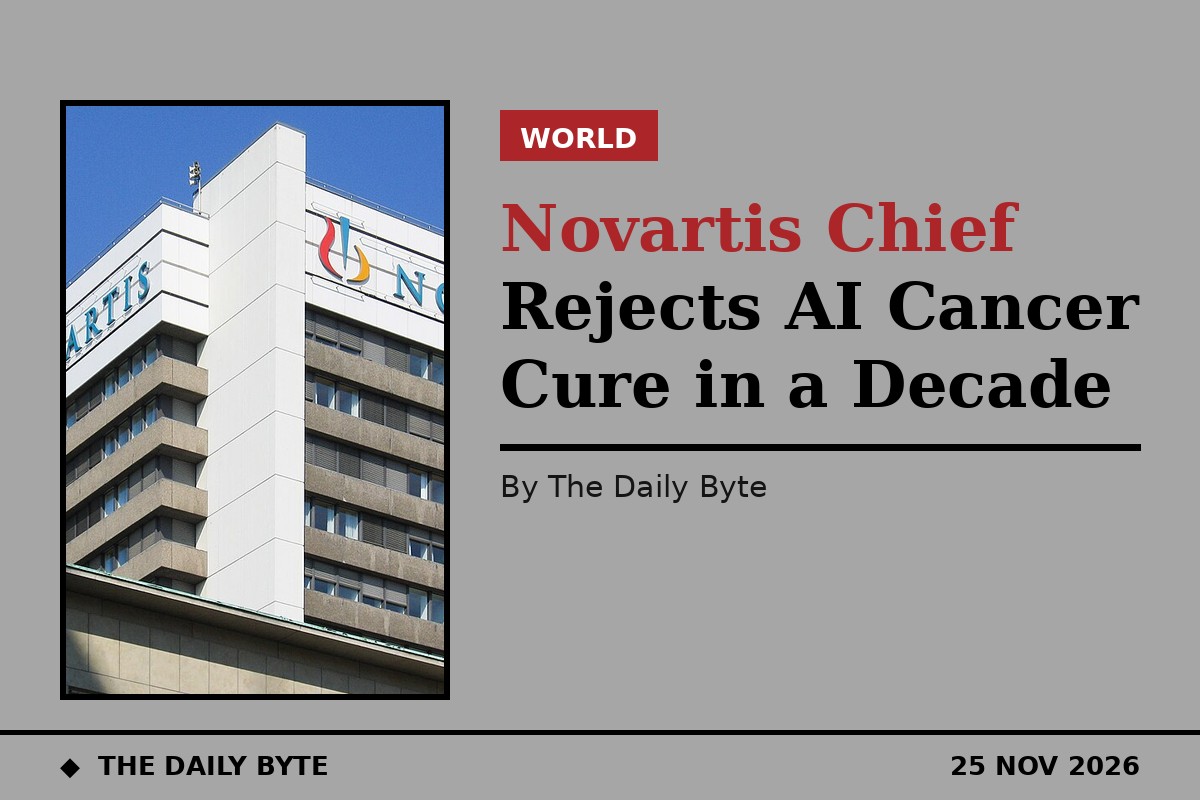
The head of Novartis has rejected the idea that artificial intelligence will cure cancer within five to ten years, arguing that it will take a decade for AI to cut just four years from the time it takes to develop a new drug. Vas Narasimhan, the Swiss drugmaker's chief executive, said the technology's real contribution is likely to sit between the boldest predictions from the tech industry and the caution of drugmakers.
Narasimhan, who joined Anthropic's board in April, made the comments in an interview with the Financial Times published on 23 November, and at a Novartis investor event in London on 19 November, the same day Anthropic staged its stock market debut in New York.
Three kinds of delay
Narasimhan broke drug development bottlenecks into three categories. Information latency, which concerns gathering data to make decisions, currently takes roughly a year in the standard 12-year development timeline, and he expects AI to drive that down to close to zero. Operational latency, which covers designing and setting up clinical trials, drafting regulatory paperwork and running the experiments, accounts for another two and a half years that AI can steadily compress.
Biological latency, however, is the hardest problem to solve, he argued. AI drug developers are already good at designing better molecules, but getting better at solving biological questions will take longer. On that basis he predicts AI could cut the full timeline from an average of 12 years to eight within a decade, and lift the share of drug candidates that succeed in human trials from 8 percent to 12 percent.
His central point is how little is known about the human body. He told the Financial Times that scientists understand only about 5 percent of what goes on inside it, compared with a far deeper understanding of programming and language, the domains where AI models learn and predict most effectively.
What AI is already doing at Novartis
Novartis is already using AI across its development work, and Narasimhan pointed to concrete gains. About 90 percent of all content in Novartis development is now AI-assisted, cutting clinical report timelines by 25 percent, while statistical programming in the company's 2026 trials got 90 percent faster. Statisticians can now analyse positive and negative trial results in a day or days rather than months, he said.
Using an in-silico trial planning platform, Novartis can run thousands of enrolment simulations in minutes rather than a few scenarios in weeks, and the simulations are 50 percent more accurate in predicting enrolment timelines than the company's previous process. The biggest time savings so far have come in early drug discovery, before a drug is tested in humans, where AI could shave up to two years off a phase that usually takes four.
Why biology is different
The pushback is aimed at predictions from AI industry leaders, including Anthropic chief executive Dario Amodei, who has suggested that cancer, Alzheimer's, heart disease and mental illness could become relics of the past within a decade. Narasimhan's position echoes Eli Lilly chief executive David Ricks, who responded on 11 November that such an outcome would be amazing but was not likely, because the map of biology is still largely a blank page.
Fiona Marshall, Novartis' president of biomedical research, made the same point at the investor event. She said tools such as AlphaFold had revolutionised protein structure prediction, but converting a promising molecule into an approvable medicine still requires navigating human biology, which researchers are not very good at even with AI. Many outputs from AI models still fail to translate into cell models, let alone into the clinic, which is why Novartis insists on lab-in-the-loop testing to validate what the models produce.
Novartis believes its advantage is data. The company has spent a decade structuring its internal research data, building an ontology it calls data42, and holds a vault of more than 150 petabytes of research data gathered over 25 years of experiments. Bringing together datasets from cell-based profiling to clinical data has already helped it identify three novel neurodegeneration targets now advancing in its later-stage preclinical programme.
The wider argument
Narasimhan's argument is not that AI will fail, but that the tech industry approaches biology with an engineering mindset while clinicians can see how little is known.
He also pointed to a possible shortcut. If drugmakers can convince regulators that they can reliably predict how a drug will behave in a human body, agencies might relax trial requirements and open the door to much faster development. Until then, he said, progress is likely to be steady and incremental, with AI compressing the work around discovery while the biology itself takes a decade or more to master.


