NSA Warns Malware Can Hijack Military ID Cards
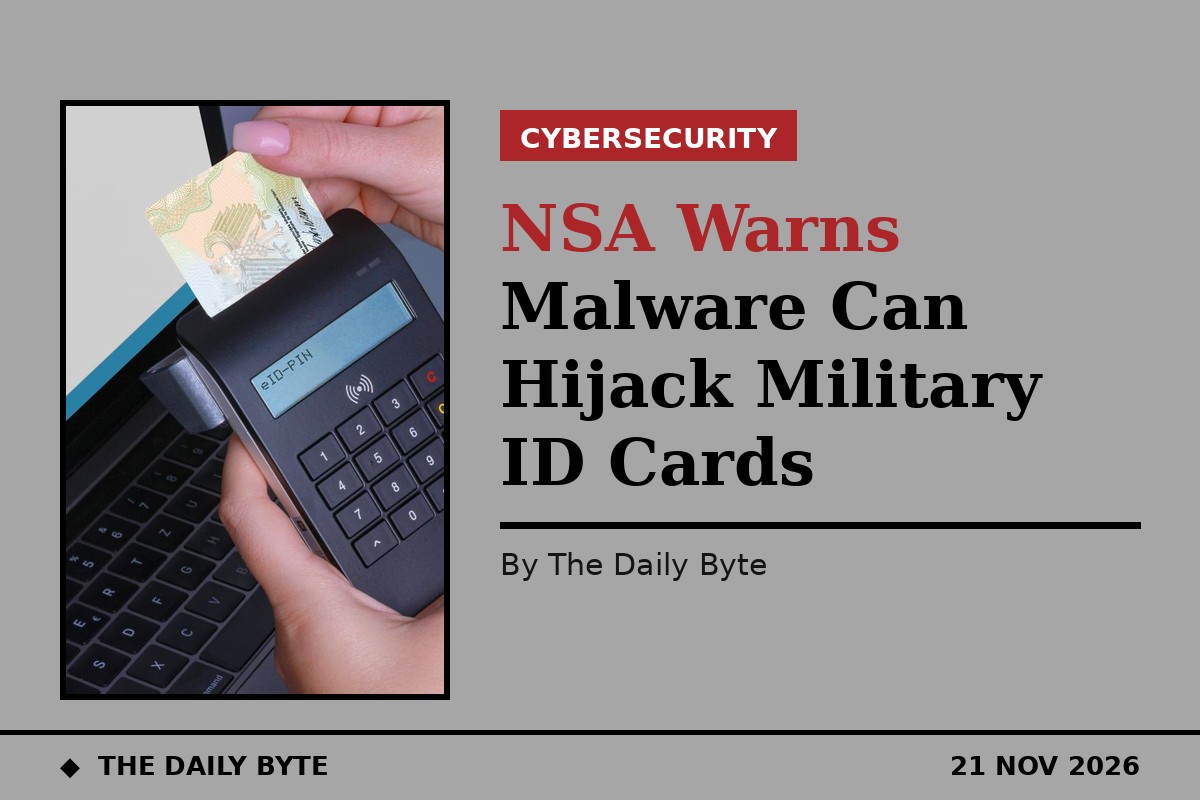
The US National Security Agency has warned that malware can hijack a military identification card left in a computer's card reader, turning an unattended desk into an open door to federal systems. The warning, published by the Department of War on 16 November 2026, says attackers have built malicious software that targets personal computers when a Common Access Card, known as a CAC, is left inserted in a connected reader.
According to the warning, the malware records the cardholder's PIN as it is typed and then uses the credentials on the inserted card to authenticate to federal and Department of War websites. The access lasts for as long as the card stays in the reader. The credentials themselves cannot be pulled off the card, the agency said. The attack works by borrowing the live session while the card is present, not by copying what is stored on it.
How the attack is thought to work
The NSA did not name a specific malware family, a victim, or a discovery date, and it attributed the activity to no particular actor. It said infection most likely happens through targeted phishing, or through a watering-hole attack, a compromised website that personnel regularly visit, probably by exploiting a known, unpatched vulnerability. In other words, the card reader is the prize; the phishing email or the booby-trapped site is the way in.
Most Department of War employees use government-issued computers, but many also keep card readers attached to personal machines for after-hours email and CAC-enabled websites. That mixed use is the gap the warning is aimed at. A personal computer without the department's protections is a softer target, and a card left in its reader after a session ends stays live for anything that can reach it.
What the NSA advises
The agency, together with the department's chief information officer, advises personnel to limit CAC use on personal computers and to remove the card whenever they step away from the machine. It also repeats the basics that make this kind of attack harder: keep operating systems, applications and security software updated, and treat suspicious emails, links, websites, advertisements, chats and text messages with caution. The warning points to the department's Zero Trust Strategy as the wider defence, a model that checks every access request rather than trusting a device just because it is inside the network.
A familiar pattern from 2012
The technique is not new. In 2012, researchers at AlienVault described a campaign called Sykipot that used spear-phishing emails carrying a malicious PDF to infect computers, then waited for the victim to insert a smart card and type a PIN, using the card to reach protected systems in a way that was hard to tell apart from legitimate use. At the time, The Register reported that the campaign's authors were believed to be based in China. That history is background only. The 2026 warning names no attacker, and nothing in it ties the current activity to Sykipot or to any country.
One naming note: the Department of War is the Pentagon's secondary name for the Department of Defense, adopted under a September 2025 executive order. Defense remains the department's statutory name. The warning itself changes nothing about the cards' security design. It is a reminder that the strongest credential in the building is only as safe as the computer it is plugged into, and the habit of leaving it there.