NSE Deploys Liquid Cooling for AI, Eyes 224 GPUs
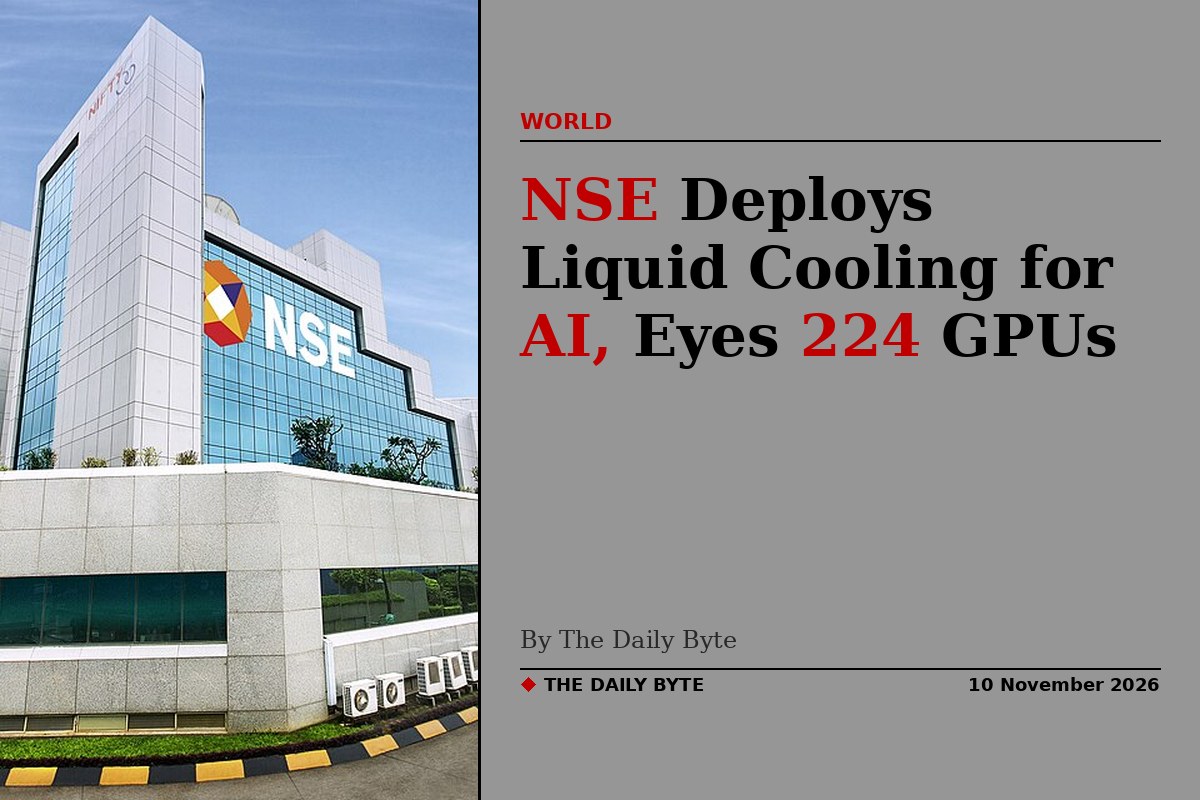
India's National Stock Exchange (NSE) has deployed direct-to-chip liquid cooling at its on-premises data centre to support its growing artificial intelligence workloads, and plans to expand its graphics processing unit (GPU) capacity to more than 80 units during the current quarter.
The exchange announced the deployment on Monday, 9 November 2026. The cooling infrastructure has been designed to support up to 224 GPUs across high-density racks, giving NSE room to keep expanding as its AI applications grow. NSE described the installation as the first deployment of its kind in Indian capital markets.
Why liquid cooling matters for AI
AI workloads place far heavier demands on computing density, power and cooling than ordinary trading systems. Direct-to-chip liquid cooling carries heat away from processors more efficiently than air cooling, allowing more powerful hardware to run in the same space without overheating.
That matters for an exchange, where systems must run continuously and reliably. NSE said the new set-up provides a scalable cooling architecture for high-density GPU computing, and that the on-premises location lets it keep complete control over its AI data, computing resources and access. The exchange said that control would support its security governance framework and compliance with applicable regulatory requirements as AI adoption expands.
What NSE's leaders said
Viral Mody, executive director at NSE, said the exchange was investing in advanced technologies to strengthen operational excellence, enhance efficiency and promote responsible resource use. He said the liquid cooling deployment would help NSE prepare for evolving computing needs while advancing a more energy-conscious technology ecosystem.
Sampath Manickam, the exchange's chief technology officer, said AI was driving a fundamental shift in technology infrastructure, with significantly higher requirements for computing density, power and cooling. The DCLC deployment provides a scalable and energy-efficient foundation for high-density GPU computing, he said, adding that it strengthens NSE's readiness for the next generation of AI workloads.
What comes next
NSE has already deployed multiple GPUs and will pass 80 during the current quarter, with the infrastructure built to hold up to 224. The exchange also plans to extend the liquid cooling technology to its co-location data centre in the near future, based on the requirements of market participants.
The exchange has not disclosed the cost of the deployment, the GPU models involved or the cooling vendor. The immediate milestones are the expansion beyond 80 GPUs this quarter and the later extension to the co-location site, where brokers and trading firms house their own systems close to the exchange.
The move places NSE among the exchanges investing directly in AI infrastructure rather than relying only on public cloud capacity, keeping its most sensitive computing inside its own data centre in Mumbai.


