Nvidia Alpamayo 2 Edge self-driving AI for cars
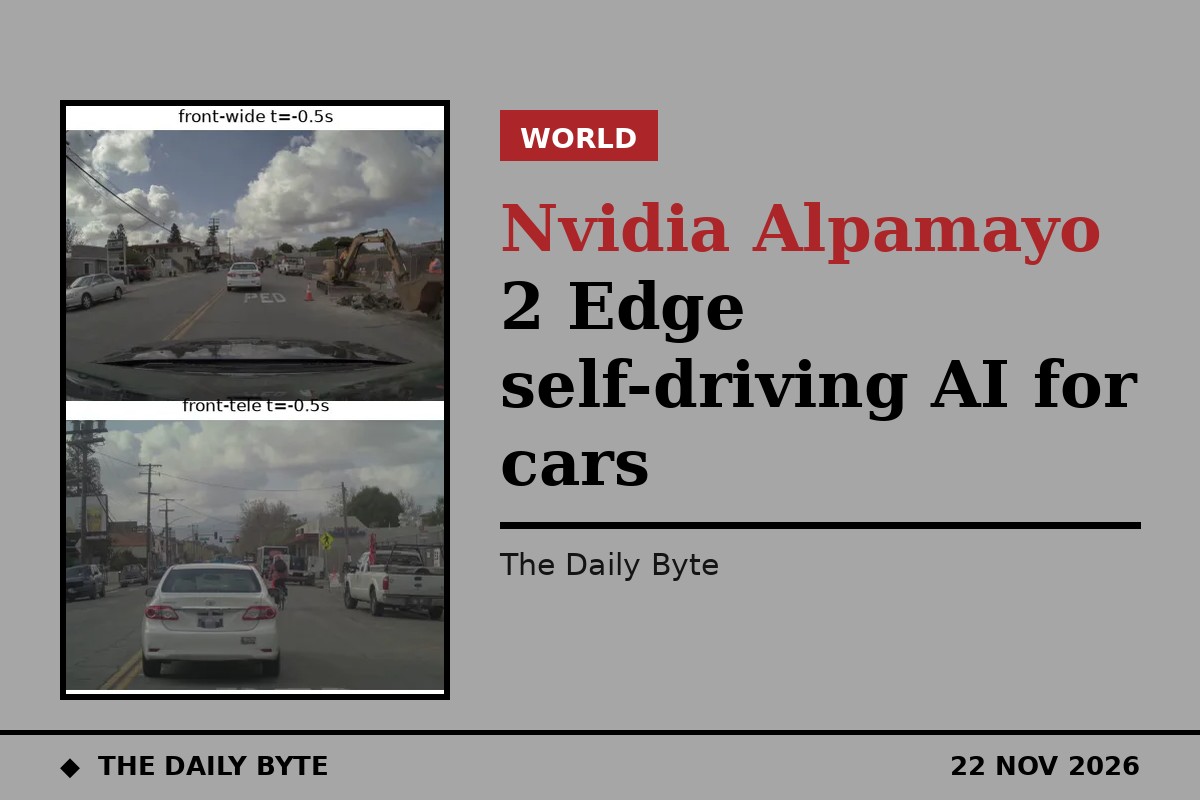
Nvidia has released Alpamayo 2 Edge, a compact self-driving AI model small enough to run in real time inside a car. The 2-billion-parameter model looks at a vehicle's surround cameras, plans the path ahead and explains its driving decisions in plain language.
The model is the in-car member of Nvidia's Alpamayo family, next to the much larger 34-billion-parameter Alpamayo 2 Super, which is intended for driving prediction, scene understanding, auto-labelling and training smaller models. Nvidia first announced Alpamayo 2 Edge in its Hyperion announcement on 21 October 2026, and released the model weights on Hugging Face on 10 November 2026. Nvidia's technical blog has now set out how the model runs within the compute and latency limits of onboard hardware.
How Alpamayo 2 Edge works
Alpamayo 2 Edge is a vision-language-action model, meaning a single AI system sees the road, reasons about it in words and outputs a driving path. It is built on the 2-billion-parameter Nemotron-based reasoning backbone of Nvidia Cosmos 3 Edge, paired with a diffusion action expert that produces the vehicle's actions.
The model takes in surround-camera video, temporal context, ego-motion history and navigation text, and turns them into future driving trajectories together with what Nvidia calls Chain-of-Causation reasoning: a short explanation of what it sees and why it is acting. It can also answer free-form questions about a driving scene.
The clever part is adaptive reasoning. Alpamayo 2 Edge only reasons out loud when a situation calls for it. During routine driving, it outputs a simple token instead of a full reasoning trace, which reduces unnecessary token generation and conserves inference compute. When a scene needs it, the model writes out its reasoning in full.
Built for the car, not the data centre
The model is designed for real-time operation on Nvidia DRIVE AGX Thor, the company's in-car computer, rather than a data-centre GPU. With Nvidia's optimisations, the model goes from camera images to a planned trajectory in 160 to 190 milliseconds on DRIVE AGX Thor, depending on how much reasoning it does.
To run at real time on Thor, the model must be further inference-optimised. Nvidia's Alpamayo Developer Hub includes the recipe for the deployment workflow: stage the checkpoint, calibrate FP8 scales, export ONNX graphs, build TensorRT engines with TensorRT Edge-LLM plugins, and run the Python harness. The reference configuration was measured on DRIVE AGX Thor-X with DRIVE OS 7.2.7.0, CUDA 13.4 and TensorRT 11.3.1.9.
Partner Embedl said it got Alpamayo 2 Edge running at 10 Hz, or 10 plans per second, on AGX Thor in less than 48 hours. The model was trained on roughly 115,000 hours of multi-camera driving video with about 3.7 million Chain-of-Causation reasoning traces, according to the model card on Hugging Face, where the weights are published under the OpenMDW-1.1 licence and the source code under Apache License 2.0.
How it scored against a bigger rival
Nvidia compared Alpamayo 2 Edge with Alibaba's 4-billion-parameter Qwen-Drive-1.0, a model twice its size. In Nvidia's AlpaSim simulator, Alpamayo 2 Edge went 15.15 kilometres between at-fault incidents, against 0.25 kilometres for Qwen-Drive-1.0, roughly 60 times farther. Its open-loop trajectory prediction was also better, with a minimum average displacement error of 0.53 metres against 1.68 metres.
These results come from Nvidia's own testing, mostly in simulation, rather than independent road testing, so they should be read as the company's own benchmark claims. Early partner feedback has been positive: one partner said the model kept its lane in more than twice as many simulation runs as the earlier Alpamayo 1.5 and planned roughly twice as fast out of the box, while another said it went from receiving the model to running its first tests on a real vehicle within a few days.
Judging the reasoning, not just the driving
Nvidia also published AlpaJudge, a human-calibrated evaluation and reward model used in Alpamayo 2 Edge development to evaluate reasoning traces, select higher-value training data and provide reinforcement-learning rewards. It comes in two variants: a reference-based version that measures agreement with a supplied reference answer, and a reference-free version that scores a rationale against synchronised camera frames and driving context.
The idea is that trajectory metrics alone only describe how a model plans or drives. Reasoning evaluation adds another dimension: whether the model's explanation identifies the relevant scene context and supports the decision it describes. Developers can use AlpaJudge to run the judge on a sample, select training examples that expose useful learning opportunities, and use human-aligned reasoning scores as rewards for post-training.
Frequently asked questions
What is Nvidia Alpamayo 2 Edge? It is a 2-billion-parameter reasoning vision-language-action model for autonomous driving that plans trajectories and explains them inside the vehicle, designed to run on Nvidia DRIVE AGX Thor.
How fast does Alpamayo 2 Edge run? Nvidia reports 160 to 190 milliseconds from camera input to trajectory output on DRIVE AGX Thor, and partner Embedl reached 10 plans per second on the hardware in under 48 hours.
Is Alpamayo 2 Edge open? Yes. The weights are published on Hugging Face under the OpenMDW-1.1 licence, with the source code under Apache License 2.0, along with deployment recipes and evaluation tools.
What is Chain-of-Causation reasoning? It is Nvidia's term for the short explanation the model produces alongside a driving trajectory, setting out what it sees in the scene and why it is acting that way. The model only produces a full reasoning trace when the scene calls for it.
Source: NVIDIA Technical Blog. Model card: Hugging Face.


