Nvidia Speeds FLUX 3 Image Generation Up to 4.45 Times
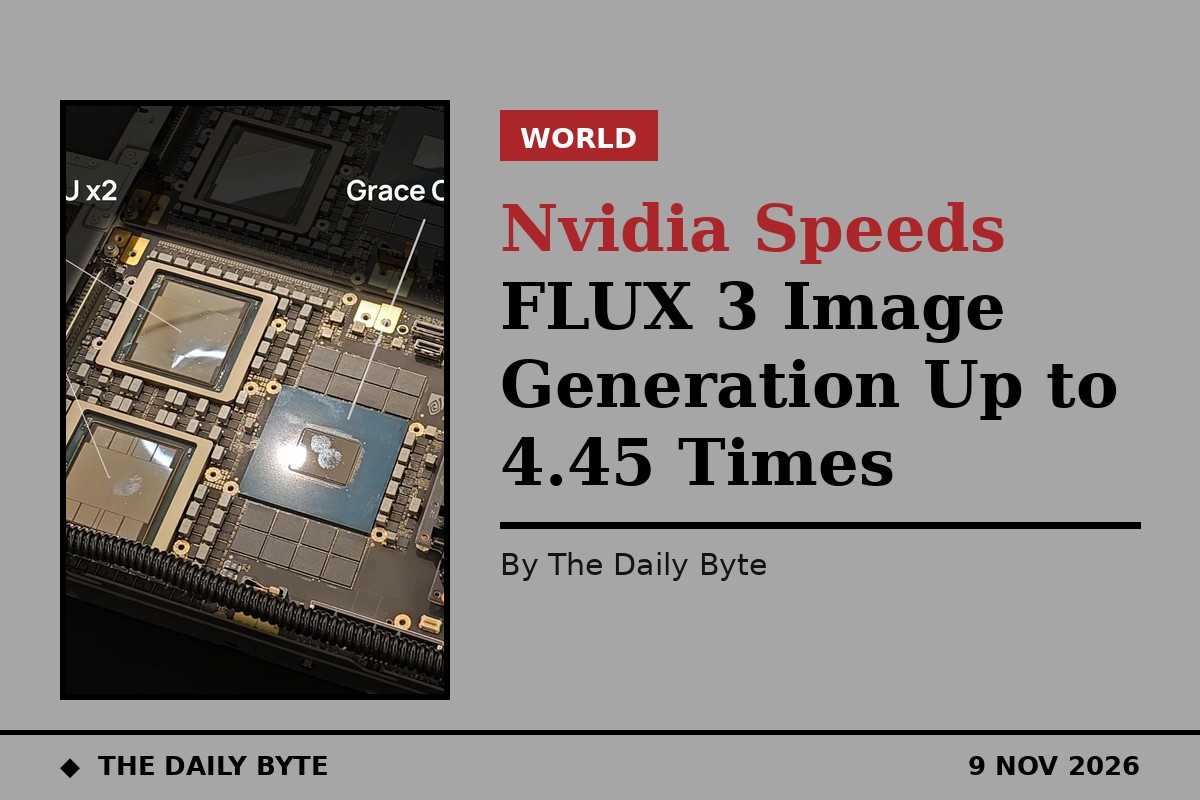
Nvidia has published benchmarks showing its TensorRT LLM VisualGen runtime speeding up Black Forest Labs' FLUX 3 Image Klein image model by up to 3.46 times for text-to-image generation and 4.45 times for image-to-image generation, the company said in a technical tutorial published on 6 November 2026. The tests ran at 2048 by 2048 resolution on a single Nvidia B200 graphics processor.
FLUX 3 Image Klein is an image generation and editing model from Black Forest Labs, released on 15 October 2026. Nvidia says the model was trained on its GB200 NVL72 systems and optimised for its graphics processors. It comes in Base and distilled checkpoints for different latency and quality needs, and it uses Qwen3-VL-4B-Instruct to condition prompts, a diffusion transformer to refine image data, and an autoencoder to encode and decode images.
Where the speed comes from
TensorRT LLM VisualGen is a dedicated runtime inside TensorRT LLM for diffusion models. The tutorial combines several optimisations: fused kernels, multi-GPU parallelism, FP8 and NVFP4 low-precision number formats, caching, and attention optimisations. Against uncompiled BF16 inference, the combined package cut Base text-to-image generation from 22.36 seconds to 6.46 seconds, and image-to-image generation from 54.64 seconds to 12.28 seconds.
Looked at step by step, the Base configuration uses 50 denoising steps with a classifier-free guidance scale of 3.5, taking 14.70 seconds for text-to-image and 40.29 seconds for image-to-image before the extra optimisations. The distilled version uses 16 steps without classifier-free guidance, finishing the same tasks in 2.71 seconds and 7.48 seconds. Denoising dominates the work, accounting for about 97 per cent of the time in the Base configuration. NVFP4 alone delivered up to 1.62 times faster text-to-image and 1.58 times faster image-to-image generation than BF16.
Multi-GPU and workstation results
On an eight-GPU Nvidia DGX B200 system, median Base text-to-image latency fell from 14.90 seconds to 3.00 seconds, and distilled latency from 2.73 seconds to 1.08 seconds. On a single RTX PRO 6000 Blackwell Server Edition graphics processor, the gains were between 1.73 and 3.25 times. The tutorial notes that the individual speed factors do not simply multiply, because each is measured against a different baseline.
What the numbers do not show
All of the timings are Nvidia's own, measured on Blackwell hardware, and they come with limits that matter. The averages come from 10 requests after two warm-up runs, with a fixed seed, and the tutorial gives no run-to-run spread. The reported latencies exclude Black Forest Labs' prompt upsampler, which the model card recommends using. Faster attention and caching settings also change the output: measured with LPIPS, a perceptual distance where lower means closer to the unoptimised output, some settings scored 0.033 while others reached 0.151 to 0.161, meaning visibly different images.
For users, the practical point is narrower than the headline. The speedups apply to this specific Nvidia setup, and results on other hardware may differ. But for studios and developers already running Blackwell graphics processors, the tutorial shows that image generation at print-scale resolution can run several times faster without changing the model itself, with the trade-off being small shifts in the finished image.