Nyana rooiwalensis: 400kg dinosaur found in South Africa
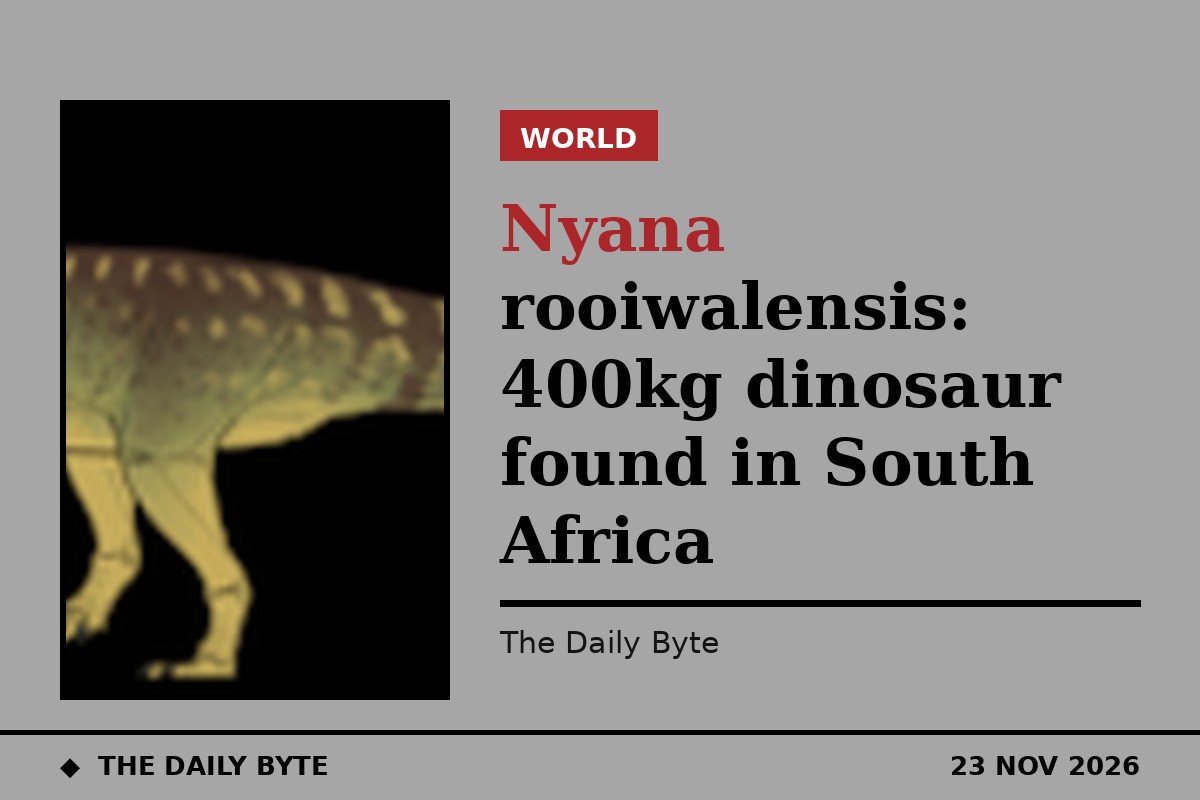
A new dinosaur species that weighed about 400 kilograms while still a youngster has been identified from a near-complete skull found in South Africa's Eastern Cape. The species, named Nyana rooiwalensis, lived more than 200 million years ago and is described in a paper published in the journal Royal Society Open Science on 11 November 2026.
Nyana belonged to the sauropodomorphs, the group of dinosaurs that eventually gave rise to enormous, long-necked giants such as Brachiosaurus and Diplodocus. What makes the discovery particularly interesting is that it dates back to the Late Triassic, a time when these early dinosaurs were evolving and diversifying. Fossilised skulls of sauropodomorphs of this age are rare, particularly in southern Africa.
A skull scanned with powerful X-rays
The fossil material was collected in 2018 from outcrops of the lower Elliot Formation near Qhemegha village in the Sterkspruit District, about two kilometres north of the village of Gcina in the Rooiwal Tribal Area of Eastern Cape Province. The specimen is housed at the Evolutionary Studies Institute at the University of the Witwatersrand, where it is permanently accessioned as specimen BP/1/8468.
The holotype includes a partial articulated skull with associated disarticulated fragments, the posterior half of the right lower jaw, vertebrae from the neck, back and tail, and parts of the forelimb and hindlimb. It is the first well-preserved, near-complete skull to be recovered from the lower Elliot Formation, and the preserved skull measures 21.3 centimetres, including a largely intact braincase, the palate and a hyoid, the small bone structure of the throat.
The research team, led by Atashni Moopen of the University of the Witwatersrand, used synchrotron radiation X-rays at the European Synchrotron Radiation Facility in France to create a detailed three-dimensional model of the skull at 20-micrometre resolution. They then compared its features with those of other sauropodomorphs to place Nyana on the dinosaur family tree.
A heavyweight that was still growing
Thin slices of limb bones examined under a microscope showed that the animal was still growing rapidly when it died, and was at least in its third year of life. The researchers estimated its weight by measuring the circumference of its thigh bone and comparing it with growth curves derived from related dinosaurs. Although Nyana was already about 400 kilograms, it still had plenty of growing to do: extrapolation of the growth curves suggests that adults may have reached multi-tonne body masses.
The study places Nyana rooiwalensis as the sister taxon of Sarahsaurus aurifontanalis, which the authors say provides a biogeographic link between the early-diverging sauropodomorphs of southern Africa and western North America. The authors write that the find "provides critical new data on skull morphology in early-diverging massopodans that will be of use to future phylogenetic studies" and supports the adoption of rapid growth strategies early in sauropodomorph evolution.
What the name means
The generic name Nyana is a word meaning "son" or "child" in Xhosa, as well as "small" in Sesotho, a reference to the young animal. The specific name rooiwalensis references the discovery of the only known specimen in Rooiwal. Phys.org reported the discovery on 13 November 2026, noting that the animal probably walked on two legs despite its weight.
Frequently asked questions
Where was Nyana rooiwalensis found? In outcrops of the lower Elliot Formation near Qhemegha village, Sterkspruit District, Eastern Cape Province, South Africa. The fossil was collected in 2018 and described in 2026.
How big was Nyana rooiwalensis? The juvenile is estimated at about 400 kilograms, based on its thigh bone. The authors estimate that adults may have reached several tonnes, although that is an extrapolation from growth curves, not a measurement from a full adult skeleton.
Why does the discovery matter? It is the first near-complete dinosaur skull from South Africa's Late Triassic rocks, and it sheds light on how early sauropodomorphs evolved and spread, including a new link between southern Africa and North America.
Source: Royal Society Open Science


