NZ Carbon Forestry Could Cost 12bn in Revenue
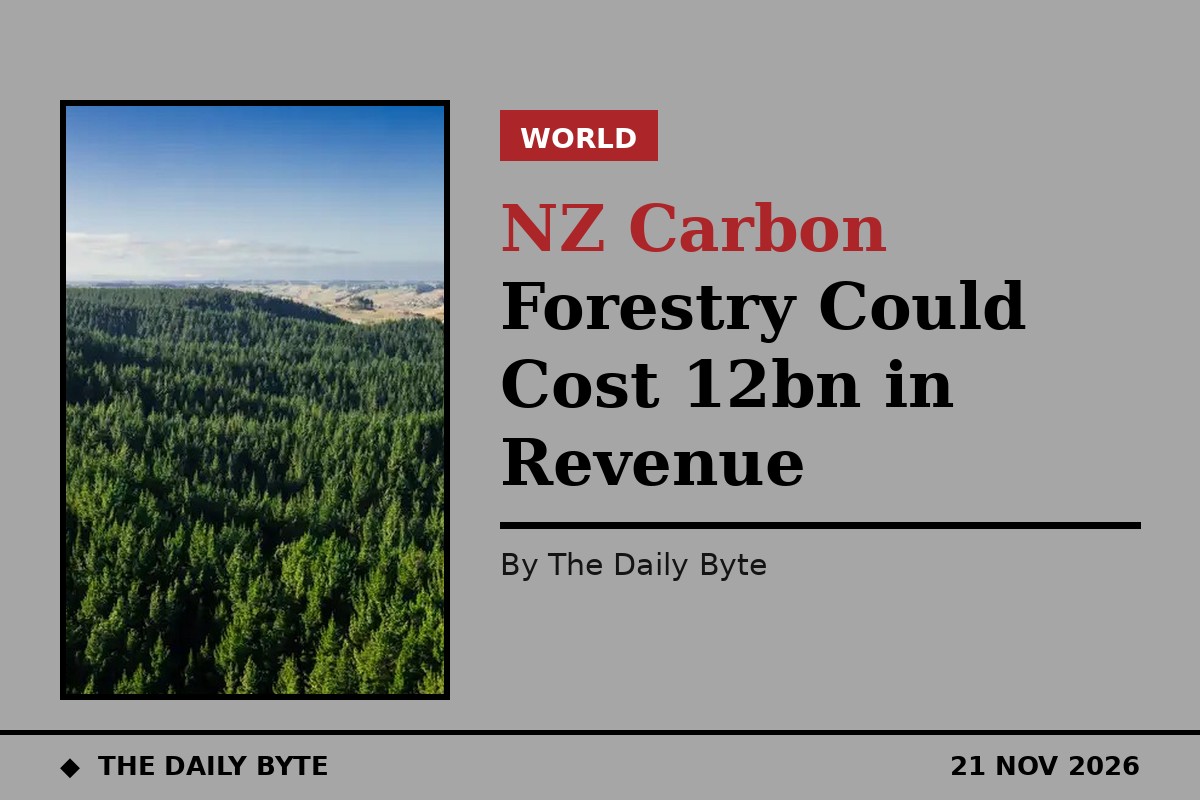
New Zealand could forgo up to $12 billion in revenue from carbon auctions if it does not overhaul its emissions trading scheme, according to new research published on Friday 20 November.
The report from policy think-tank Motu describes the New Zealand Emissions Trading Scheme (NZ ETS) as "not fit for purpose" and "a rudderless ship caught in crosswinds", warning that delaying reform beyond 2030 could cost the government around NZ$11-12 billion in auction revenue through to 2035.
How the scheme stops working
Under the ETS, polluters must surrender one carbon credit - a New Zealand Unit - for each tonne of emissions they produce in a year. They can buy units at quarterly government auctions or receive some free, and forestry owners can earn and sell units for carbon dioxide stored in trees.
The problem, the report says, is that there is no limit on the number of forestry units that can enter the scheme. As long as trees keep being planted and polluters can afford the credits, there is little incentive to cut emissions.
Motu's modelling, echoed by the Parliamentary Commissioner for the Environment, found that by the mid-2030s a glut of forestry units would meet falling demand from polluters as they decarbonise anyway. With no extra credits needed from the quarterly auctions, the government would lose control over supply and demand - and the ability to earn auction revenue.
The country would briefly meet its 2050 net-zero target, the report warns, but emissions would then rise again.
"The NZ ETS is a functional market built on assumptions that are now outdated," lead author Catherine Leining said. "Under current settings, the Government stops auctioning NZ ETS units in the early 2030s and progressively loses control over unit supply and prices."
A second damning verdict
The Motu research is the second report in just a few months to declare the scheme rudderless. In August, the Parliamentary Commissioner for the Environment called for forestry - which can earn carbon credits - to be removed from the scheme altogether.
The government has said the ETS should be the main tool for driving down New Zealand's emissions. Caretaker climate minister Simon Watts told the annual global climate summit this week that the scheme, established in 2008, was "the second oldest in the world".
Motu says the scheme is creating "investment risk for emitters and foresters, climate target risk for the government, and intergenerational risk for New Zealanders". Price volatility makes it hard for foresters and emitters to plan, the government is already losing revenue through failed auctions, and the failure is pushing the costs of climate change onto younger generations.
The proposed fix
Like the Commissioner's report, Motu's suggested "direction of travel" is to take sequestration such as forestry out of the scheme altogether, while stockpiled surplus credits could be kept to "honour past investments".
Auction revenue under the revamped scheme would be enough to fund a separate Removals Investment Mechanism, paying for native planting, wetland restoration and other forms of carbon storage. Leining said that would mean carbon removals and emissions cuts could both happen without one being traded off against the other.
"Aotearoa New Zealand needs both deep emissions reductions and more carbon dioxide removals. The single emissions price we have now can't do both jobs at once," she said.
Motu's modelling showed a net fiscal benefit even after paying for a removals scheme, and that New Zealand could not only reach and maintain its net-zero target by 2050 but also reach the Climate Change Commission's more ambitious net-negative target - a recommendation the government rejected last year.
The authors stress their scenarios are proof-of-concept, not proposals or forecasts. The full working paper, "Scoping NZ ETS and removals pathways for better climate and nature outcomes", will be released on 26 November.


