Ofsted Reforms Could Come Quickly, Says Oliver
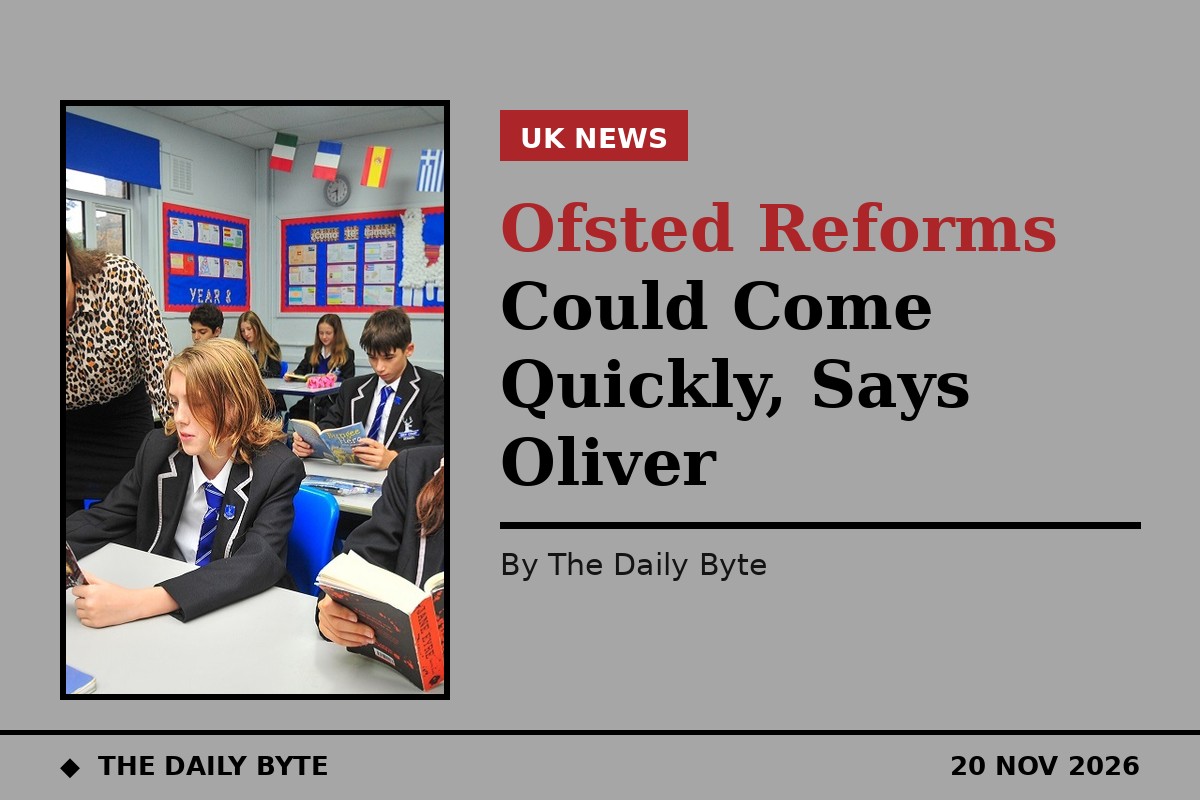
Some of the changes being drawn up for Ofsted could happen "really quickly", the inspectorate's chief inspector has said, while others will have to wait until its next annual update in September.
Sir Martyn Oliver was speaking at the Schools and Academies Show in Birmingham, where he was asked when reforms being prepared with Education Secretary Lucy Powell might reach schools. He said he was in talks with the Department for Education, union leaders and sector organisations, but the details of the changes have not yet been confirmed.
"Some things I can do really quickly," he said. "Others that are perhaps more changes to toolkits, words... they're more fundamental. It just becomes a really complex process."
Why some changes will take longer
Oliver pointed to the scale of the system Ofsted oversees. "It's not just a report card on a website. It triggers a whole host of automatic systems and it's really very complex when you're dealing with 92,000 providers and millions... of children," he said.
Ofsted makes annual changes to its inspection framework each September, with the changes announced in advance during the summer term. This year's annual changes were announced in June. Oliver said he wanted that to become the settled rhythm, with no more than one change each September, announced as early as April or May.
"I really want to make that a way of reducing the pressure, not constantly changing," he said. "I want to get committing to just one change every single September, and we should tell people really early, like in April, May, what those changes are."
But he suggested schools would not have to wait until September 2027 for everything. "Some things I should want to do quite quickly... I'm working hard," he said.
Pressure on schools at the centre
The reforms follow growing concern about the impact of inspections on school leaders and staff. Independent research commissioned by Ofsted and published last month found that almost nine in ten schools reported their staff's wellbeing was negatively affected by an inspection under the new framework. Around half, 47 per cent, said they were affected "a fair amount" or "a lot".
Oliver said that figure was the one he was most concerned about. "That's the figure I've got to work hard on as the chief inspector. I've got to shift that dial," he said. "I don't want to see half of people expect to say it was somewhat or a lot. I want it to be a little or not at all."
He also acknowledged the wider pressures facing school leaders, including rising special educational needs, falling rolls and difficulty recruiting specialist staff. While Ofsted could not control those pressures, he said, "we can reduce the pressure from inspection".
"I can alleviate the unnecessary pressures that come with inspection," he told the audience, adding that he was committed to improving things for school professionals as well as for children.
Context, complaints and confidence
Powell has said she wants to see changes to Ofsted's "culture and approach" as well as its framework, and told the education committee earlier this month that she wanted context and inclusion to be "recognised in a different way" in inspection judgements.
Oliver said inspectors already had to take context into account, and that he did not want schools to be penalised for working in a more challenging area or for taking on children with more complex needs. He pointed to Ofsted's similar-schools model, which compares a school with others in similar circumstances, and said inspectors looked at data over time, taking into account special educational needs, free school meals, children in need, stability and deprivation levels.
He also gave more detail on a pilot of an independent complaints review process, which for the first time would allow a review of the outcome of a complaint, including where aspects were linked to what inspectors found. In the new year, Ofsted will also use a podcast to showcase schools that receive "exceptional" grades under its report-card framework, which was introduced in November last year and gives schools one of five grades, from "exceptional" to "urgent improvement", across at least six evaluation areas.
The speech came after teaching unions recently expressed no confidence in Oliver and urged him to step down, arguing that the new inspections had failed to reduce pressure on school staff. A spokesperson for the education secretary has said Powell retains confidence in him as chief inspector. No date has yet been confirmed for the announcement of the changes.