Oil falls as IEA forecasts supply surplus
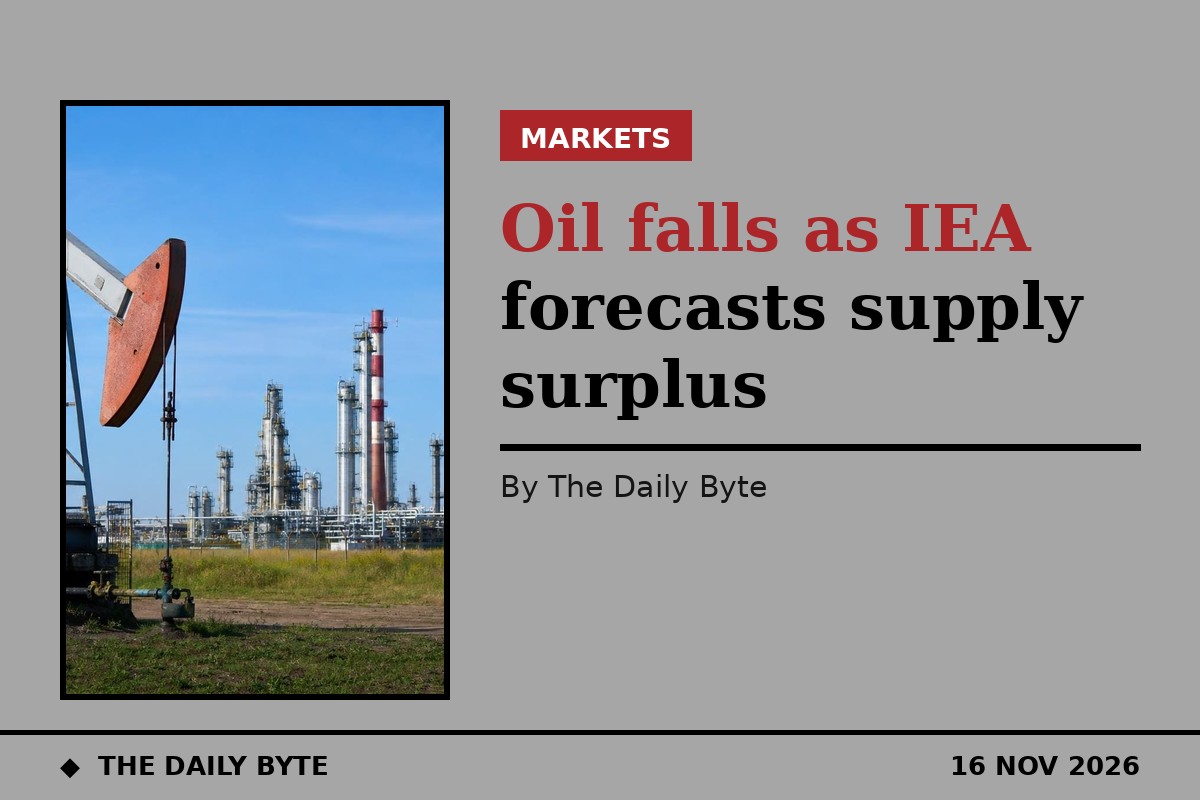
Oil prices fell on Monday 16 November 2026 after the International Energy Agency (IEA) forecast that the world oil market will return to a surplus in the fourth quarter of the year, as exports from the Gulf recover faster than demand.
Brent crude futures were trading at $95.30 a barrel on Monday morning, down 0.56 per cent, while US West Texas Intermediate (WTI) crude stood at $87.05, down 0.27 per cent, according to market data reported by The Hindu BusinessLine. Earlier in Asian trading, Brent was down 54 cents at $95.30 and WTI was down 22 cents at $88.34.
Surplus replaces an expected deficit
The IEA said in its November Oil Market Report that global oil supply is expected to average about 105 million barrels a day in the fourth quarter, around 1.7 million barrels a day above forecast demand. The agency had previously expected the quarter to show a deficit, and the revision marks the first time since the war in Iran began that the market has flipped into surplus.
Global supply rose by a further 2.3 million barrels a day to 105.4 million barrels a day in October, the IEA said, after an increase of 3 million barrels a day in September. The agency attributed the rise to lofty Gulf exports despite continuing attacks on energy infrastructure and shipping, and said observed oil stocks rose by 52 million barrels in October.
Demand set to fall this year
On the demand side, the IEA said world oil demand is forecast to fall by 2.7 million barrels a day in 2026, to 102.3 million barrels a day, before rebounding by 2 million barrels a day in 2027. The agency said the year-on-year decline in demand is set to ease to 2.7 million barrels a day in the fourth quarter, from an average of 4.4 million barrels a day over the second and third quarters.
Supply is expected to rebound by 6.6 million barrels a day to an average of 108.1 million barrels a day in 2027, although the IEA lowered its 2027 supply forecast because of constrained Iranian shipments. The agency also warned that attacks on shipping threaten the security of navigation needed to sustain the recovery, and said tight supplies of refined products, particularly diesel, remain the main concern.
Prices well below October peak
North Sea Dated crude, the benchmark for Brent, has fallen by more than 30 per cent from a high of $136 a barrel on 8 October to around $93 a barrel at the time the IEA report was prepared, although it remained about $22 a barrel above pre-war levels, the report said.
Traders will now look to the next meeting of the OPEC+ producers, due on 29 November, for any response to the surplus. For consumers, lower crude prices could ease pressure on fuel costs and inflation if the decline is sustained, although the IEA cautioned that shipping risks in the Strait of Hormuz could still push prices higher.