Oil Prices Fall Nearly 25% in a Month as Supply Surges
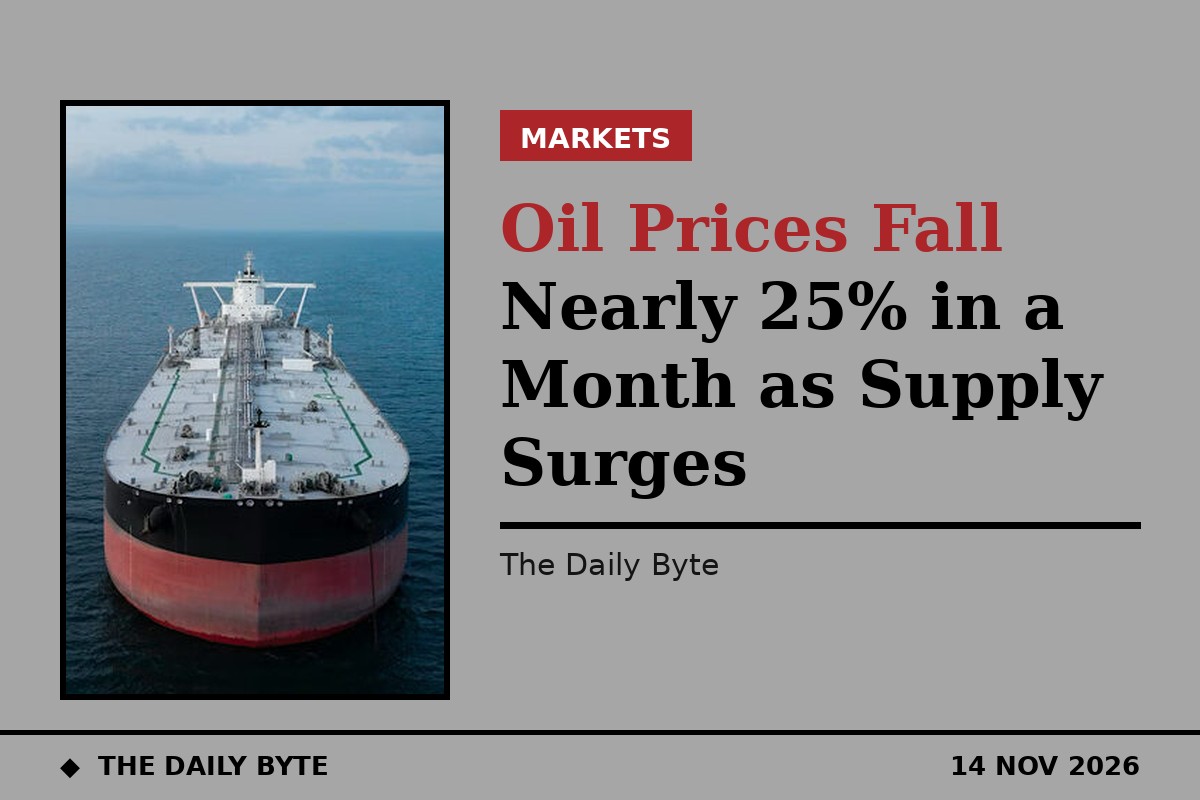
Oil prices have fallen by nearly a quarter since the start of November, as a recovery in Middle East supplies and weakening demand have overwhelmed the risks from continued attacks on tankers in the Strait of Hormuz.
Brent crude settled at $95.84 a barrel on Friday 13 November, up two cents on the day, while US West Texas Intermediate finished at $88.56, down 18 cents. Both benchmarks ended the week about 2.5% lower, after far steeper falls the previous week, when Brent dropped 16% and WTI lost 13%.
Brent fell below $90 a barrel at one point during the week, its lowest level since mid-September, before recovering towards the end of the week. The scale of the retreat stands in sharp contrast to the fears of a supply shock that drove prices higher when the war with Iran began.
IEA says supply now exceeds demand
The International Energy Agency said on Friday 13 November that global oil supply had exceeded demand for the first time since the war with Iran began. The agency described the development as the first signs of a return to balance in the oil market.
Traders say the shift in sentiment has been dramatic. Phil Flynn, senior analyst with the Price Futures Group, said: "It is clear the biggest fear a few months ago was a fear of shortage. Now it looks like the biggest fear is a surplus."
Washington's focus has also moved from the threat of renewed direct conflict towards blockading Iran and increasing other economic pressures, which has eased fears of a wider disruption to supplies.
Gulf producers raise output
More than eight months after the conflict began, Gulf oil producers have brought exports close to pre-war levels. Saudi Arabia reported producing 10.5 million barrels of oil per day in October, a level the kingdom had reached only once since 2022.
Iraq and Kuwait also increased output, while the United Arab Emirates gained the ability to expand production without restrictions under OPEC quotas. Producers have already begun cutting their selling prices to attract buyers: Abu Dhabi National Oil Co. lowered the price of its main crude grade, while Saudi Arabia also reduced prices for key shipments.
Supplies from outside the region have added to the surplus. Weekly US oil production exceeded 14 million barrels per day for the first time, while Brazil and Guyana set new production records. The recovery in exports has been supported by ship-to-ship oil transfers in the Gulf of Oman, an arrangement that allows shipments to continue despite persistent threats to shipping through the Strait of Hormuz.
Demand is weakening too
Falling prices are not solely the result of increased supply. According to oil trader Vitol, the war with Iran has reduced global oil consumption by approximately 3 million barrels per day.
In October, China's oil imports fell approximately 15% year over year to 9.9 million barrels per day, while European countries also reported double-digit declines in diesel demand. In the United States, crude and fuel inventories rose last week, driven by softer refined products demand and a jump in oil imports, the Energy Information Administration said on Thursday.
Lower oil prices are easing inflationary pressure on the global economy, although the risk of supply disruptions remains.
Risks to shipping remain
Despite the increased supplies, the situation in the region remains unstable. Attacks on vessels in November killed at least one sailor, while oil spills affected the Persian Gulf coastline. Transport costs also remain elevated: shipping US crude to Asia adds approximately 20% to its price, more than double the figure recorded a year earlier.
On Thursday, Iran's military said four oil tankers were hit by explosions in the Strait of Hormuz after ignoring warnings. Reuters said it could not immediately verify the Iranian accounts. That same day, the Houthis said they had attacked a pumping station on the Saudi East-West oil pipeline, an oil facility in the Saudi Red Sea city of Yanbu, and an Aramco building in the capital Riyadh.
US President Donald Trump said on Truth Social that a deal with Iran was not necessary to end the war. For now, the market is torn between rising supply from the Middle East and the absence of any change in the negotiating positions of the United States and Iran, which is refusing to allow nuclear inspectors into the country.