Oil Prices Head for Third Weekly Loss as Hormuz Flows Rise
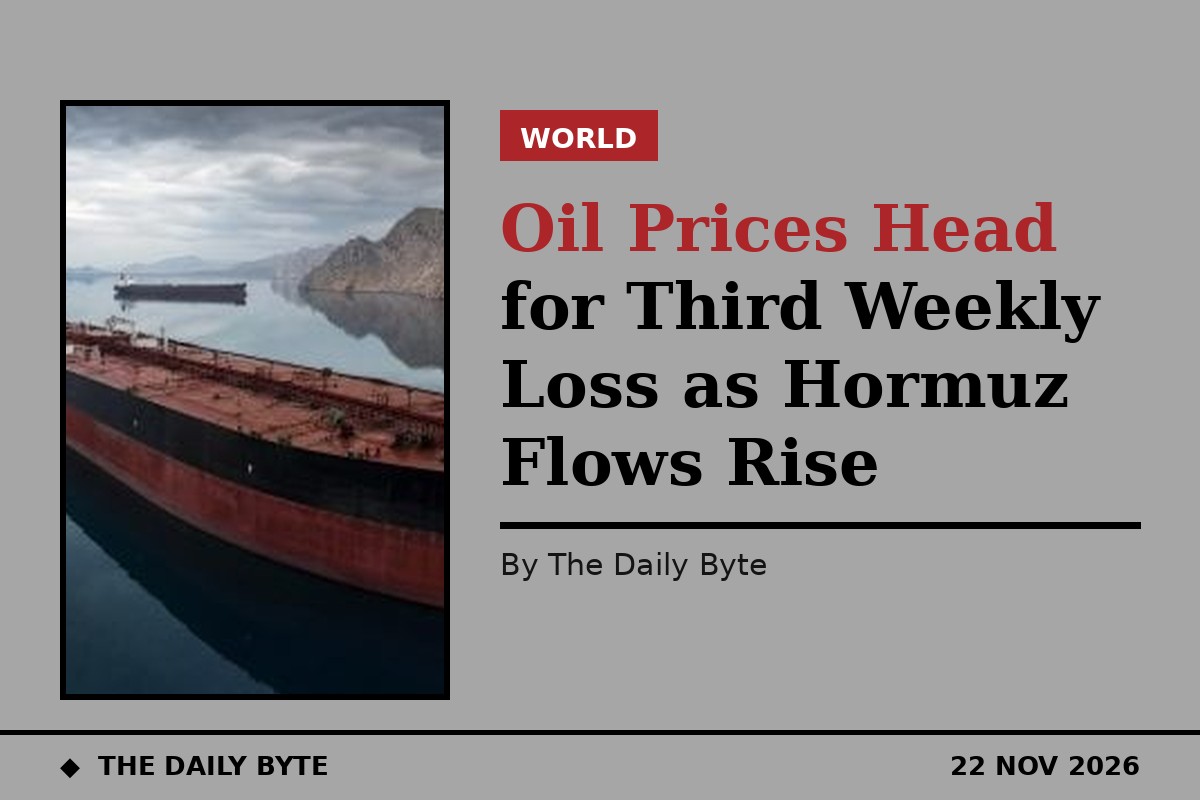
Oil prices ended higher on Friday but remained on track for a third consecutive weekly decline, as strong export flows from the Middle East and expectations of a supply surplus outweighed fears of renewed attacks in the region.
Brent crude settled at 92.57 dollars a barrel on Friday, up 59 cents or 0.64 percent, while US West Texas Intermediate (WTI) closed at 83.98 dollars, up 77 cents or 0.93 percent, Reuters reported. The late rebound came on fears of renewed attacks in the US-Israeli war with Iran and pre-Thanksgiving buying, but it was not enough to erase the week's losses.
Third straight weekly fall
Brent was on track for a weekly decline of nearly 4 percent and WTI of about 5 percent, the third straight weekly fall for both benchmarks. Reuters reported on Friday that Brent had been on track for a near 5 percent weekly decline and the December WTI contract for a 6.5 percent weekly drop.
The reason, traders said, was that crude shipments through the Strait of Hormuz have returned to roughly pre-war levels, fuelling expectations of a supply surplus. This week we keep having relatively strong export flows out of the Middle East, Aldo Spanjer, a commodity strategist at BNP Paribas, told Reuters, adding that there was also a narrative that as long as people are talking, maybe there is a deal in the making.
Earlier in Friday's session, Brent had traded down to 91.31 dollars a barrel and WTI to 82.85 dollars, despite the Houthi attacks on Riyadh and reports of tanker disruptions in the Strait of Hormuz.
Houthi attacks and Hormuz tanker incidents
On Friday, the Iran-aligned Houthi movement warned workers and people near Saudi Arabia's Red Sea ports to evacuate immediately and urged shipping companies to remove vessels, saying they would target Saudi ports in Jeddah and the Red Sea if a Saudi-led coalition strikes Yemen's Hodeidah port. The Houthis fired missiles at Riyadh on Thursday, including targets in the capital's financial district.
Iran's intensifying attacks on tankers transiting the Strait of Hormuz, running at roughly one incident per day in November, still add a meaningful geopolitical risk premium to the market, according to UOB Group analysts in a client note. At least three tankers were attacked in or near the strait on Saturday, and UKMTO said two tankers were struck separately by projectiles early on Saturday while leaving the Persian Gulf.
Yet the physical flow of oil has proved resilient. With Hormuz shipments back near pre-war levels, the market's focus has shifted from disruption to oversupply, and the International Energy Agency has warned of a potential oversupply in the fourth quarter of 2026 and in 2027.
IEA counts the cost of the war
The International Energy Agency said on Thursday, in its World Energy Outlook, that the Middle East conflict has caused the biggest disruption ever to global oil and gas trade. The agency estimated cumulative supply losses of 2.8 billion barrels of oil and 60 billion cubic metres of natural gas, and said the conflict could cut world oil demand by more than 4 percent by 2035 if governments accelerate electrification, efficiency and fuel-switching measures in response.
US inventory data added to the pressure. The US Energy Information Administration said crude oil stocks rose by about 3.4 million barrels to 417.8 million barrels for the week ending 13 November, far above the projected increase of 58,000 barrels. Gasoline inventories grew by 5.2 million barrels, while distillate stocks, including diesel, increased by 1.6 million barrels.
Attention now turns to OPEC+, whose ministers will hold a series of meetings on 29 November to decide their output policy for 2027.


