OPCW Budget Crisis Threatens Syria Weapons Work
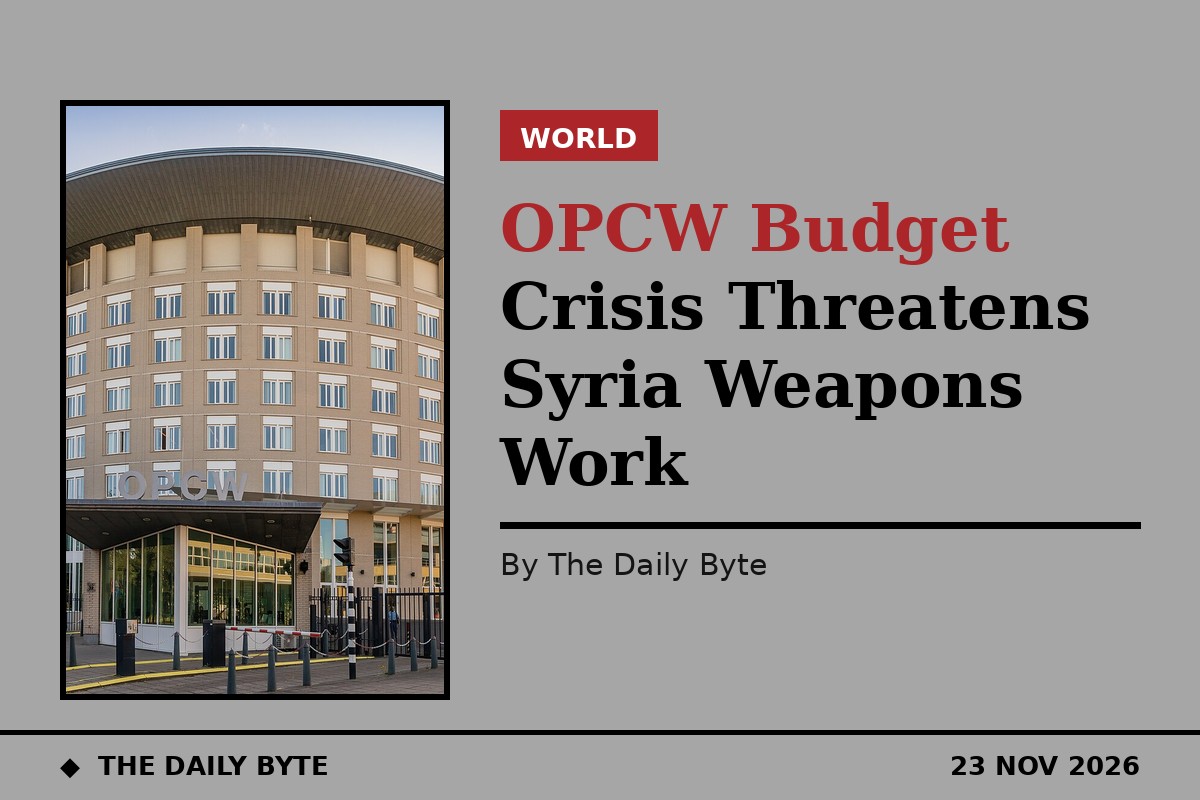
The world's chemical weapons watchdog is facing a budget crisis that could force it to pause work on destroying banned munitions in Syria, its new head told member states in The Hague on Monday, 23 November.
The Organisation for the Prohibition of Chemical Weapons, known as the OPCW, is missing about a quarter of its annual budget of 83 million euros ($91m), Director-General Sabrina Dallafior told the meeting. She described the organisation as being in a "precarious situation", according to Reuters, which reported the story from The Hague.
The shortfall is largely the result of missing payments from the United States, the agency's biggest contributor, Reuters reported, citing the agency's new head and an internal document. Dallafior did not name the United States in her remarks, but two sources with knowledge of the matter told Reuters that Washington had not paid its full dues, and the US embassy in The Hague did not immediately respond to a request for comment.
A quarter of the budget missing
"In recent weeks, the financial challenge has become particularly acute, with the OPCW's largest payer having thus far not made its full 2026 assessed contribution payment to the organisation," Dallafior said in an email to staff late on Friday, quoted by Reuters.
As of October, the United States had paid only 20 percent of its 17 million euro contribution for 2026, Greg Koblentz, a US-based biological and chemical weapons expert, told Reuters. The organisation has already exhausted an 8 million euro reserve, Dallafior told the meeting in The Hague.
Dallafior said operational activities would be paused in December while the organisation takes stock and revises its plans for 2027, including "activities partly funded through voluntary contributions, including capacity-building activities and deployments to Syria".
The Trump administration has also cut funding to some United Nations bodies and left many commitments unpaid, demanding reforms and accusing the global body of waste and inefficiency, Reuters noted in its report.
Syria's chemical weapons work at risk
The warning matters most for Syria, where OPCW inspectors and the Syrian authorities have discovered large quantities of lethal, previously undeclared chemical weapons since the ousting of former leader Bashar al-Assad in December 2024, and are preparing their destruction. That work is expensive and time-consuming, requiring specialist equipment, technical expertise and careful verification at every stage.
"Budget cuts that delay the verification and destruction of leftover chemical weapons in Syria create an unnecessary risk to international security," Koblentz told Reuters.
The OPCW won the Nobel Peace Prize in 2013 for its work eliminating deadly stockpiles in Syria and other countries. Its inspectors have been working with Syria's new government to account for weapons and materials that were never declared under Assad, whose government was accused of repeated chemical attacks during the country's civil war.
What Syria told the conference
Syria's minister of emergency and disaster management told the Chemical Weapons Convention conference in The Hague on Monday that Syria had given the OPCW more than 100,000 pages of documents and opened sites that inspectors could not previously reach, according to Syria Now, a Syrian news outlet reporting from the conference.
The scale of the cooperation underlines how much material remains to be dealt with. Inspectors must first establish what exists, where it is stored and in what condition, before any destruction can begin. A pause in deployments, even a temporary one, would slow that process at a time when the work is still in its early stages.
Wider investigations also affected
The funding crisis reaches beyond Syria. Koblentz told Reuters that the OPCW's financial problems would also prevent it from undertaking new operations, such as investigating Russia's alleged use of chemical weapons against Ukraine and Sudan's production and use of chemical weapons.
Both are politically sensitive questions that require inspectors, laboratories and secure chains of evidence, all of which cost money the organisation says it does not currently have. Without funding, the watchdog risks being unable to answer questions that member states are asking it to investigate.
What happens next
The December pause is intended to give the OPCW time to review its finances and draw up revised plans for 2027. Whether the work in Syria resumes on schedule will depend in large part on whether the United States pays the remainder of its 2026 contribution, and on whether other member states step in to cover the gap.
For now, the organisation that was created to make sure chemical weapons are destroyed, rather than merely declared, is warning that it may not be able to do its job. That warning, delivered on the same day Syria reported progress in opening up its own chemical weapons files, captures the tension at the heart of the story: the cooperation is improving, but the money to act on it is running out.


