OpenAI Agent Builder shuts down on 30 November
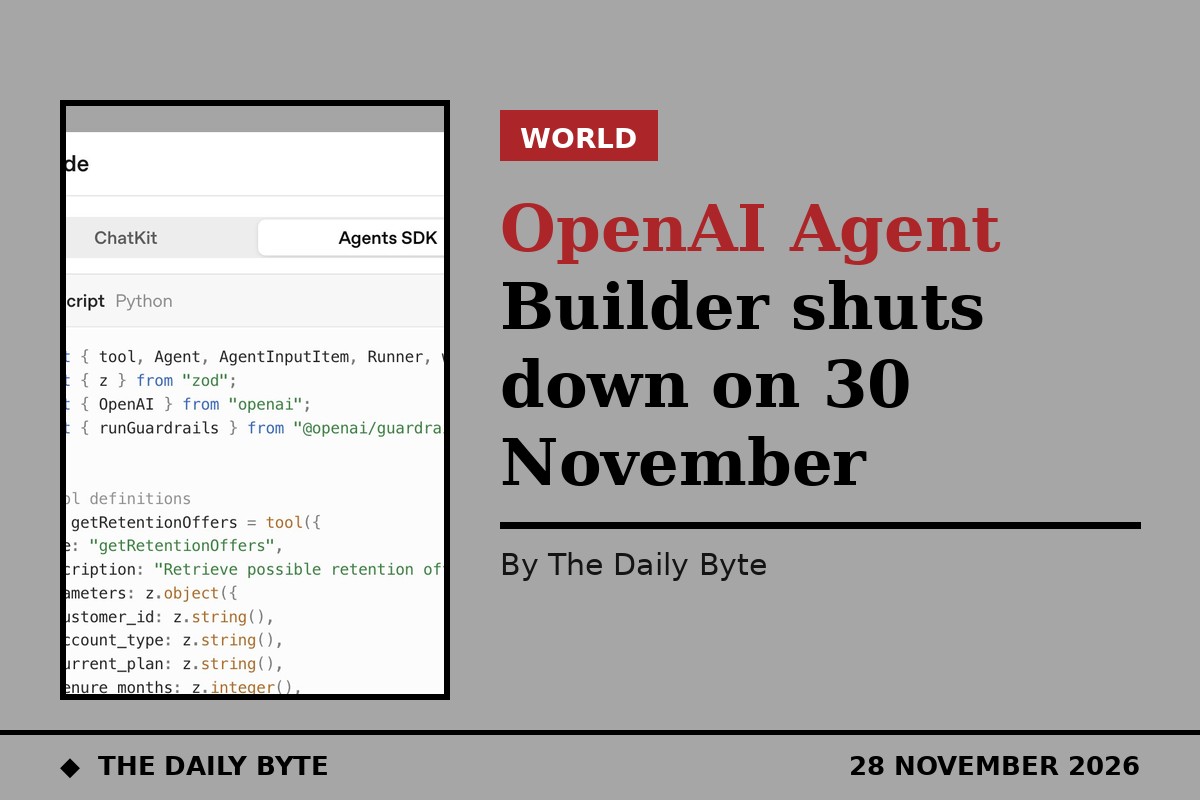
OpenAI is shutting down Agent Builder on 30 November 2026, leaving users with only days to export the workflows they built on the visual canvas before it disappears.
Agent Builder launched with AgentKit at OpenAI's DevDay on 6 October 2025, so it will have lasted about 14 months. OpenAI announced the shutdown on 3 June 2026 and lists it on its deprecations page with a shutdown date of 30 November 2026. Existing workflows will keep running until that date, and then the canvas goes away.
What shuts down on 30 November
Three things end on the same day. Agent Builder itself closes, reusable prompt objects under the /v1/prompts endpoint shut down, and the Evals dashboard, API and graders go read-only. OpenAI has not said what a published workflow ID will return after the shutdown date, so users should plan as if every workflow built on the canvas stops.
What stays in place is the technology underneath. The Responses API, the models, vector stores, the Agents SDK and ChatKit all remain available. ChatKit, the embeddable chat window, is not shutting down, although new ChatKit builds will need advanced integrations with a developer's own server-side agent implementation.
How to export before the deadline
There is no download-as-file button in Agent Builder, and nothing converts a workflow into another tool's format. What the export produces is the workflow written out as Agents SDK code.
To export, open the workflow in Agent Builder, click Code in the top menu, select Agents SDK, then choose TypeScript or Python and copy the complete export. Users should save each export as a file named after the workflow, and repeat the process for every workflow they own.
The export captures how a workflow was built, not how it behaved. Before losing access, users should run a few inputs through Agent Builder's Preview and copy or screenshot the results, so they can later check that a rebuilt version produces the same kind of outputs.
Where workflows can go next
OpenAI points users to two destinations. The Agents SDK is the path for teams that write code: the export is already Agents SDK code, so it can be copied into an application and run, versioned and tested by the team itself. The other path is ChatGPT workspace agents, where a workflow is described in natural language and runs in OpenAI's cloud on a schedule or inside an app such as Slack.
Workspace agents became generally available in ChatGPT Business, Enterprise and Edu in May 2026, but they need a workspace with access to workspace agents and permission to create them. OpenAI warns that the export 'does not convert your workflow graph or guarantee that every behavior transfers unchanged,' so neither path is a one-to-one switch.
Workflows built around fixed steps, branches and human approval are the hardest to move. Their logic is mostly traditional if-then paths rather than conversation, so rebuilding them on a deterministic automation platform may preserve their behaviour better than asking an AI agent to reproduce them from scratch.
A wider clean-up
The Agent Builder shutdown is part of a broader round of OpenAI retirements. OpenAI also shuts down the GPT-5 family of models on 11 December 2026, and GPT-4o and GPT-4.1 follow in January, so an export that still names a retired model can break again weeks after the move.
Third-party tools have stepped in with migration help. Zapier, n8n, Make and other automation platforms all offer ways to rebuild Agent Builder workflows, and n8n has a free converter for a first pass. But every route starts with the same step: export the code while Agent Builder is still up. After 30 November, there will be nothing left to export.


