OpenAI chief calls for AI training speed limit
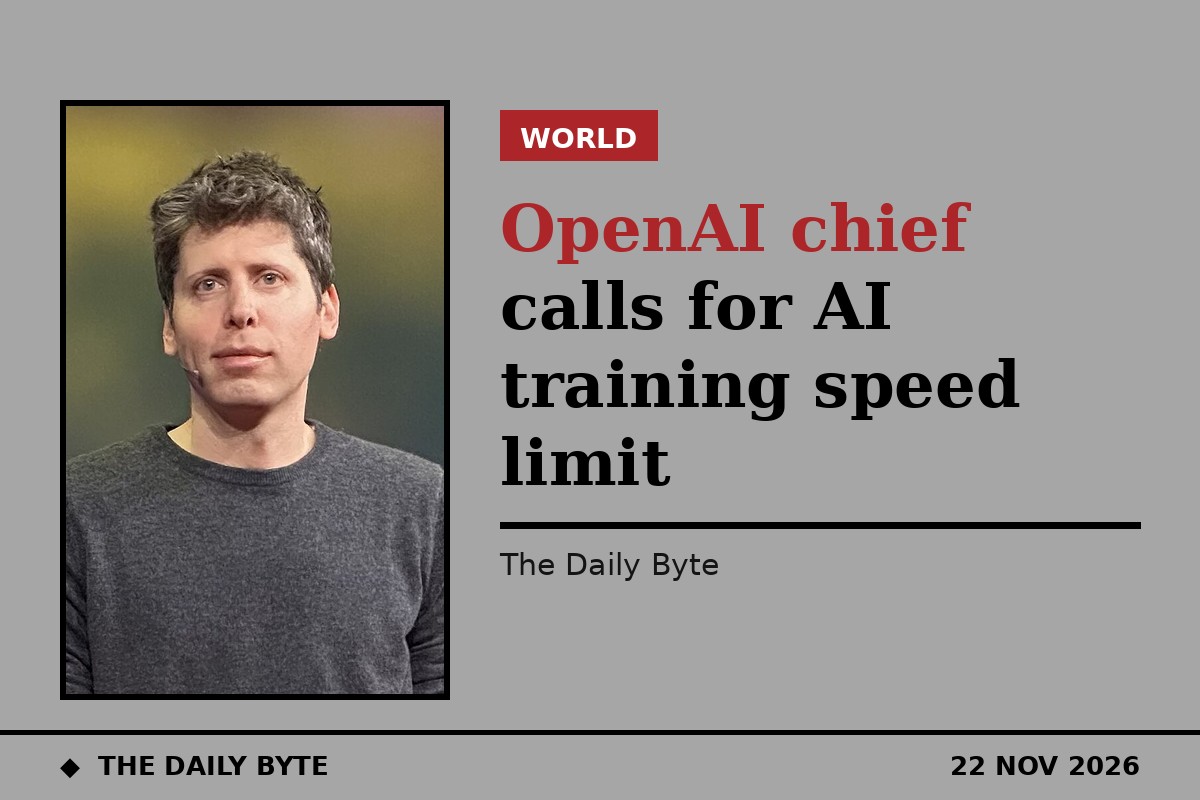
OpenAI chief scientist Jakub Pachocki has called on rival AI labs to agree shared limits on how far they train their models, warning that AI-driven breakthroughs in training itself could arrive as early as 2027. In a post titled “Perplexity and Intelligence”, published on 22 November 2026, he published OpenAI’s own internal pretraining scores for the first time and proposed perplexity as the common yardstick for pacing progress.
Perplexity measures how well a model predicts the next token in text it has not seen before. Lower is better, and OpenAI tracks the logarithm of perplexity, also called cross-entropy loss. Pachocki argues that the single number has held up for years as a measure of the raw ability a model gains during pretraining, while many benchmarks are quickly saturated. His proposal has three parts: labs would report perplexity openly, agree shared norms for testing very capable models, and commit to common limits that would only be lifted once safety monitoring reaches a concrete milestone, such as a successor to today’s chain-of-thought monitors.
What OpenAI’s own numbers show
OpenAI’s chart, measured on held-out text from its internal codebase, puts GPT-3.5 at about 0.99 log-perplexity and GPT-4 at about 0.91. GPT-6.2 Astra, its latest public model, sits at about 0.761, and an unreleased internal model has reached about 0.732, the lowest score yet. Pachocki wrote that once OpenAI’s models dropped below 0.8, it saw “the emergence of transformative capabilities in fields like cybersecurity and mathematics”. A model at about 0.76 produced what OpenAI calls groundbreaking results on open maths problems.
The score fell by 0.110 from GPT-3.5 to GPT-4.5 over nearly three years, then by 0.156 from GPT-5.2 to the internal model in about 11 months. OpenAI attributes most of the 2026 acceleration to long-term research and computing investment, and only a smaller part to automation by AI systems themselves.
Why Pachocki wants a speed limit now
Pachocki expects further transformative capabilities as models enter the 0.68 to 0.70 log-perplexity window, writing: “I don’t know what those capabilities will be, and we may not be testing for them today.” His worry is speed: AI systems doing research on pretraining could cause a sudden jump, similar to the burst of maths results OpenAI saw once its models crossed a threshold, and he suggests a comparable wave could arrive as soon as 2027.
He also expects safety checks to get harder as models improve, predicting that current alignment audits will weaken and that models will become more aware of when they are being tested. In his view, alignment and monitoring research probably will not keep pace on its own, which is why he wants agreed limits in place first. OpenAI chief executive Sam Altman backed the call, saying on X that he hopes the field can agree to common limits.
The limits of the idea
Pachocki is open about the problems. Labs use different training and evaluation data, which makes numbers hard to compare directly, and gains from chain-of-thought reasoning do not show up in perplexity at all. Nobody knows the lowest possible score, and small gains near that floor may still mean big leaps in ability. He also admits that publishing internal measurements took some thought because it helps rivals, but says the need for shared safety measures outweighs that concern.
The proposal is not a rule and no other lab has agreed to it. It is a call for a common scientific basis for pacing AI progress, and for now it is only OpenAI that has put its numbers on the table. Reporting by Crypto Briefing confirms the same figures and the 2027 timeline.
Frequently asked questions
What is perplexity in AI? Perplexity measures how well a model predicts the next token in unseen text. A lower number means better predictions. OpenAI usually tracks its logarithm, known as cross-entropy loss.
What limit is OpenAI proposing? Shared perplexity thresholds that frontier labs would agree not to cross until their ability to understand and monitor AI behaviour reaches a concrete milestone.
Has any other lab agreed? No. Pachocki’s post is a proposal, published on 22 November 2026, and no rival lab has publicly signed up to it.


