OpenAI Tests AI on Drug Discovery With MedChemBench
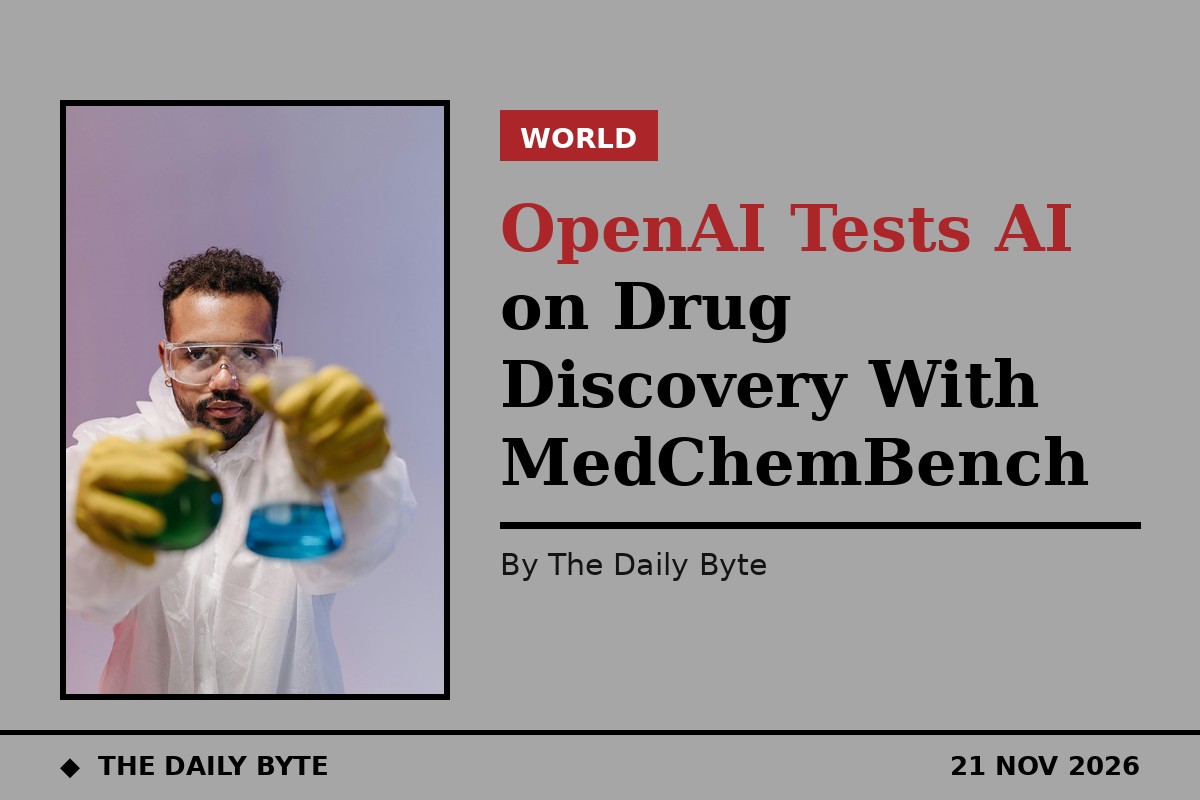
OpenAI has introduced MedChemBench, a benchmark that tests whether artificial intelligence models can do the reasoning work of medicinal chemistry: connecting a molecule's structure with experimental evidence, explaining results, comparing compounds and predicting their properties. The company published the benchmark on Friday, 20 November, alongside results for its latest models.
Medicinal chemistry is the work of designing and refining molecules that could become drugs, and its central difficulty is trade-offs. Improving one property of a molecule can make another worse: a compound might act strongly against a disease-related protein but be poorly absorbed, or break down too quickly in the body. Chemists work through those trade-offs by designing, making and testing related compounds, then deciding what to try next. MedChemBench asks whether a model can follow that reasoning.
How the benchmark is built
MedChemBench contains 99 problems drawn from 117 published papers and patents, covering 761 distinct molecular structures. For most problems, the model receives the context available at a chosen point in a real research programme: the biological target, the researchers' goals, the compounds studied so far and selected experimental findings. Later results are withheld and used to grade the answer.
The benchmark grades four components: reconstructing molecular structures, with correct atom connections and stereochemistry; scientific reasoning, meaning explanations supported by the supplied evidence; ranking and selection of compounds; and property predictions, judged against the numerical values and categories reported in the source material. In the underlying technical paper, molecular structure accounts for 37.49 percent of available credit and scientific rationale for 35.78 percent, with ranking and selection at 17.51 percent and numerical prediction at 8.92 percent.
Astra leads, but choosing compounds lags
At the highest reasoning setting shared by all eleven models tested, known as xhigh, GPT-6.2 Astra earned 84.5 percent of the available credit, ahead of GPT-6 Astra at 83.3 percent, GPT-6.1 Sol at 82.0 percent and GPT-6.1 Terra at 75.1 percent. GPT-5.6 Sol trailed at 58.2 percent. At maximum effort, GPT-6 Astra reached 83.8 percent.
The component scores separate the strengths from the weaknesses. GPT-6 Astra earned 95.4 percent of the available credit for reconstructing molecular structures and 91.05 percent for scientific rationale, but only 50.42 percent for ranking and candidate selection and 47.02 percent for numerical prediction. One problem asked models to assemble a molecule from a central structure and two attached groups while preserving an 18-atom ring. GPT-6 Astra reconstructed it correctly in all ten responses; GPT-5.6 Sol produced a 15-atom ring and GPT-5.6 Luna split the molecule into two disconnected fragments. Such errors change the identity of the molecule before any reasoning about its behaviour begins.
Trade-offs, not single scores
A problem based on research into inhibitors of PRMT5, a protein studied in cancer drug discovery, shows why the benchmark grades several properties together. The model must predict how three related compounds will behave: how strongly they block PRMT5 in cells, how readily they cross a cell barrier, and how quickly liver enzymes break them down. The withheld results showed a trade-off: compound 23 blocked PRMT5 in cells at a lower concentration, while compound 24 crossed the cell barrier more readily and broke down more slowly in the liver-enzyme assay. Stronger activity against a target does not necessarily come with better permeability or slower breakdown, and a useful model must weigh both.
What the scores do not prove
OpenAI states plainly that the results do not establish whether models can discover new drugs or improve laboratory decisions. The benchmark tests reasoning from historical evidence rather than real-world drug discovery, each response was a single attempt without tools, feedback or new experiments, and prior exposure to the published sources cannot be ruled out. As a check, the authors added source identifiers to all 99 prompts for nine models: mean overall-score changes ranged from a 0.23-point decrease to a 0.80-point increase, with every model's confidence interval including zero, which cannot establish whether the material appeared in training data.
The technical paper describes MedChemBench as close to saturation in its current form, and says grading of open-ended design and synthesis remains partly tied to reference answers, which may penalise plausible alternatives. Proposed extensions include prospective cases, expert adjudication of alternative answers, explicit treatment of assay uncertainty, and an agent-based track allowing retrieval, calculation, structure verification and multistep revision. For now, the benchmark draws a clear line: today's best models can read a molecule and explain the evidence well, but deciding which compound to make next remains the harder test.