Opposition Leaders Reject Electoral Act 2026
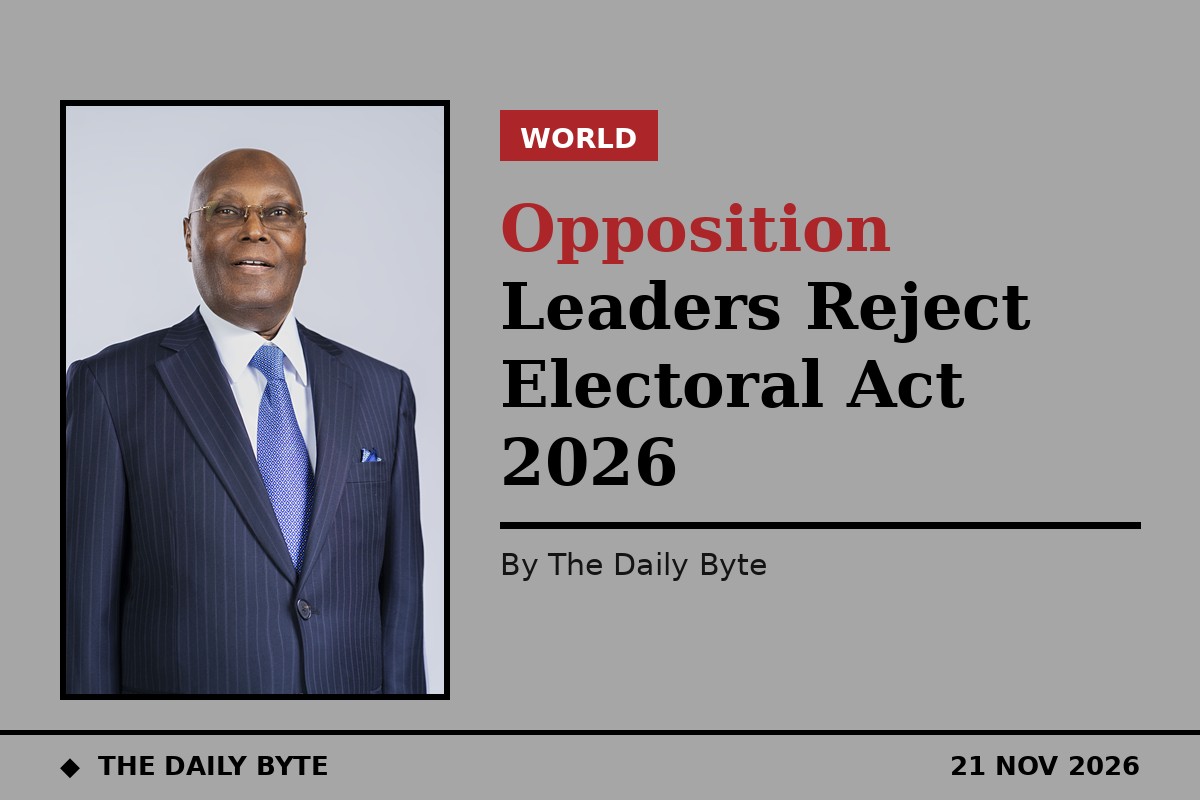
Nigeria’s opposition leaders have rejected the Electoral Act 2026 outright, calling it anti-democratic and demanding that the National Assembly urgently amend it before the 2027 general elections. They set out their position at a world press conference on the state of the nation held at the Transcorp Hilton Hotel in Abuja on Thursday, 19 November.
The meeting, held in the hotel’s Lagos/Osun Hall, brought together a rare cross-party line-up. Those present included former Vice President Atiku Abubakar, the Labour Party’s 2023 presidential candidate Peter Obi, African Democratic Congress (ADC) National Chairman David Mark, ADC National Secretary Rauf Aregbesola, former Rivers State Governor Rotimi Amaechi, New Nigeria Peoples Party (NNPP) chieftain Buba Galadima, Senator Dino Melaye, former ADC National Chairman Ralph Nwosu, former Cross River State Governor Liyel Imoke and Federal Capital Territory Senator Ireti Kingibe.
Reading a joint statement on behalf of the coalition, NNPP National Chairman Ajuji Ahmed said the Act, hurriedly signed by President Bola Tinubu, had loopholes for rigging in the 2027 general elections. He said the leaders considered several of its provisions a major offensive against the will of the people, and demanded that the National Assembly immediately commence a fresh amendment to remove what they called the obnoxious provisions.
Electronic transmission and primaries at issue
Central to their objections are Section 60(3) of the law, which they say gives presiding officers excessive discretion over the electronic transmission of election results, and Section 84, which governs the mode of party primaries. The opposition wants mandatory real-time electronic transmission of results from polling units, arguing that the Act’s optional transmission leaves room for manual tampering.
Under the Electoral Act 2022, parties could nominate candidates through direct primaries, indirect primaries conducted by delegates, or consensus arrangements. The 2026 Act, signed into law by President Tinubu on 18 February, limits parties to direct primaries and consensus options, effectively removing the indirect primary system. It also shortens campaign periods and timelines for party primaries, imposes stricter voter registration requirements limited to birth certificates, passports or national IDs, and increases penalties for electoral offences.
The Act also changes the funding schedule for the Independent National Electoral Commission, mandating that its funds be released six months before an election rather than 12 months, and requires the commission to publish audited accounts within six months. Critics say the changes fall short on mandatory real-time result uploads and could weaken public confidence in the voting system.
Presidency dismisses the objections
The opposition leaders also condemned the conduct and outcome of the Federal Capital Territory Area Council election held the previous Saturday, describing it as a signal of what to expect in 2027. Atiku urged that the opposition’s position on the electoral process be submitted to all foreign embassies, warning that the collapse of democracy in Nigeria would affect democracy across Africa.
The Presidency swiftly rejected the opposition’s claims. In a statement, presidential spokesman Bayo Onanuga described the allegations as reckless and spurious, dismissed suggestions that the amendment was part of a plan to turn Nigeria into a one-party state as false and unfounded, and defended the Electoral Act 2026 as an improvement on the previous law. The opposition leaders said they would resist the Act’s implementation through constitutional means, signalling possible legal challenges or further pressure for revision.
Sources: Fairview Africa and CEOAfrica.


