Osaki ransomware halts Japan smart meter output
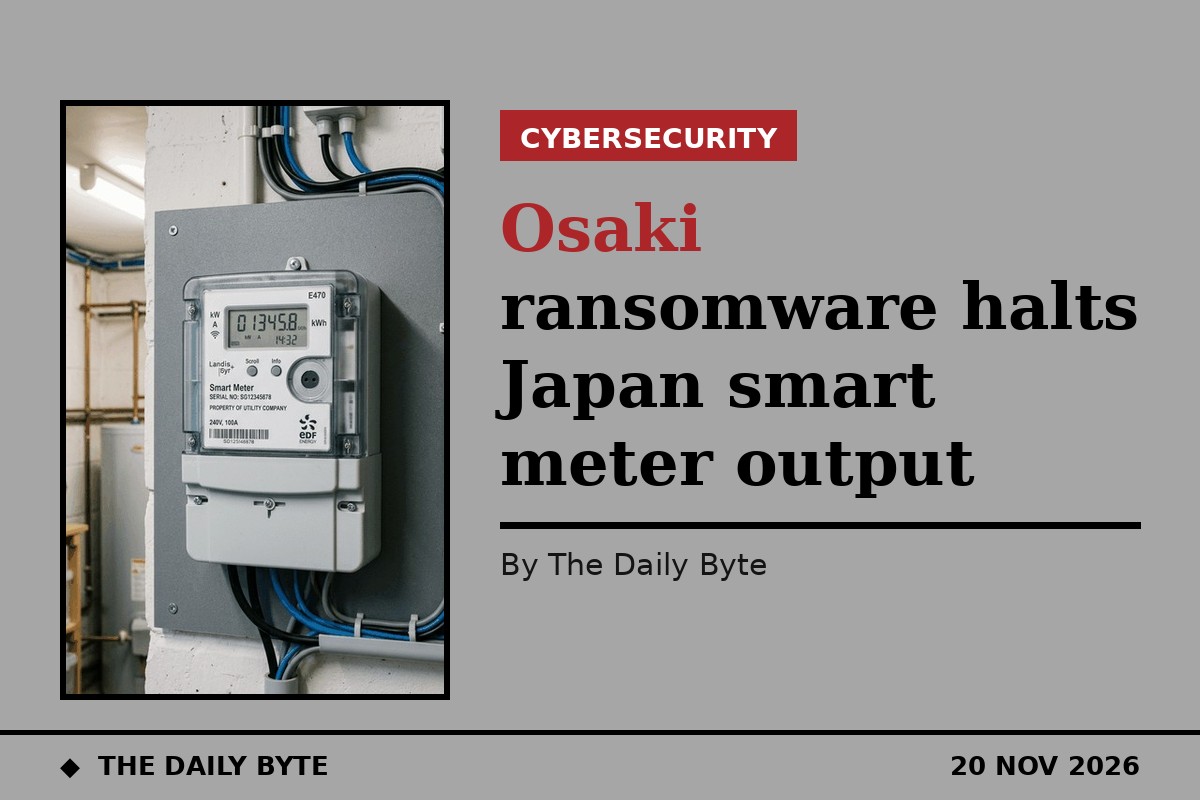
Japanese manufacturer Osaki Electric has suspended production and shipments of smart meters after ransomware encrypted data on its servers, halting output at three sites with no date set for restarting. Staff confirmed the encryption at about 10:35 a.m. on Tuesday 17 November, the company disconnected its systems from external networks around noon, and it disclosed the attack in a notice dated 18 November signed by chairman and chief executive Yoshihide Watanabe.
The company shut down production-related systems at its Saitama research and manufacturing centre in Miyoshi, Saitama Prefecture, and at two group companies, Iwate Osaki Electric and Osaki Platech. It set up an emergency response headquarters led by its president and chief operating officer, and said it is investigating with external specialists, including whether data was leaked outside the company. It has consulted with police and the relevant authorities, and is progressively informing customers and business partners. The financial impact remains unknown.
Attackers entered through the VPN
A second report from the company, summarised by Japan Cyber Watch, says the attackers got in on 15 November through its VPN device, its only entry point from outside, most likely by guessing the password of an account that still had no multi-factor authentication. Some virtual servers were encrypted. Backups are intact and recovery is under way, but there is still no date to restart production and shipments.
On 19 November the company found technical information that appears to come from its systems posted on a site believed to belong to the attackers, and what else may have leaked is under investigation. Osaki has not named the ransomware family or the attackers, and has not confirmed whether data was stolen. Japan Cyber Watch notes that the Qilin group has listed Osaki on its leak site, but stresses that such claims are unverified and the company has not confirmed them.
A supplier Japan's utilities cannot replace quickly
The disruption matters because of Osaki's position in Japan's power system. Jiji Press reported on 18 November that the company's smart meters account for roughly 40 percent of the domestic market, and its own investor materials state that it sells smart meters to all ten of Japan's regional power companies and holds the top share of the domestic market. The affected products include smart meters and measurement and control equipment for power companies, and Japan's second-generation smart meter rollout is scheduled to begin in the financial year to March 2027.
Jiji Press also reported that products already in use were not affected, so the damage sits in the supply of new meters rather than in installed devices or grid operations. Even so, the market reacted quickly: Kabutan reported on 19 November that Osaki shares fell sharply for a fifth straight session and hit a year-to-date low after the disclosure landed following the 18 November market close. Kyodo News reported on 19 November that production management systems had become unusable, which is the kind of outcome that stretches an outage from days into weeks.
Osaki says it will not negotiate
Kyodo News also reported on 19 November that a party believed to be behind the attack had made contact with the company, and Osaki said it has no intention of negotiating. Refusing to pay removes the fastest route to a decryption key and puts the whole recovery burden on the company's own backups and external specialists, but it is the posture the company has chosen in public.
The company's next disclosure is the one that matters. Osaki has committed to prompt further disclosure, and customers and investors are waiting for three items: a restart date for the Saitama centre and the two group plants, a finding on whether data left the company, and a first estimate of the earnings impact it has so far declined to give. Until then, utilities waiting on Osaki shipments must manage installation pipelines meter by meter, and the incident stands as a concrete case for asking suppliers harder questions about multi-factor authentication on remote access, separation between office networks and factory floors, and how quickly a plant can restart without the systems that were encrypted.