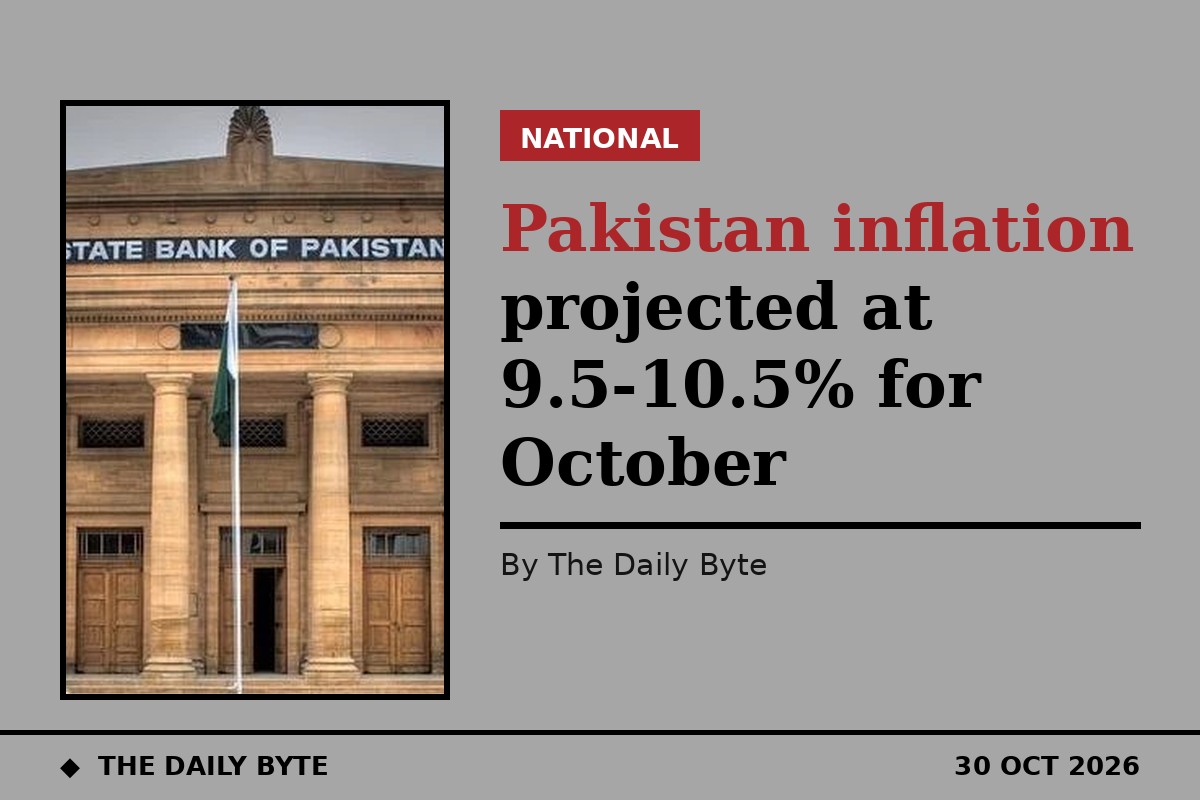
Pakistan's October inflation projected at 9.5-10.5% as imports outpace exports
**
Pakistan's Finance Division has projected inflation of 9.5 to 10.5 per cent for October 2026, warning that the outlook remains sensitive to international energy prices, food supplies and base effects. The forecast appears in the division's Monthly Economic Update and Outlook for October 2026, which describes stability consolidating in the first quarter of 2026-27, while flagging geopolitical tensions, renewed conflict in the Gulf region, volatile oil prices, trade disruption and elevated global inflation as the main downside risks.
A wider external gap
The report puts the current account deficit at $874 million for July to September, wider than $755 million a year earlier. Goods imports rose 14.3 per cent to $17.8 billion, well ahead of a 7.7 per cent rise in goods exports to $8.5 billion. Machinery imports increased 19.3 per cent, metal imports 24 per cent and transport equipment 19.2 per cent, while petroleum imports rose 6.5 per cent. Food exports grew 25.3 per cent, led by rice, and textile exports rose 5.3 per cent, but not by enough to close the gap.
Reserves, remittances and rates
There were offsets. Workers' remittances rose 14.0 per cent to $10.9 billion, more than covering the combined goods and services trade deficit, and a $3.0 billion sovereign Eurobond issue in September helped produce a balance-of-payments surplus of $3.1 billion. State Bank liquid reserves stood at $21.5 billion on 16 October, and the rupee stood at Rs276.8 to the dollar on 28 October, against Rs280.97 a year earlier. Headline consumer inflation had eased to 10.3 per cent year on year in September, from 11.1 per cent in August. The State Bank raised its policy rate by 50 basis points to 12.0 per cent, citing inflation risks from the intensifying Middle East conflict and high global energy prices. The message is therefore mixed: stability is holding, but household budgets remain exposed to oil and food prices.
Sources: Mettis Global; BeNewz.