Pakistan: Nuclear Weapons Decisions Must Stay Human
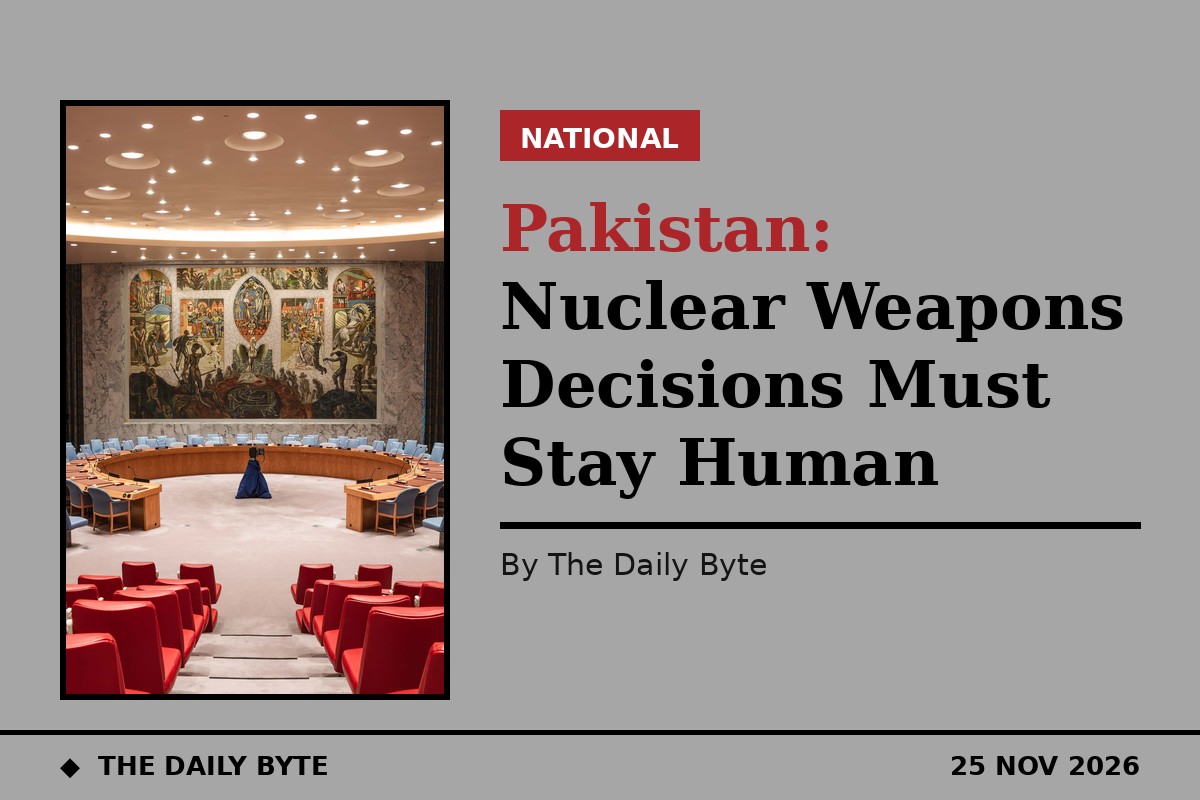
Pakistan has told the United Nations Security Council that the decision to use nuclear weapons must always remain in human hands, warning that artificial intelligence must never be used to target nuclear command, control and communications systems.
Ambassador Syed Haider Shah, Pakistan's Permanent Representative to the United Nations, delivered the message at a high-level open debate held on 24 November under the title "Conflict Resolution in an Era of Rapid Technological Change". The session, held under Latvia's presidency of the Council, examined how fast-moving technologies, from artificial intelligence to autonomous systems, are changing armed conflict and the work of resolving it.
Human judgment must remain central
Shah warned that bringing artificial intelligence into military systems could shorten the time available for decisions in a crisis, raising the risk of miscalculation and accidental escalation. That danger, he said, was sharpest in the nuclear domain, where interference, error or compressed timelines could have catastrophic consequences.
"This is most critical in the nuclear domain, where decisions on the use of nuclear weapons must remain under human control, and AI systems must never be used to target nuclear command, control and communications systems," he said.
Technology itself was neutral, the ambassador argued, and its consequences depended on the intentions and motivations of those deploying it. Human judgment and control, he said, had to remain central throughout the design, development and deployment of emerging technologies.
Rules, restraint and wider access
Pakistan called for safeguards, regulations and governance frameworks to ensure that technological progress contributes to peace and stability rather than becoming an instrument of geopolitical domination or warfare. In the military domain, Shah advocated restraint and confidence-building measures, including crisis communication channels, deconfliction mechanisms and mutual restraint, to reduce mistrust and prevent accidental escalation.
He also cautioned against allowing advanced technologies to become the preserve of a handful of powerful countries. All member states, including developing nations, should take part in their development through democratic, inclusive and equitable processes, he said, and restrictions introduced in the name of technological safety should not be used to deny countries access to essential technologies, infrastructure or capabilities. Developing countries, he added, retain an inalienable right to the peaceful use of technology.
Shah further warned that misinformation, disinformation, fake news and cyberattacks, including attacks on critical infrastructure by state and non-state actors, were being supercharged by emerging technologies. The UN Charter and international law, he said, apply in all situations, irrespective of the underlying technology, and the international community should work together to clarify their application and develop practical responses.
Guterres: the answer must never be "the algorithm did it"
UN Secretary-General Antonio Guterres, who also addressed the debate, said artificial intelligence could not be allowed to become "a convenient alibi to bypass accountability". He said today's wars had become proving grounds for AI-enabled targeting, and that when civilians are killed or human rights violated, the answer must never be that the algorithm did it. He repeated his call for negotiations on a legally binding treaty on lethal autonomous weapons.
The president of the International Committee of the Red Cross, Mirjana Spoljaric, told the Council that AI-powered warfare did not automatically mean better outcomes for civilians, while Microsoft's Frederick Humphries said technology should be put to work for prevention, mediation and civilian protection. Latvian President Edgars Rinkevics, who chaired the debate, said intelligent systems must remain firmly under human control and serve humanity, not the other way around.
Pakistan is currently serving as a non-permanent member of the Security Council, and the debate was the signature event of Latvia's first-ever presidency of the body. The ambassador's statement was also reported by Daily The Destination, and the UN's own account of the session confirms the Secretary-General's remarks.