Pakistan Calls Population Growth a National Emergency
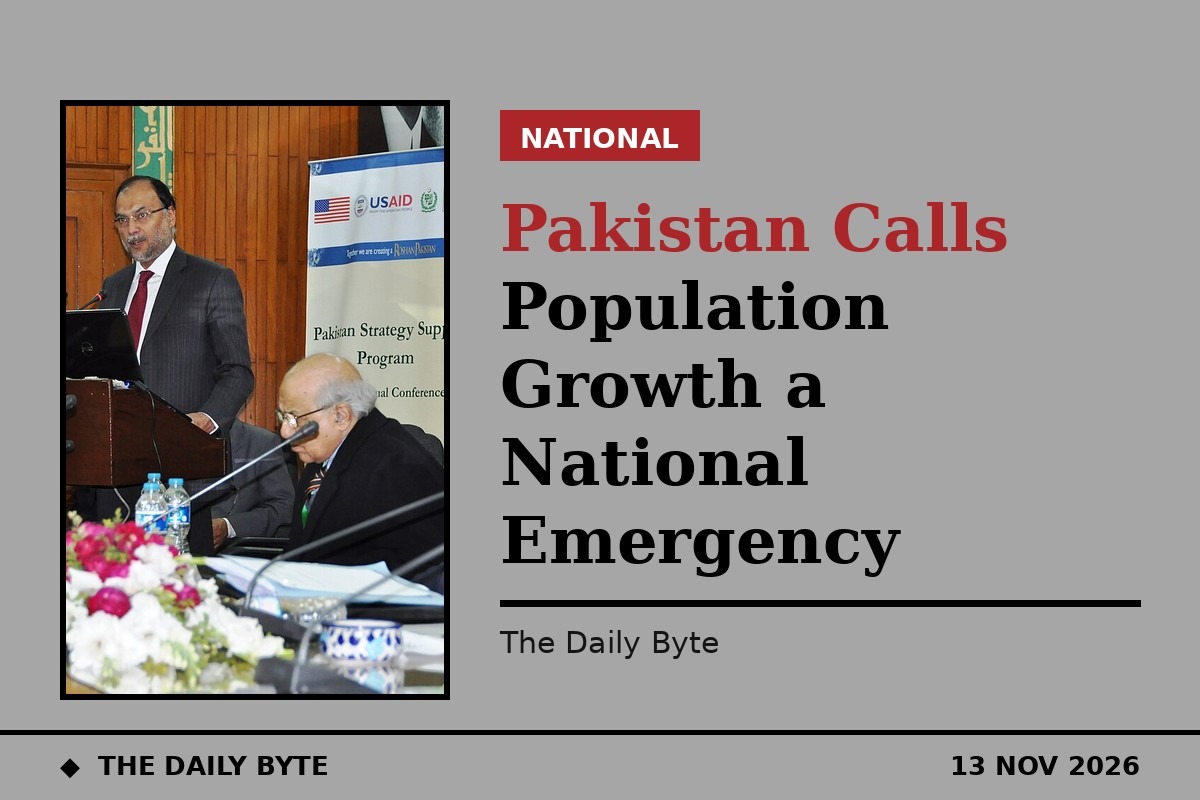
Pakistan has declared its rapidly growing population a national emergency, after new figures showed the country's population growth rate climbing again instead of falling. Planning Minister Ahsan Iqbal made the declaration at the first meeting of the Executive Committee of the National Population Council, held at the Planning Commission in Islamabad on Thursday, 12 November 2026.
Mr Iqbal, who co-chaired the meeting with Health Minister Syed Mustafa Kamal, called population management "a matter of national emergency" and urged immediate, coordinated action by the federal government and all four provinces, according to the Press Information Department (PID).
Growth rate rises to 2.55 per cent
The figures behind the warning show a reversal of a decades-long trend. Pakistan's population growth rate had fallen gradually since 1980, reaching 2.4 per cent over the 1998 to 2017 census interval. But the digital census of 2023 recorded a rise to 2.55 per cent, the first increase in decades.
"The renewed acceleration in population growth is alarming; we have taken our foot off the brake and put it on the accelerator. This trend must be reversed," Mr Iqbal said, according to the Associated Press of Pakistan (APP).
The 2023 census put Pakistan's population at 241.49 million, an increase of 33.82 million people since the 2017 census. At the current annual growth rate of 2.55 per cent, the population is projected to exceed 386 million by 2050, the minister told the meeting.
Pakistan is now the fifth most populous country in the world, with 80 per cent of its people under the age of 40 and 66 per cent below 30, according to the PID statement.
Pressure on schools, jobs and health
Officials at the meeting warned that fast population growth is straining schools, hospitals, jobs and basic services. A briefing by Dr Saima Bashir, Member Social Sector at the Planning Commission, noted that 40 per cent of the population has never attended school and only 25 per cent of women are in the labour force.
Mr Iqbal said the population challenge left millions of young people entering adulthood "without access to quality education, skills training, or meaningful employment". He also pointed to a structural problem in the National Finance Commission award, under which 82 per cent of the provincial share is based on population size, creating what he called a perverse disincentive for provinces to slow growth. "Without revisiting this formula, provincial commitment to population stabilization will remain weak," he said.
Senator Sherry Rehman, who attended online, underlined the human cost, saying that every 50 minutes a woman in Pakistan loses her child during childbirth. Dr Samia Rizwan of UNICEF warned that 30 newborn deaths occur every hour and that maternal and newborn health campaigns often fail to reach grassroots level.
New commission under the prime minister
The meeting ended with agreement to set up a National Population Commission led by the prime minister, with representation from all four provinces. The commission will be tasked with setting targets, ensuring accountability and driving a unified national strategy on population management.
The meeting also discussed a Planning Ministry proposal for a high-powered commission comprising the prime minister and all four chief ministers. Information Minister Attaullah Tarar said the fragmentation of responsibilities after the 18th Amendment was a major obstacle, while Religious Affairs Minister Sardar Muhammad Yousaf backed using the Council of Common Interests and religious leadership to promote responsible family planning.
Representatives of the Population Council, the United Nations Population Fund (UNFPA), the World Health Organization and UNICEF also took part, along with provincial health secretaries and population welfare directors.
Frequently asked questions
What is Pakistan's population growth rate? According to the 2023 digital census, the growth rate is 2.55 per cent a year, up from 2.4 per cent recorded between the 1998 and 2017 censuses.
What is Pakistan's population now? The 2023 census recorded 241.49 million people, an increase of 33.82 million since 2017. At the current rate, the population is projected to pass 386 million by 2050.
What has the government decided to do? A National Population Commission led by the prime minister, with representation from all four provinces, will set targets and drive a unified national strategy on population management.