Pakistan plans Raast QR fees as merchants hit 2.03m
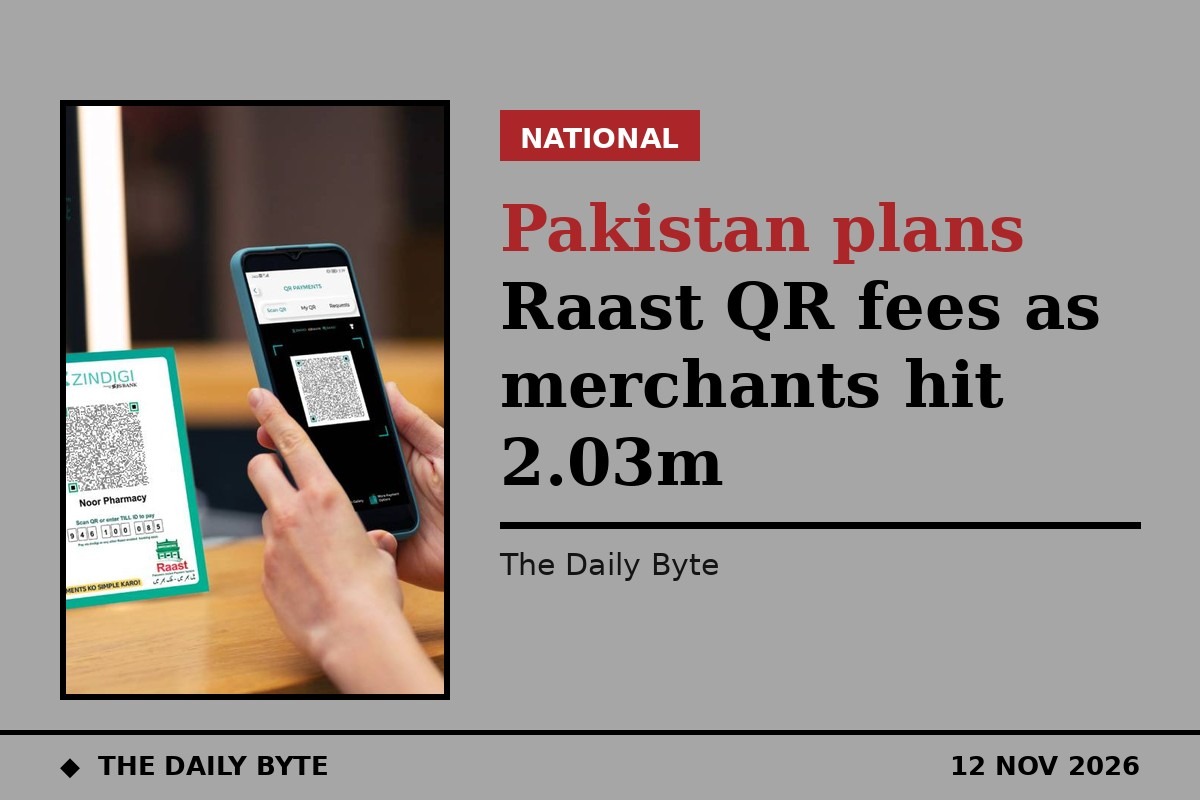
Pakistan has asked the State Bank of Pakistan to prepare a working paper for a merchant discount rate (MDR) scheme for Raast QR payments, as the number of businesses accepting digital payments climbed to 2.03 million under the government’s Cashless Pakistan drive.
The directive was issued by Minister of State for Finance Bilal Azhar Kayani at a high-level review meeting on Cashless Pakistan at the Finance Division in Islamabad on Thursday, 12 November. The meeting brought together senior public and private sector stakeholders to review progress on the decisions taken by the Cashless Committee under Prime Minister Shehbaz Sharif’s chairmanship.
What the State Bank has been asked to do
Kayani directed the State Bank to prepare a working paper so that the Raast QR MDR scheme can be taken up for approval. The MDR is the fee charged on each digital sale, and the working paper comes before any approval — so neither the rate shopkeepers would pay nor the start date has been settled yet.
The instruction was reported by the state-run Associated Press of Pakistan and confirmed in separate reporting by technology outlets TechJuice and TechProlonged, all published on 12 November.
Merchants up fourfold to 2.03 million
The meeting was told that the number of active merchants accepting digital payments has risen fourfold, from 500,000 to 2.03 million, under the Prime Minister’s Cashless Pakistan initiative. The overall volume of digital payments has doubled within a year, according to the figures discussed at the meeting.
Officials also discussed improving the framework for Raast QR payments and making sure a central dashboard captures not only the volume of transactions but also their value and the number of unique account users.
Government payments go Raast-only from 16 November
From 16 November, all payments for Asaan Assignment Accounts across the country will be made through the Raast digital system. Cheque payments under those accounts end on 15 November, and the drawing and disbursing officers who authorise the payments have already been trained for the switch.
The change follows a meeting chaired by Prime Minister Shehbaz Sharif last Friday, 6 November, at which he directed officials to prepare a time-bound roadmap for fully digital payments. Most federal and provincial government payments are due to be digitised by December 2026, while payments under the Benazir Income Support Programme are already made entirely through digital wallets.
QR codes on 45 million utility bills
Raast QR codes have now been placed on more than 45 million gas and electricity bills, allowing consumers to pay from home by scanning the code. All NADRA centres have also been equipped with Raast QR payment facilities, the meeting was told.
The Prime Minister has separately called for a media campaign encouraging electricity and gas consumers to pay their bills through the QR codes printed on them, and for Raast QR payments at shops to continue under government patronage.
What happens next
Kayani will separately meet the presidents and chief executive officers of banks in Karachi to discuss the Prime Minister’s Cashless initiative and how banks can play their part in expanding digital payment services.
The 12 November meeting was attended by senior representatives of the Finance Division, the State Bank of Pakistan, the Ministry of Information Technology and Telecommunication and NADRA, along with Easypaisa, JazzCash, Bank Alfalah, JS Bank and Karandaaz Pakistan.
Source: TechJuice, with reporting by APP via TezKhabar and TechProlonged.