Panama Seeks Full Mercosur Membership by 2029
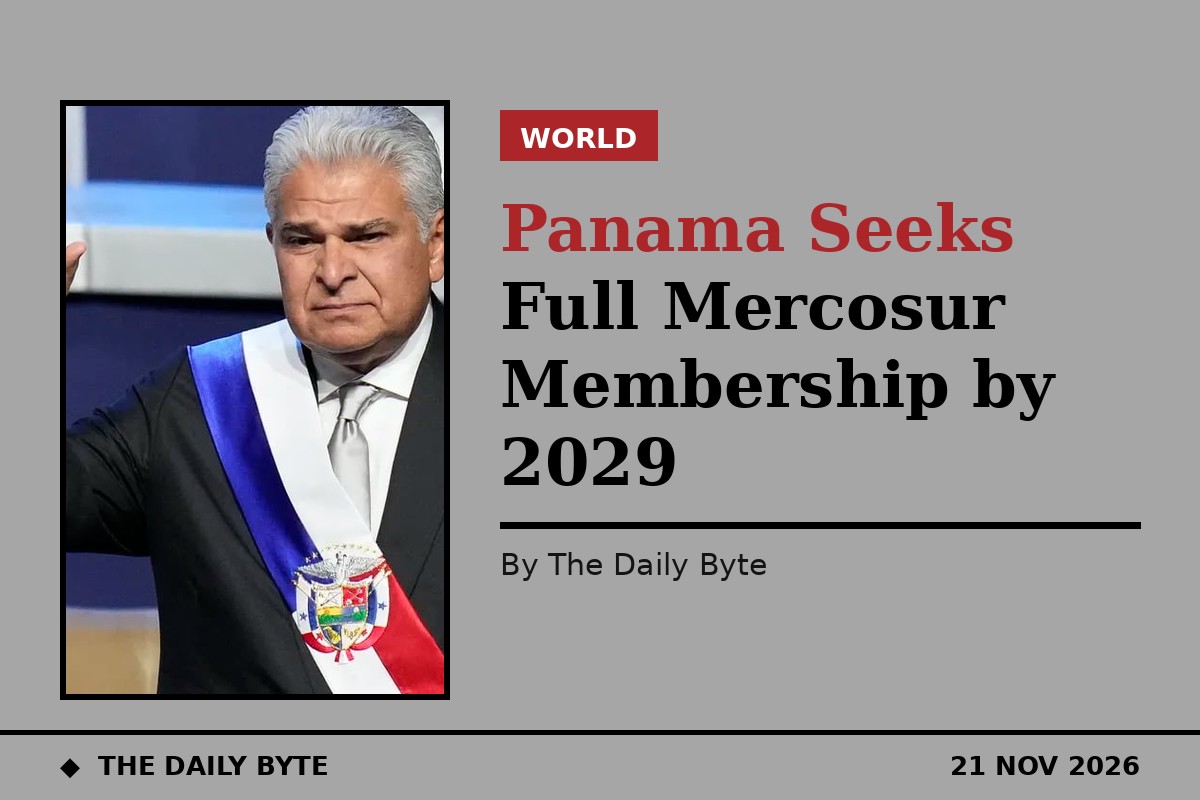
Panama's President José Raúl Mulino has said he will seek full membership of Mercosur, the South American trade bloc, before his term ends in 2029, arguing that United States tariffs have left his country with little choice but to diversify its trade ties.
Mulino made the pledge in an interview with the Buenos Aires Herald on the sidelines of a World Governments Summit regional dialogue in Punta Cana, in the Dominican Republic, on Friday. The gathering brought together heads of state, ministers and business leaders from more than 30 countries. He described full membership as "enormous and very beneficial" for Panama, and said the push to join the bloc was already enshrined in law so that future governments could not reverse it.
Panama has been an associate member of Mercosur since December 2024, a status it shares with Chile, Colombia, Ecuador, Guyana, Peru and Suriname. Associate members take part in the bloc's activities but do not join its customs union or take part in its decisions. Full membership would change that, giving Panama a seat at the table and a say over the bloc's common external tariff.
What full membership would require
Joining as a full member is not automatic. It requires the approval of every existing member — Argentina, Brazil, Paraguay, Bolivia and Uruguay — and Panama must bring its rules into line with the bloc's protocols. There is no guaranteed timetable: Bolivia's own path to full membership began in 2015 and was only completed in 2024.
Mulino said the process was already under way. "We're making progress. We've started with Brazil, which served as our sponsor in joining Mercosur," he said. He added that he would not attend the bloc's next summit in Montevideo on 4 December, but had instructed his commerce minister to represent him and continue the negotiations.
The framework agreement underpinning the move was signed in Montevideo in December 2024 and signed into law in Panama in October 2025. It aims to build a free trade area by progressively removing tariffs and restrictions on trade in goods, services and investment. Panama must now negotiate bilaterally with each member state to settle the specific rights, obligations and preferences that will govern its relationship with each one.
Why Panama wants in
For Mulino, the attraction is straightforward. "Mercosur countries are very large and very strong in agribusiness, chemicals, and natural gas — a range of sectors that are important to Panama," he said. In return, Panama offers the bloc access to the Panama Canal's logistics, the Colón Free Zone and its tourism sector.
He also framed the move as a historic shift. Joining Mercosur marks the first time the country has engaged in regional integration with the southern part of the continent, he said, adding: "That's where our market is." Panama does not seek to compete with the bloc's members, he said, "but rather to complement" them. "We build bridges, and [member countries] should see us in that light."
Mulino said he wanted the organisation to evolve from a South American bloc into a more broadly Latin American one, with Panama able to bring Central America and the Caribbean closer to the south. "We are a transit hub. And the [logistics] hub is essential," he said.
Tariffs and the United States
The push comes against a backdrop of renewed tension with Washington. Mulino said the United States' tariff and security policies under President Donald Trump had overshadowed his appearance at the summit, and he was blunt about the effect of the tariffs on smaller economies.
"Trade is no longer about sitting down with the big players to negotiate trade deals. Because the big player comes along and raises tariffs on the small [country], and that's the end of trade — as has already happened and is happening," he said. He said the reasons behind the tariffs "have no commercial logic whatsoever; it's simply because the big player has a whim to raise tariffs, and that's the end of the small player's ability to export."
Mulino said Panama's diplomatic, trade and security ties with the United States had been "excellent, though often tortuous", and that the experience was "vast and will continue to be so, with considerable uncertainty in some cases". He singled out security as the most sensitive issue for both countries, pointing to organised crime and drug trafficking.
A country in transformation
Mulino also linked the Mercosur bid to a broader transformation at home, noting that Panama now has full control of its ports and that the government has acquired all shares in the Petroterminales oil pipeline. The aim, he said, is to position Panama in the energy sector as well as in regional integration — and to show that, with Washington turning protectionist, it has other doors to knock on.