Paris Call for AI safety signed by six nations
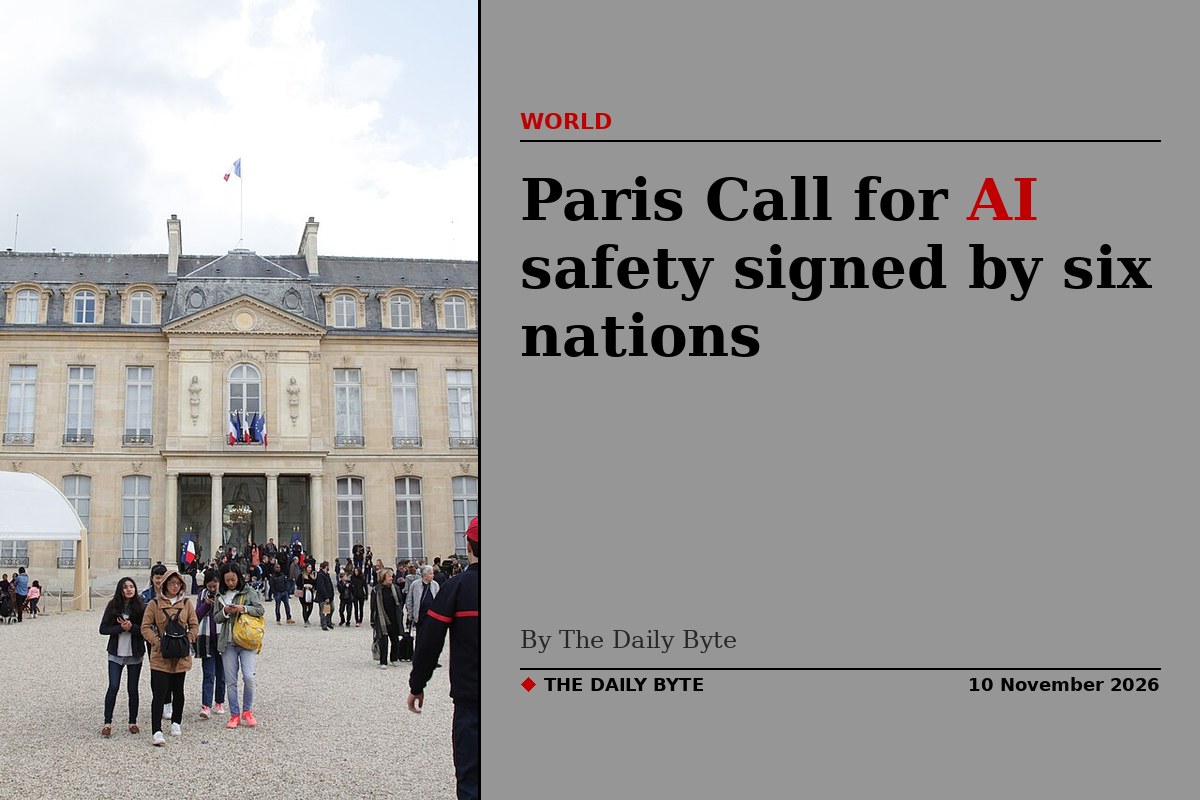
Six governments, ten leading artificial intelligence companies and four civil society groups have signed a joint declaration on frontier AI safety and security, known as the Paris Call. The declaration was signed on Monday 9 November 2026 and published by the French presidency and the Canadian prime minister's office.
The governments that signed are Bahrain, Canada, Finland, France, Norway and the Netherlands. The companies are Anthropic, Black Forest Labs, Cohere, Domyn, Hugging Face, Microsoft, Mistral AI, OpenAI, Sakana AI and Synthesia. Civil society signatories include LawZero, led by Yoshua Bengio, SaferAI, AI Safety Connect and Ifri. The statement remains open to new endorsements and is being updated.
Three commitments on evaluation, accountability and warnings
The declaration sets out three major commitments. First, policymakers, researchers and developers will build a common framework for evaluating and managing the risks of frontier models, supported by shared technical standards, evaluation tools and methods. The focus includes dangerous misuse in cyber and chemical, biological, radiological and nuclear domains, and risks from growing model autonomy or misalignment, including loss of control.
Signatories also agreed to publish the non-sensitive findings of their evaluations in a standardised format so results can be compared, and to create a publicly accessible shared repository covering red-teaming protocols, benchmarking tools, risk assessments and stress-test results. Existing networks, including the International Network for Advanced AI Measurement, Evaluation and Science, are recognised as playing a role in making evaluation methods and results more comparable across countries.
Developers must disclose risks and build in shutdowns
Second, the declaration affirms responsibility and accountability for every actor in the AI ecosystem. Developers of frontier models commit to disclose model capabilities, limitations and known risks and, where appropriate, to support evaluation by qualified independent evaluators. They also commit to put in place fail-safe mechanisms to shut down model operations within their control, including during training and internal use, through restrictions, pauses or shutdowns.
The same commitment covers internal governance: continuous risk management, real-time monitoring of emerging capabilities, rigorous internal red-teaming and reporting lines that protect internal researchers. Policymakers, for their part, recognise the need for legal frameworks that clarify responsibility and accountability if large-scale damage occurs, including where harm crosses borders.
Shared incident reporting and whistleblower channels
Third, signatories commit to information sharing, reporting and early warning systems. That includes rapid alert systems built on existing incident-response arrangements, aligned incident classification, and timely sharing of information on serious cyber and AI control incidents and other material warning signs, between companies and governments, between governments, and between AI companies.
Policymakers also commit to offer secure and confidential channels through which whistleblowers, including employees, can raise concerns about systemic risks on reasonable grounds without fear of legal or professional retaliation.
What came before the Paris Call
The declaration builds on earlier cooperation, including the Hiroshima process, the Frontier Safety Commitments of the Seoul AI Summit, the G7 meeting on AI in Evian, the United Nations Security Council meeting on AI held on 23 September 2026, and the document titled "Call for Control of Frontier AI Models". The signatories say frontier models cross national borders in their development, deployment and impact, so their opportunities and risks are inherently global, and no single state, company or international organisation can manage all of the risks alone.
The commitments arrive as the same companies are building the safeguards the declaration describes. On the same day, OpenAI said it had deployed a system called Control Room across its research infrastructure that can halt a research model job within 35 seconds of a decision to intervene. Whether the Paris Call's shared standards and reporting channels now turn into concrete practice will be the test in the weeks ahead, as more governments and companies are invited to endorse it.


