Parliament Agenda From 16 Nov Has No Constitutional Reforms
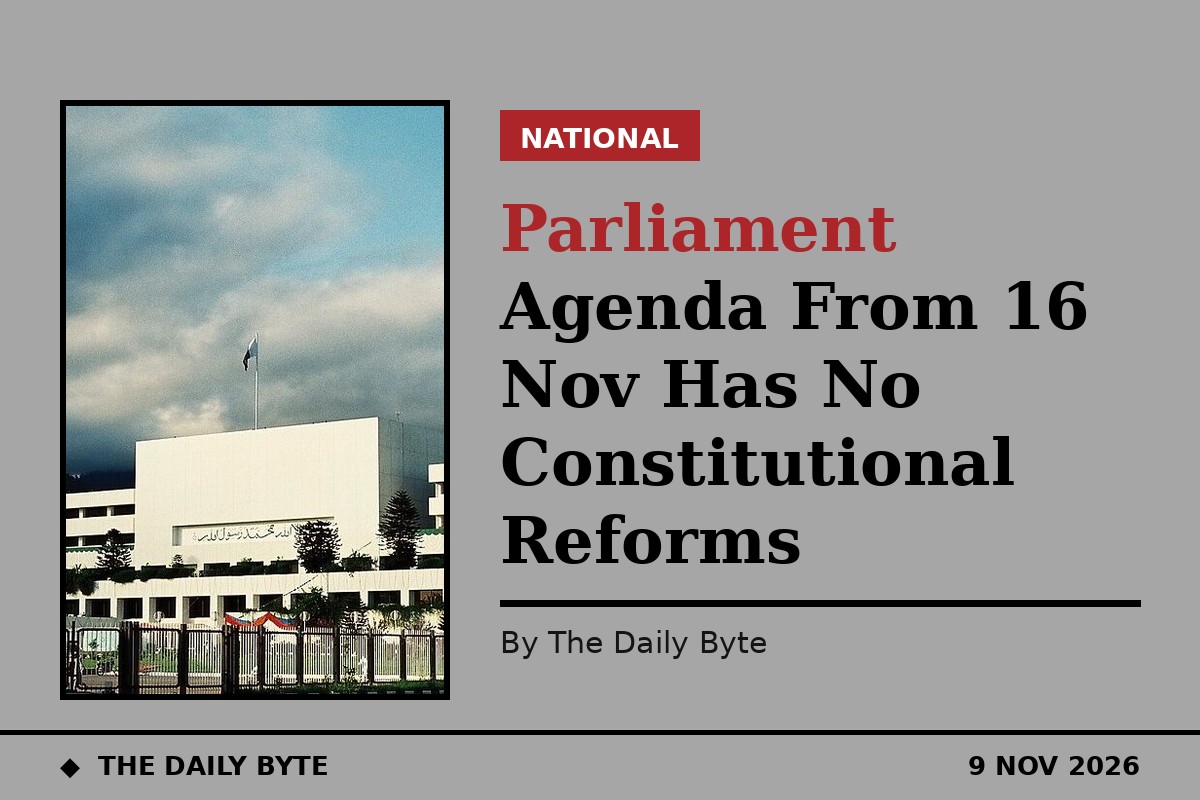
No proposal for a constitutional amendment, a referendum or electoral reforms is on the agenda for the coming sessions of the National Assembly and the Senate, which begin on 16 November, according to sources in the Parliament Secretariat.
Highly placed sources in the secretariat told The News and Jang on Sunday that the proposals and bills received so far, from the treasury benches and private members alike, gave no indication that any constitutional amendment, electoral reform or referendum would be taken up. The National Assembly session will start on Monday and continue for two weeks, and the Senate session will begin on the same day.
Referendum is the prime minister's call
The sources were also clear on who can call a referendum. They said the move was the sole prerogative of the prime minister and that the president had nothing to do with it. Any referendum would first have to be approved by a joint sitting of parliament, which would consider and decide the question.
Article 48(6) of the Constitution says that if the prime minister decides it is necessary to hold a referendum on a matter of national importance, the matter may be referred to a joint sitting of parliament. The current version of the clause was substituted by the Eighteenth Amendment in 2010, shifting the power to initiate a referendum to the prime minister, subject to joint parliamentary approval. Older versions of the clause had allowed the president, acting in discretion or on advice, to call one.
The sources pointed out that national referendums in Pakistan have historically been held under special or military-backed regimes, citing the votes held in 1984 under General Zia-ul-Haq and in 2002 under General Pervez Musharraf. Both took place without the approval or consent of parliament, since the Constitution was held in abeyance at the time.
The new-provinces proposal behind the speculation
The speculation about a referendum grew out of a proposal to redraw Pakistan's administrative map into 12 provinces, with a nationwide referendum envisaged before a possible 28th Constitutional Amendment. Under the arrangement under consideration, Punjab could be divided into four provinces, Khyber Pakhtunkhwa and Balochistan into three each, and Sindh into two. Sources familiar with the proposal have said the amendment could be taken up in the first half of 2027, with preparatory steps possibly beginning in the first quarter, but no final decision has been taken on boundaries, administrative structures or the constitutional process.
Defence Minister Khawaja Asif has publicly backed the creation of new provinces on administrative grounds, saying in an interview with Geo News on Sunday that the number could reach 12 if the divisions were drawn on administrative rather than ethnic or political lines. He said discussions on new provinces had been going on for about two months. Planning Minister Ahsan Iqbal has separately suggested dividing each of the four provinces into three smaller units, arguing that the current structure is too centralised to deliver public services.
The idea has already met resistance. The Sindh Assembly has passed a resolution rejecting any division of Sindh, and the Pakistan Peoples Party has formally opposed it. Political observers quoted by The News said that putting a referendum on new provinces before a joint sitting would be an uphill task even if the prime minister agreed to it, warning that a proposal without assured majority support could disturb the whole political applecart.
What happens next
According to the observers, the PTI minus its jailed founder would be willing to support such a proposal, but the ruling PML-N and PPP alliance would not want to become party to it, since both parties would lose their political strongholds if the existing provincial arrangement were broken up. It is understood that the wider reset move would ultimately be shelved after acceptance of its first agenda item, the revision of the National Finance Commission Award, in the longer run.
For now, the two houses will meet on 16 November with no constitutional business before them, and the question of new provinces and a referendum remains a debate outside the formal agenda rather than a matter parliament is about to decide.