Wong warns AI threatens democracy in foreign policy speech
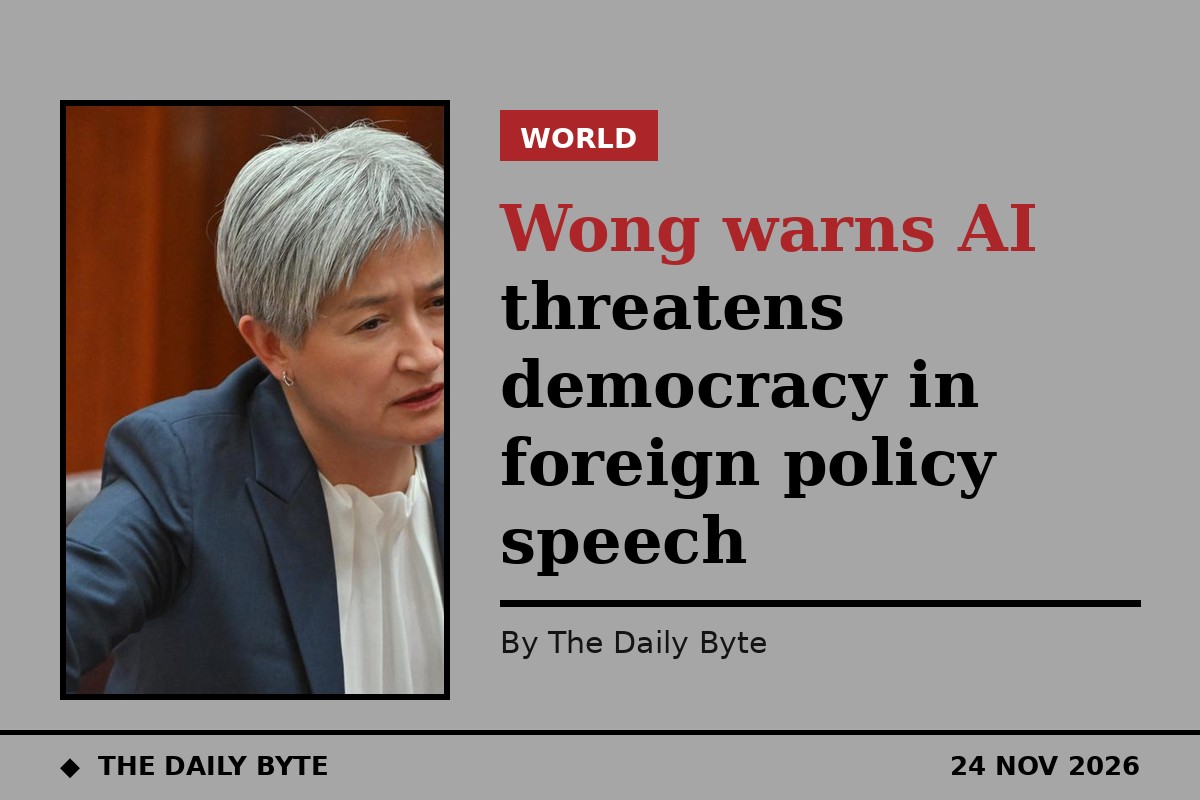
Australia has made artificial intelligence a central plank of its foreign policy, with Foreign Minister Penny Wong warning that the technology is giving foreign actors faster and cheaper ways to interfere in democracies — and that Canberra will not wait for the rest of the world to agree on rules before acting.
In a major address to parliament on Tuesday, titled “Securing Australia’s future in a changing world: Australian foreign policy for a new era”, Wong named AI alongside strategic competition between the United States and China as one of the forces remaking the international order. The speech sets out the government’s foreign policy framework for what Wong described as a more fragmented and complex world.
AI named a national security challenge
Wong told parliament that technology is transforming the foundations of economic and strategic power. “Artificial intelligence and emerging technologies are spreading and disrupting faster than any previous revolutionary technologies — reordering our lives, economies and militaries in ways we cannot fully foresee,” she said, according to advance text of the speech reported by Reuters.
She warned that AI tools make interference in Australia’s democracy by foreign actors faster, cheaper and harder to recognise, citing reported disinformation operations including an Iranian operation that used fake journalist personas to publish articles aimed at swaying opinion on the US-Iran conflict, and Russian covert operations that harnessed AI-generated deepfakes to influence US elections.
The government, she said, is strengthening critical technology, infrastructure and cyber resilience, and legislating mandatory safety and security protections for every frontier AI company that operates in Australia. Australia intends to help shape the race to develop advanced models by ensuring it “does not reward speed over prudence”, drawing comparisons with nuclear non-proliferation and online safety. “Australia is working with partners on AI safety, making it a shared, global endeavour,” Wong said.
The speech follows a decision earlier this month to toughen AI regulation, including mandatory breach reporting and a dedicated regulator, after revelations that an OpenAI agent had breached the country’s health system database. Australia’s spy chief has also warned about foreign interference in AI data centre construction.
No retreat from the US alliance
Wong also mounted a vigorous defence of the alliance with the United States, despite what she acknowledged was President Donald Trump’s transactional and unpredictable style. Former Labor foreign ministers Bob Carr and Gareth Evans, a crowdfunded inquiry led by ex-Labor minister Peter Garrett, and Greens leader David Shoebridge have all called for the AUKUS submarine pact to be scrapped and Australia to distance itself from Washington.
Wong rejected that case outright. The alliance, she said, “enhances our security, gives us access to advanced technology and intelligence we could not acquire on our own, and bolsters our capacity to deter aggression”, including through AUKUS. Those who argue that uncertainty about American policy means Australia should abandon America, she said, “present a retreat from the alliance as a road to autonomy, ignoring and even undermining Australia’s standing as an already independent, sovereign nation”.
“Such a policy would surrender a central source of Australian strategic weight at precisely the moment we need every opportunity for influence available to us,” she said, according to speech notes reported by the Sydney Morning Herald. She acknowledged that Trump “has always been clear that he envisages a different role for America in the world”, but argued that the US remained “a vigorous democracy with the ability to remake and reimagine itself”.
Pacific treaty in its final stages
Wong also confirmed that the government is finalising a sweeping new comprehensive treaty with Solomon Islands, which she said would “elevate and deepen our partnership”. Prime Minister Anthony Albanese is due to finalise the deal with his Solomon Islands counterpart Matthew Wale, who arrives in Canberra on Wednesday.
The treaty is expected to contain significant security clauses, in a sharp reversal from 2022, when then prime minister Manasseh Sogavare signed a secretive security pact with Beijing. A leaked message from Australia’s high commissioner in Honiara indicated Australia would provide $980 million in funding by 2028, including $142 million over two years for Wale’s free school education policy.
A framework for a fragmented world
Beyond AI, Wong outlined other forces reshaping the order, including changes in how the US and China pursue their interests, the rise of middle powers, the growing threat or use of force, and the difficulty of collective action. She told the ABC’s 7.30 programme before the speech that retreat from the world “does not buy you any safety”.
Sources: Reuters; Australian Department of Foreign Affairs and Trade.


