Peru Creates Secret Register for Terror-Style Gangs
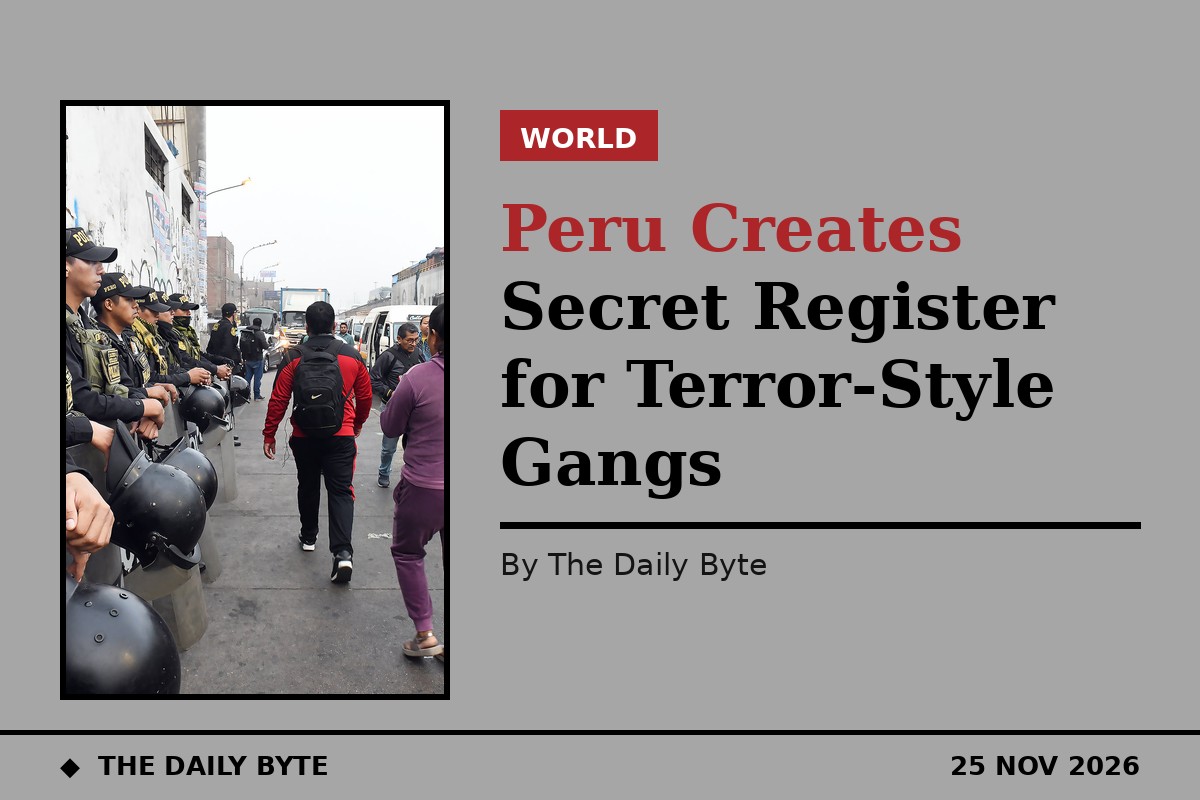
Peru has published a legislative decree creating a secret national register of criminal organisations that use terrorist-style tactics, in the government's latest attempt to tighten the law against organised crime. Legislative Decree 1746 was published in the official gazette El Peruano on 21 November and took effect the following day, 22 November.
The decree creates the Registro Nacional de Organizaciones Criminales con Practicas Terroristas, known as RENOCTE. It will be run as an administrative repository by the National Security and Defence Secretariat, SEDENA, and its contents are classified as secret. The measure was issued under powers delegated by Law 32743, which authorised the executive to legislate on citizen-security matters for 90 calendar days.
Three tests for listing
An organisation can be entered on the register only if it meets three criteria. It must have an organised and hierarchical criminal structure. It must plan, carry out or promote attacks involving explosives or civilian or military weapons against people, homes, transport, public services, essential infrastructure or other economic activities. And it must pursue illegitimate financial or property benefits through those attacks.
The decree adds a new offence to Peru's Penal Code. Article 317-C prescribes imprisonment of 15 to 35 years where an offender uses fear, through such attacks, in committing the organised-crime offence in order to secure an illegitimate financial or property benefit. The provision sits alongside the existing organised-crime law, Law 30077, and does not redefine the separate offence of terrorism itself.
Freezing assets without waiting for a court
The financial consequences are immediate. Peru's Financial Intelligence Unit, UIF-Peru, is authorised to order the immediate freezing of funds and assets belonging to individuals and legal entities included in the register, without first obtaining a court ruling. The decree also allows preventive migration alerts to be generated, and strengthens the exchange of information and intelligence among state institutions.
Because the register is classified, the public will not be told which groups have been listed. The available details do not identify which organisations, if any, have been added to RENOCTE since it took effect, or whether any assets have yet been frozen under the new law. That secrecy is part of the design: the register is meant to help the state anticipate the groups' actions and identify their structures and financing before moving against them.
Part of a wider security package
Decree 1746 was published alongside two related decrees on the same day. Decree 1745 gives the Ministry of Defence responsibility for planning, supervising and carrying out prison construction and upgrades, using military engineering units to speed works and address overcrowding. A further decree establishes an autonomous disciplinary tribunal at INPE, the national prisons institute. Implementing regulations for the register must be approved within 30 working days of the decree taking effect.
The move builds on Peru's deepening security partnership with the United States. In September, during a visit to Lima by Secretary of State Marco Rubio, President Keiko Fujimori announced that Peru would join Shield of the Americas, a United States-led coalition of more than 15 countries. Her government had already proposed treating organised criminal gangs as terrorist organisations, and had asked for legislative powers to classify certain groups as hostile organisations. The Council of Ministers approved the creation of the register last week, and the government formalised it on Sunday, 23 November.
The backdrop is a security crisis driven by extortion, contract killings, human trafficking, illegal mining and drug trafficking. The government argues that existing tools have not kept pace with groups that use bombings and armed attacks to extract money and control territory. Whether the secret register changes that will depend on how it is used in practice: which groups are listed, whether the asset freezes survive legal challenge, and whether the intelligence it gathers leads to prosecutions that the courts can sustain.


