Peru mega-prisons modelled on El Salvador CECOT
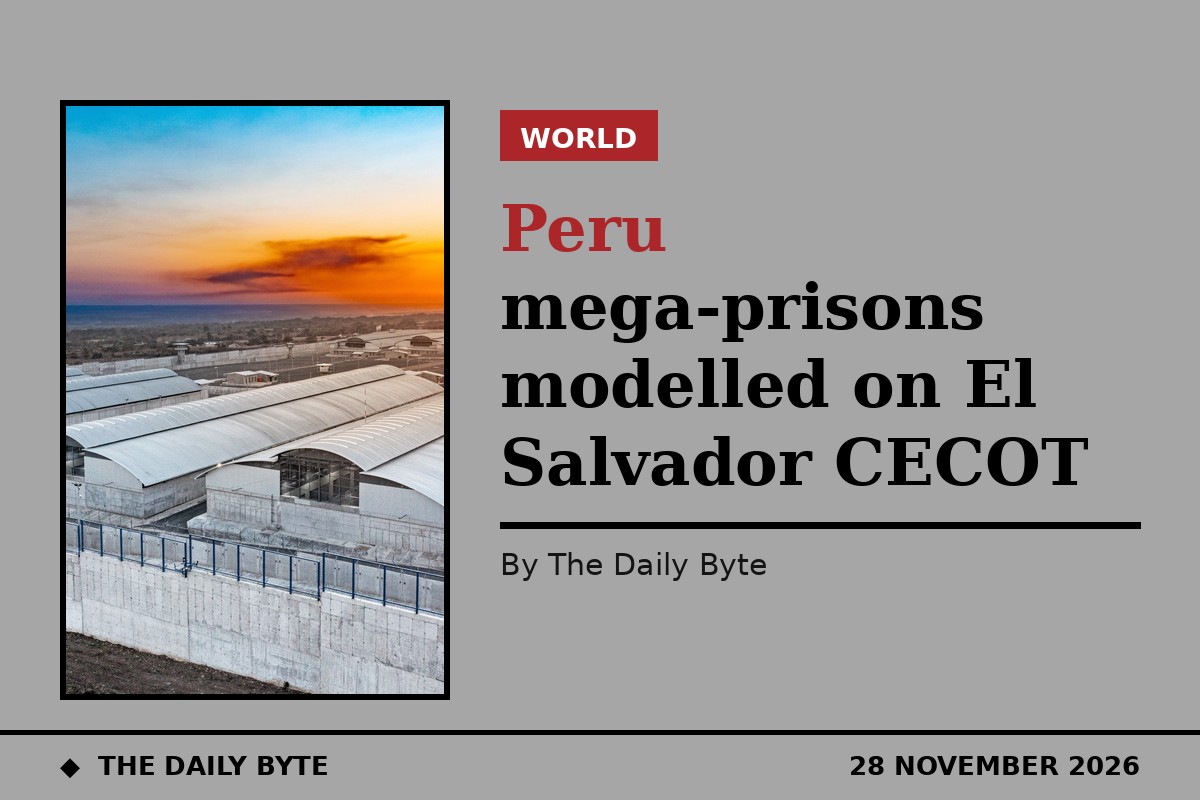
Peru's government is pressing ahead with plans to build two mega-prisons modelled on El Salvador's Terrorism Confinement Center, known as CECOT, as President Keiko Fujimori adopts the region's most severe approach to organised crime. The two facilities, in Huaura province about 150 kilometres north of Lima, would hold 24,000 inmates between them.
Fujimori toured CECOT on 29 October, during a three-day state visit to El Salvador in which she met President Nayib Bukele and signed cooperation agreements on security, justice, health and tourism. Speaking at the prison, she said Peru needed once again to recover order, this time from criminal gangs rather than terrorist groups, and that the country should learn from El Salvador's example. On 4 November, less than a week after the visit, she handed over some 2,600 hectares of state land for the project and told Justice Minister Ernesto Alvarez to build the prisons quickly.
Two prisons, two populations
According to Alvarez, the two prisons will serve different populations. Huacho 10 will hold 10,000 of the most dangerous prisoners in total isolation, while Huacho 14 will hold 14,000 first-time offenders enrolled in the government's Productive Prisons programme, which puts inmates to work in workshops. Fujimori has said the prisons could be built in about seven months, the same time it took to build CECOT, although no cost or completion date has been published.
The plan has advanced alongside a wider security drive. On 8 November, Legislative Decree 1742 authorised the armed forces to reinforce security around prison perimeters, part of a series of measures by Fujimori's government to overhaul a prison system struggling with rising crime and severe overcrowding. Peru's national prison authority, INPE, reports 107,227 inmates held in space built for 41,764. Alvarez has himself described the prisons as universities of crime, and the government argues that separating the most dangerous offenders is essential to breaking the power of gangs inside the system.
A model spreading across the region
Fujimori's approach has drawn both support and criticism. Alvarez insisted after a cabinet meeting last week that it is not necessary to build a CECOT, since Peru need not restrict fundamental rights to such an extreme, yet he had earlier proposed hangar-type prisons following the model of El Salvador, and said El Salvador had offered Peru technology, with the United States also offering modern technology through its embassy. Bukele himself has cautioned against an exact copy, saying at the joint press conference that copying it identically would make no sense because all countries are different.
Peru is not alone in following the Salvadoran example. According to InSight Crime, 16 mega-prisons have been proposed in 10 Latin American countries since CECOT opened in 2023. Costa Rica inaugurated its 5,100-inmate High-Containment Centre Against Organised Crime on 14 October, built on plans donated by El Salvador, and Ecuador's El Encuentro prison opened in November 2025. The model is also controversial: El Salvador's state of exception has suspended constitutional guarantees since March 2022, more than 90,000 people have been detained, and Amnesty International documented at least 470 deaths in state custody through December 2025.
The government points to El Salvador's fall in killings as justification. El Salvador reported 82 homicides in 2025, a rate of 1.3 per 100,000 people, although killings had already fallen from 6,656 in 2015 to 1,147 in 2021, before Bukele's state of exception began. For Peru, where extortion and killings by criminal gangs have become a daily fear — Lima bus drivers stopped work and marched on Congress against extortion on 10 November — the mega-prisons are presented as the centrepiece of the response. Whether they reduce crime or simply extend a model that critics say trades rights for order will be judged in the months ahead, as construction begins in Huaura.


