Peru Warns Miners Face Illegality as Reinfo Deadline Nears
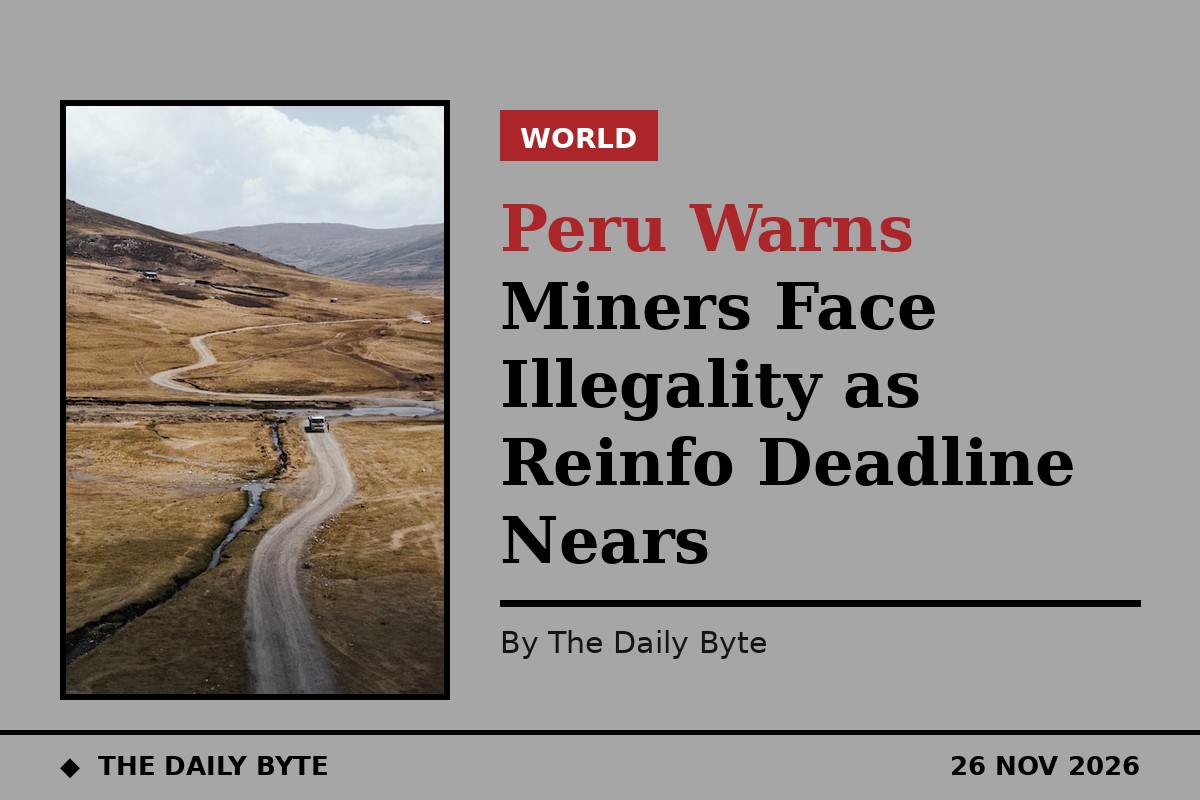
Peru's government has warned that tens of thousands of informal miners could fall into illegality overnight at the end of the year unless Congress passes a new mining law before a deadline it has refused to move.
Energy and Mines Minister Guillermo Shinno told reporters on Tuesday that if nothing is approved by 31 December, all the miners, even the informal ones who need help, will be left illegal, and that the country must not reach that outcome. He added that although time is very short, progress can be fast if there is political will.
At stake is the Registro Integral de Formalizacion Minera, known as Reinfo, the register that lets small-scale and artisanal miners keep working while they move towards formal legal status. The register expires on 31 December 2026 under a law passed in December 2025, and the government says it will not be extended again.
Hundreds of miners took to the streets of Lima and the southern city of Juliaca this week to demand more time before the deadline. Their confederation, CONFEMIN, wants a four-year extension to 2030 and has called another national protest for 1 December.
A replacement law stuck in Congress
President Keiko Fujimori's government wants to replace Reinfo with a new framework, the Small-Scale and Artisanal Mining Law, known as the MAPE law. It would give miners registered under Reinfo until June 2028, an 18-month consolidation period, to meet the legal requirements for formalisation.
The bill was presented to the Chamber of Deputies more than a month ago, but it has still not been put to a vote in committee. That delay could leave a legal vacuum from 1 January, with miners who are still in the formalisation pipeline suddenly without any legal cover for their work.
Shinno has argued that the MAPE law would let miners keep working for 18 months without needing Reinfo, under a simplified process, and he has urged them not to fall for the arguments of illegal miners who want the register extended to avoid prosecution. He has also said some of those pushing for an extension are seeking legal protection against possible illegal mining charges.
CONFEMIN is pressing for wider changes as well as more time. As well as a four-year extension, the group wants a new census so miners currently outside Reinfo can join the process, and changes to concession rules that it says would free up idle areas for production. It is also demanding the resignation of Shinno and Deputy Minister Mayra Figueroa, whom it accuses of incompetence and conflicts of interest.
The formal mining industry is pushing in the opposite direction. It wants Reinfo to lapse, arguing that a mechanism created as a temporary route to formalisation has ended up shielding illegal activity. Gonzalo Quijandria, vice-president of the National Society of Mining, Petroleum and Energy, told business leaders on Wednesday that there should be no more Reinfo, no more illegal mining and no more crime.
The dispute has reached the highest levels of Peruvian politics. At the annual CADE business conference near Cusco this week, the president of the Chamber of Deputies, Oscar Reto, was whistled at after declining to take a position on a possible extension. Roberto Sanchez, leader of Juntos por el Peru and a rival of Fujimori in this year's presidential second round, joined the miners' march in Lima and promised to defend their right to formalisation.
Why the deadline matters beyond the mines
Peru is the world's third-largest copper producer, and its new deposits are a key source of supply for power grids, electric vehicles and data centres. Small-scale mining is also an important source of income in poor rural areas with few other jobs, which is why the deadline carries such political weight.
At the same time, unregulated mining deprives the government of tax revenue and has complicated the development of the country's copper resources. Disputes over mining rights have delayed projects, including those of MMG Ltd and Southern Copper Corp, and conflicts between informal and illegal miners and large companies are becoming more frequent.
With five weeks left in the year, Congress now faces a choice between three paths: pass the MAPE law, extend Reinfo once more, or let the register lapse and leave tens of thousands of miners outside the law on 1 January.


