Petrol Falls Again to Rs314 as OGRA Moves to Daily Pricing
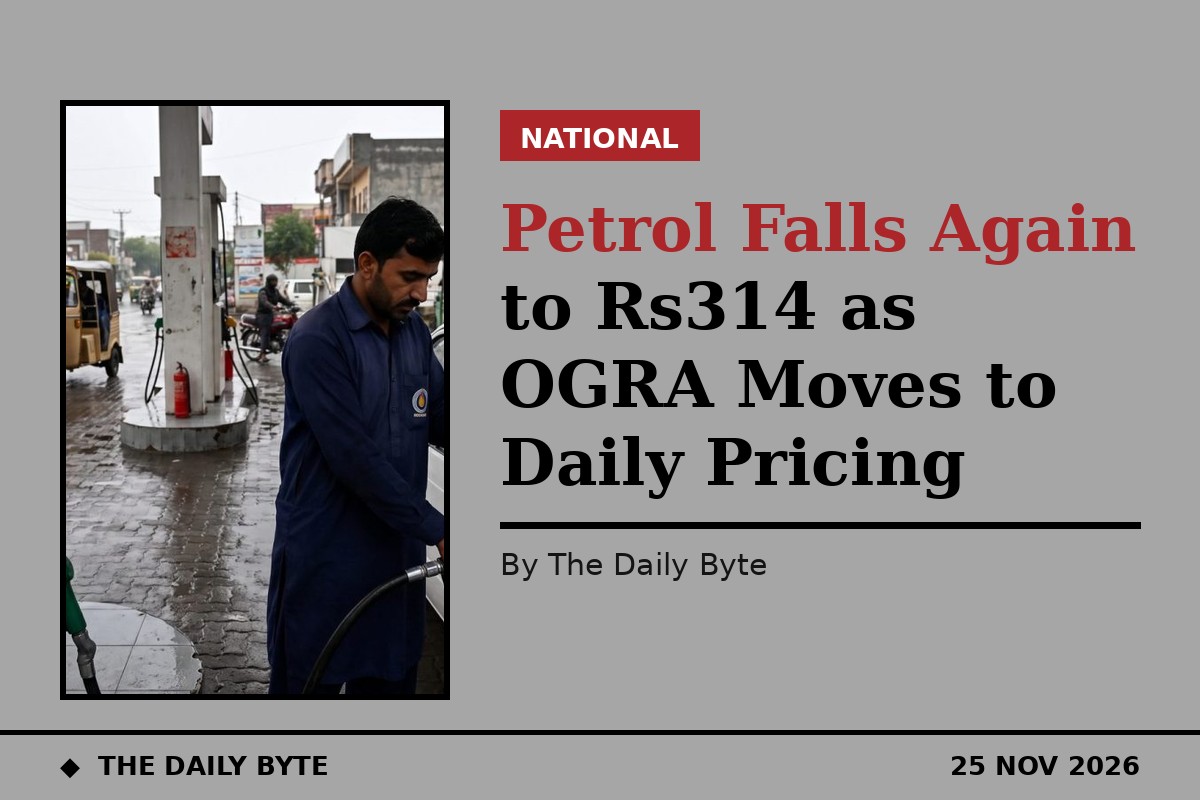
Petrol will cost Rs314 a litre and high-speed diesel Rs348 a litre from Thursday, 26 November, after the Oil and Gas Regulatory Authority (OGRA) announced a second fuel price cut in two days. Petrol falls by Rs4 a litre and diesel by Rs5, according to the OGRA notification issued on Wednesday, 25 November.
The new rates follow a cut that took effect only on Wednesday morning, when petrol was reduced by Re1 to Rs318 a litre and diesel by Rs4 to Rs353. Motorists have now seen petrol fall from Rs319 a litre on Monday to Rs314 in the space of three days, with diesel down from Rs357 to Rs348 over the same period.
Second cut in two days
OGRA said the revised ex-depot prices were calculated under the petroleum products pricing mechanism approved by the federal government. The regulator has begun publishing daily petroleum prices on its website, so changes in international oil prices can be passed on to consumers more quickly.
Under the new rates, a litre of petrol costs Rs4 less than the Rs318 charged on Wednesday, while diesel is Rs5 cheaper than the Rs353 rate. Diesel has now dropped below Rs350 a litre. The notification states the revised prices apply from 26 November, and that the rates will be reviewed again the following day under the daily system.
How daily pricing works
Pakistan previously revised fuel prices every fortnight. The government introduced a weekly review after conflict in the Middle East began on 28 February, when Israel and the United States attacked Iran and Tehran shut the Strait of Hormuz, the route for around a fifth of global energy supplies. The federal cabinet approved changes to the pricing mechanism on 30 October as volatility continued.
Under the revised formula, the import price of petrol is determined from the actual import cost of the relevant Pakistan State Oil cargo. If that cost is unavailable for daily pricing, the premium, incidentals and customs duty of the last available cargo are used instead. For local refineries, the government has temporarily fixed the premium, incidentals and customs duty used in calculating the ex-refinery petrol price at their 7 March levels, before the war, for 30 days.
The difference between the import price and the resulting ex-refinery price is to be surrendered by refineries under the petroleum levy account, with the benefit passed on through a corresponding reduction in the petrol price. The government has also introduced a short-term adjustment to smooth price movements, incorporating the benefit from a premium differential into petrol prices at a rate of $2.95 per barrel per day.
What it means at the pump
The back-to-back cuts bring some relief to commuters, transporters and businesses after months in which fuel prices were revised only twice a month. Diesel is the bigger cost for goods transport and farming, so the Rs5 cut matters most for freight and food prices, while the petrol cut eases the daily cost of motorcycles and cars.
Whether the relief lasts will depend on international oil prices and the rupee. Tensions have mounted since a fragile June truce between Tehran and Washington collapsed, reviving fears of wider conflict and disrupting energy flows through the Strait of Hormuz. Under daily pricing, any fresh rise in global prices would now reach Pakistani pumps within a day, just as quickly as the falls have.