Philippine Stocks Hit Six-Year Low as Peso Slides
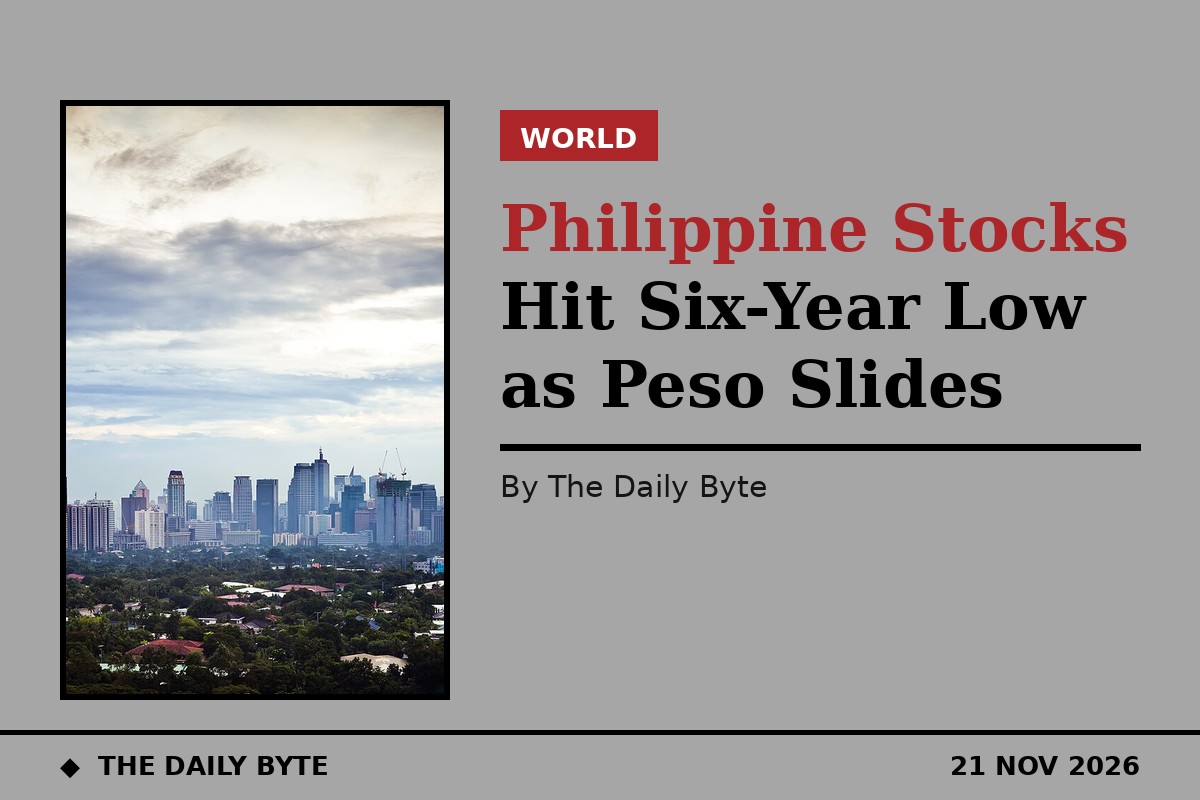
Philippine shares fell to their weakest close in more than six years on Friday 20 November, as weak company earnings, inflation worries and slowing growth rattled investors.
The benchmark Philippine Stock Exchange index, the PSEi, dropped 170.93 points, or 3.12 per cent, to finish at 5,306.98, its weakest close since 30 March 2020, in the early months of the Covid-19 pandemic. The broader All Shares index slid 2.4 per cent to 3,005.29.
All six sectoral gauges ended the day in the red. Services led the fall, down 5.93 per cent, followed by mining and oil at 5.62 per cent. Industrials fell 2.29 per cent, holding firms slipped 2 per cent, financials lost 1.61 per cent and property dipped 0.98 per cent.
Port operator International Container Terminal Services, or ICTSI, was the session's heaviest drag, tumbling 7.22 per cent. Reports linked the fall to a threat by the South African government to revoke the company's licence to run the Durban container terminal. Continued profit-taking in the stock added to the pressure, according to Philstocks Financial research head Japhet Tantiangco, who pointed to nagging growth and inflation concerns and a lack of strong positive catalysts.
Every sector fell
Foreign investors turned net sellers, with 853.07 million pesos in outflows, as 6.68 billion pesos in foreign selling outpaced 5.83 billion pesos in buying, according to Philippine Stock Exchange data.
For the week, the PSEi gave up 286.51 points, or 5.1 per cent, extending its losing streak to a second straight week and posting declines in four of the past five weeks. With the index breaching its 5,400 support level, Rizal Commercial Banking Corp. chief economist Michael Ricafort sees the next technical floors at 5,000 and 4,880.
Ricafort noted that recent earnings declines at major listed firms have stoked stagflation fears, while a wider balance of payments deficit and higher crude prices threaten to bloat the country's import bill. He added that the peso's slide to 63.81 against the US dollar could raise import costs further and feed domestic inflation. The peso has been trading close to its record low of 63.95, touched in October.
Stagflation fears
The wider backdrop is a slowing economy with stubbornly high prices. October inflation was 7.8 per cent, unemployment stood at 5.4 per cent in September, and the economy grew 2.1 per cent in the third quarter, the fifth consecutive quarter of deceleration. Moody's Analytics has cut its 2026 growth forecast for the Philippines to 2.4 per cent, from 3 per cent, citing weak domestic demand and a faster than expected loss of momentum.
The balance of payments deficit widened to 10.6 billion dollars in the first ten months of 2026, more than double the 4.6 billion dollar shortfall in the same period last year, and already above the central bank's full-year projection of 9.2 billion dollars. In October alone, the deficit reached nearly 1.5 billion dollars, against a 706 million dollar surplus in October last year.
The market's fall came in the same week the Philippines hosted the ASEAN summit and handed the bloc's chair to Singapore. The index is now within about 175 points of its March 2020 closing low.


