Philippines Signs Emergency Oil Access Deals
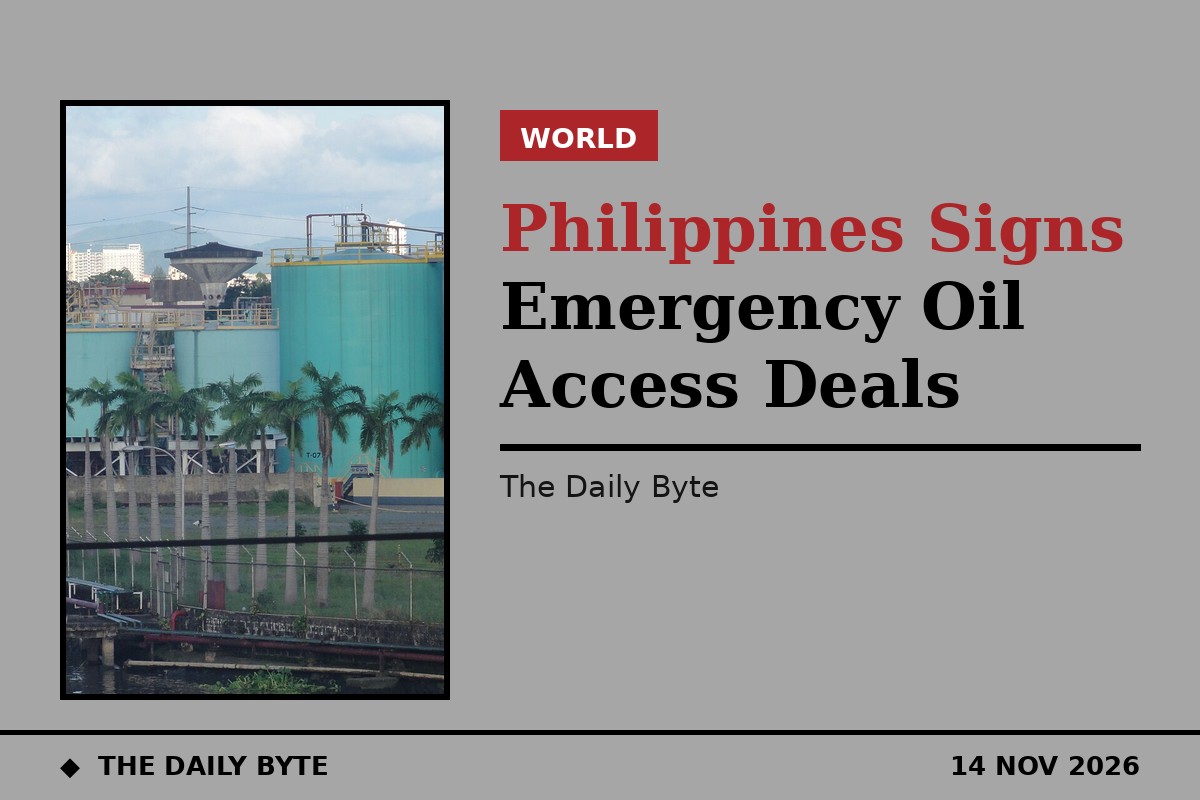
The Philippines has signed two letters of intent to explore emergency access to oil stored in Indonesia and Thailand, in the first pilot projects under a planned ASEAN joint oil stockpiling scheme. The agreements were announced in Manila on Saturday, 14 November 2026, on the sidelines of the ASEAN Business and Investment Summit.
The Economic Research Institute for ASEAN and East Asia (ERIA) and the Indonesian Business Council signed the two letters of intent with energy companies, ERIA said. The pilots will examine whether the Philippines can draw on existing storage facilities in Indonesia and Thailand if its own oil supplies are disrupted.
The two pilot projects
The first pilot pairs PNOC Exploration Corporation, the exploration arm of the state-owned Philippine National Oil Company, with PT Interport Mandiri Utama of Indonesia. The second pairs the same Philippine company with the Shell Company of Thailand Limited. ERIA and the Indonesian Business Council signed both letters as knowledge partners, contributing research and helping to bring the parties together.
The pilots focus on an arrangement known as oil ticketing. Under such a deal, a participating entity pays for the right to buy oil held in another country's storage facilities during an emergency, subject to conditions agreed in advance. ERIA said the approach could reduce the need for governments to build new storage tanks and buy additional oil stocks outright.
Why the Philippines needs a back-up supply
The Philippines imports 99 per cent of its crude oil, according to ERIA, leaving it heavily exposed when Middle East supplies are interrupted. Across South-East Asia, dependence on imported crude reached about 66 per cent in 2024, and Thailand imports 94 per cent of its crude. Most ASEAN member states also rely heavily on supplies from the Middle East and hold relatively limited emergency oil stocks.
The push for a regional answer gathered pace after the war involving Iran disrupted energy markets this year. Arab News reported that the Manila pilots are aimed at strengthening energy security against supply disruptions from the Middle East linked to that conflict. Philippine President Ferdinand R. Marcos Jr. had earlier called for a regional study on joint oil stockpiling, building on ERIA's work, and for political support to move towards putting it into practice.
A wider ASEAN stockpiling scheme
The two pilots are the first practical step under a broader ASEAN plan for shared emergency oil stocks. Reporting by Nikkei, cited by Reuters, has said the joint stockpiling scheme could begin as early as 2027, with Indonesia and Thailand hosting storage facilities and the Philippines expected to be the first country to draw on them. The initial focus is on diesel and petrol rather than crude oil.
ERIA's study of an ASEAN oil stockpiling strategy found that closer regional cooperation could also cut costs. It estimated that raising the share of reserves held as joint stocks from 10 to 30 days, while keeping the same total volume and the same five days of ticketed stocks, could lower annual stockholding costs from US$2.80 billion to US$2.19 billion, a saving of about US$610 million a year.
What happens next
The letters of intent are exploratory, not supply contracts. No volumes, prices or start dates have been disclosed, and the pilots must still work through commercial terms, product sourcing and the practicalities of moving fuel between countries in an emergency. ERIA said the initiative was highlighted during the energy session of the ASEAN Business and Investment Summit in Manila on 14 November, and it follows a high-level business roundtable in Singapore on 30 July 2026.
If the pilots succeed, they could become the template for a region-wide system in which ASEAN members pay in advance for the right to buy fuel stored by their neighbours when a crisis hits. Laos and Timor-Leste are also reported to be considering joining the scheme. For the Philippines, the immediate prize is a tested back-up route for fuel if its imports are cut off, rather than a new source of oil in normal times.
Sources: Economic Research Institute for ASEAN and East Asia (ERIA); IDNFinancials, citing Nikkei reporting via Reuters.


